Anthropic · Status at source date: Announcements
Anthropic Positions Claude Sonnet 5.5 for Faster, Lower-Cost Everyday Work
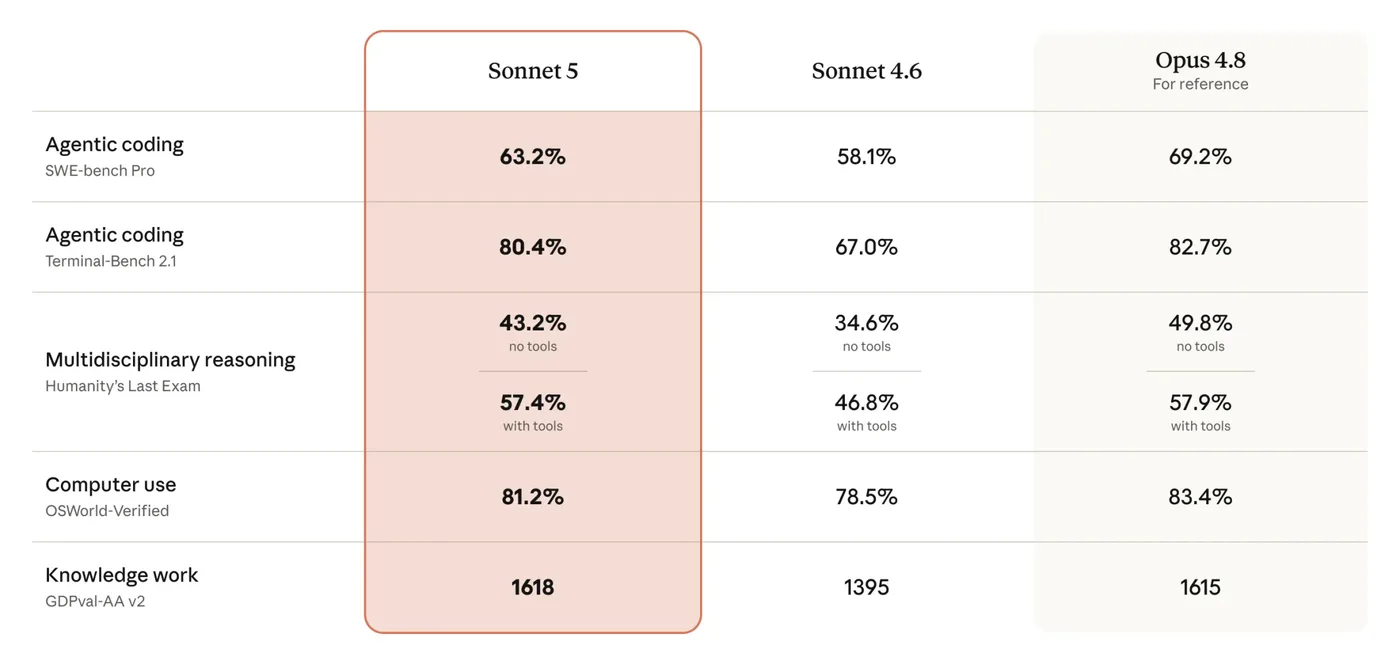
Anthropic says Claude Sonnet 5.5 complements Opus 5.5, claiming more than 30% faster operation and up to 30% lower cost for most work than Sonnet 5.
What changed
Vendor claims about speed and cost
Anthropic released Claude Sonnet 5.5 as a faster, lower-cost complement to Opus 5.5. Anthropic says it runs more than 30% faster than Sonnet 5 and costs up to 30% less for most work.
Anthropic says the per-token pricing is unchanged and attributes the lower claimed cost to use of fewer tokens. These are vendor claims, not independently verified results or a guarantee that every workflow will be faster or cheaper.
Separate token economics from total work cost
A lower token count can reduce model usage cost, but a team’s total cost also includes prompt preparation, integrations, human review and rework. A routine analysis that returns a plausible answer quickly may still cost more overall if it takes longer to validate.
Use a recurring report or document task with stable inputs and a known quality standard. Compare output quality, elapsed time, token or usage cost where available, reviewer time and required revisions.
A useful decision rule is to adopt the model for a workflow only if it meets the existing acceptance threshold while reducing total reviewed-output cost or turnaround time. This prevents a headline token saving from outweighing extra correction work.
Choose the task before choosing the claim
Sonnet 5.5 may merit testing for routine analysis and document work, as the announcement suggests. Suitability depends on the team’s accuracy, format and review requirements, not only on an aggregate speed figure.
The comparison with Opus 5.5 should remain contextual: Anthropic describes Sonnet as a complement, not a replacement for every task. No task-specific benchmark, availability condition or independent evaluation is provided here.
Why it matters for advertisers
A faster, lower-cost model could reduce the expense of repeatable work, but the useful measure is total reviewed-output cost rather than vendor speed claims alone.
What to check next
- Pilot Sonnet 5.5 on one recurring report with a stable benchmark.
- Compare output quality, elapsed time, usage cost, revisions and reviewer time.
- Keep Anthropic’s performance and cost figures labelled as vendor claims.
Sources & contributor credit
- Original source · Anthropic
Source cited in the published Week 40 newsletter. Article observation/reporting date is shown separately; this page’s original publication date is not inferred.
- Newsletter coverage · Paid Media Collective Week 40
Published edition used for story selection, copy, source credits and media; curation is distinct from original authorship.

Original creator unverified
Contributor roles follow the published newsletter and its linked evidence. Reporting, official discussion and visual authorship are kept separate; no independently unverified first-reporting priority is awarded.
Attribution evidence and limitations
Published story and credit line reconciled with the expanded article.
Original post, primary documentation and secondary reporting links retained.
Visible image content inspected for story relevance; image credit retained separately from reporting credit.
Attribution checked . This is a review date, not the original publication date.
- Published on this site
- Article updated
This update reflects the dated source reporting. Availability may have changed. Further coverage of this same development will be added to this page.