BigQuery · Status at source date: Newsletter archive
BigQuery Global Queries enable cross-region joins
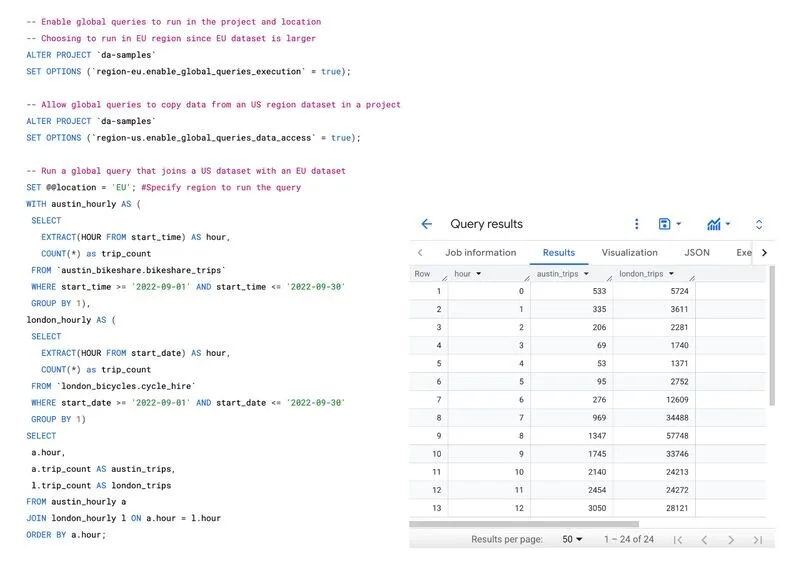
BigQuery has launched Global Queries in preview, allowing analysts to join datasets across different regions in a single SQL statement without manually moving data. Alicia Williams tested the feature by joining bike-sharing data from Austin (stored in the US region) and London (stored in the EU region) to compare rental patterns by hour.
What changed
The feature eliminates one of the friction points in working with geographically distributed data. Previously, cross-region analysis required copying data between regions, which created additional storage costs and increased synchronisation complexity. For organisations with multi-region data strategies - whether for compliance, latency, or organisational reasons - this simplifies analysis while maintaining data residency.
Sources & contributor credit
- Newsletter coverage · Paid Media Collective newsletter
Original newsletter text, contributor labels and media for this update.
- Source referenced in newsletterLinkedIn
Linked from the original newsletter. The source publication date has not been independently confirmed.
Original creator unverified
The names below are source credits. The original creator and first-reporting priority have not yet been independently verified.
Attribution evidence and limitations
Full attribution review pending.
A source link alone does not establish original authorship.
Original image and video creators have not yet been verified.
- Published on this site
This update reflects the dated source reporting. Availability may have changed. Further coverage of this same development will be added to this page.
Original newsletter text and archive evidence
BigQuery Global Queries enable cross-region joins
BigQuery has launched Global Queries in preview, allowing analysts to join datasets across different regions in a single SQL statement without manually moving data. Alicia Williams tested the feature by joining bike-sharing data from Austin (stored in the US region) and London (stored in the EU region) to compare rental patterns by hour.
The feature eliminates one of the friction points in working with geographically distributed data. Previously, cross-region analysis required copying data between regions, which created additional storage costs and increased synchronisation complexity. For organisations with multi-region data strategies - whether for compliance, latency, or organisational reasons - this simplifies analysis while maintaining data residency.
Source captured . No explicit first-contributor label was provided for this update.