Google Cloud · Status at source date: Rollout
BigQuery makes reusable column aliases generally available
Google’s 15 October release notes say reusable column aliases are generally available in BigQuery, but the capability remains disabled by default and requires opt-in.
What changed
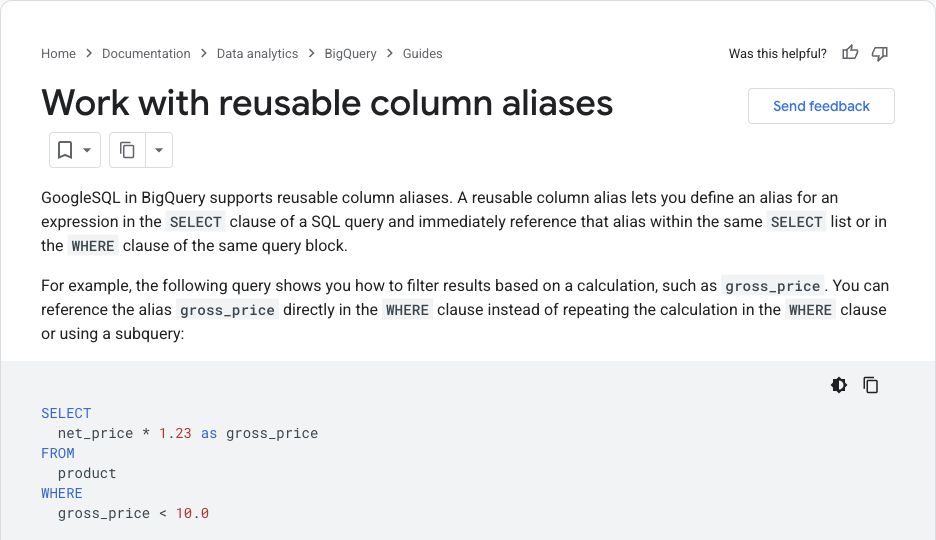
Google’s BigQuery release notes dated 15 October state that reusable column aliases are generally available. The feature allows an alias defined in a SELECT statement to be referenced elsewhere in the same SELECT list or in a WHERE clause within the same query block. Google also states that it is opt-in and disabled by default.
For paid-media and measurement teams, the practical value is readability and maintainability. Repeated expressions in reporting SQL can make a query harder to inspect, especially where channel mapping, campaign naming logic or derived metrics appear in several places. Reusable aliases may reduce some repetition when a team deliberately adopts the option. That is an editorial interpretation of the documented syntax, not a promise of broader query simplification in every case.
Google’s accompanying guide adds an important qualification: enabling reusable aliases changes name-resolution behaviour. A physical table column takes priority over an alias with the same name, while an alias can take precedence over an outer-query column, function argument or script variable. An administrator enables the option at project or organisation level. These details make the setting a behaviour change to review, rather than a cosmetic formatting preference.
PMC recommends testing representative reporting queries before adoption. Compare calculated metrics, row counts and filters against the current output, including examples with reused names. A shorter query is useful only if it still calculates the intended measure. Give derived fields distinctive names and document the setting alongside the query so another analyst can reproduce the result.
The feature is not a promise of faster execution or lower costs. Google documents limits around grouping, aggregate and window expressions, and aliases must be defined before they are referenced. Read the official guide for the exact query pattern you intend to change. For teams maintaining shared reporting SQL, a small reviewed migration is easier to assess than enabling the setting and rewriting a library at the same time.
Why it matters for advertisers
It translates a confirmed syntax release into a cautious reporting-SQL consideration without inventing performance or cost benefits.
What to check next
- Test existing queries before enabling reusable aliases.
- Check column-name collisions and name-resolution rules.
- Confirm opt-in settings and unsupported aggregate or window uses.
Sources & contributor credit
- Official Source · Google
Hosted official-documentation screenshot retained and guide rechecked. Google institutional source; Luka Cempre discovery credit only. No individual first-reporting priority claimed.
- Official documentation · Google Cloud
Guide update date; name-resolution and opt-in requirements.
- Discovery and distinct analysisLuka Cempre
Post supplied through Markifact; export timestamp is not a launch date. Google official release notes; no named author. Luka Cempre provides discovery/explanation, first reporting priority unproven.

Original creator unverified
Credits reflect the editor's latest changes. Original authorship has not been independently verified for this version.
Attribution evidence and limitations
Full attribution review pending.
A source link alone does not establish original authorship.
Original image and video creators have not yet been verified.
- Published on this site
- Article updated
This update reflects the dated source reporting. Availability may have changed. Further coverage of this same development will be added to this page.