Industry · Status at source date: Newsletter archive
Google introduces the Open Knowledge Format for AI agent knowledge
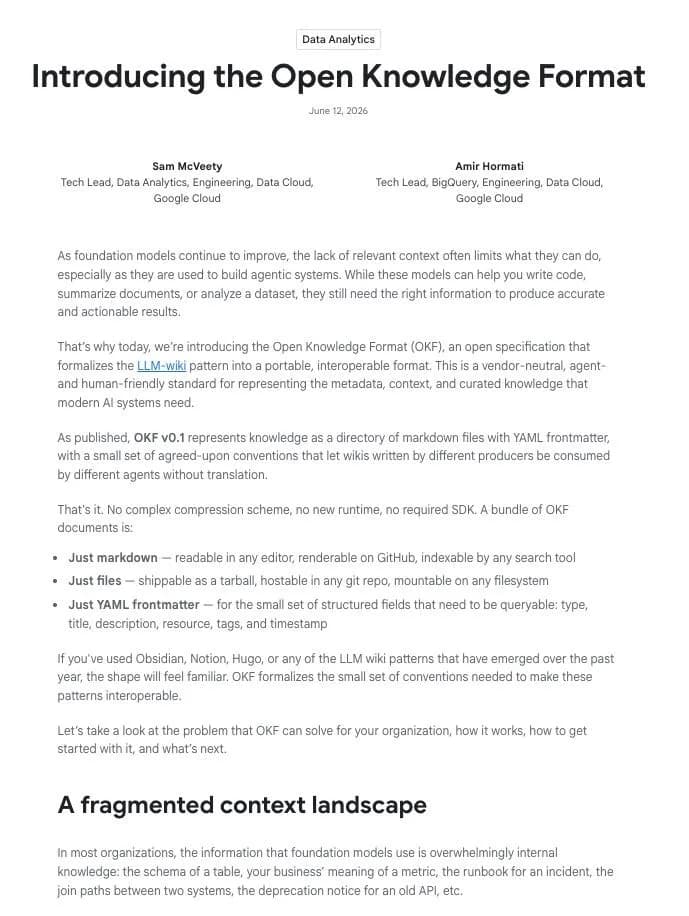
Google has introduced the Open Knowledge Format (OKF), a vendor-neutral open specification for giving AI agents the curated context they need, flagged by Charly Wargnier. Published by Google Cloud on 12 June and available on GitHub, OKF v0.1 represents knowledge as a directory of plain Markdown files with YAML front matter, with no runtime, SDK, or build step: "just markdown, just files."
What changed
Concepts link to each other with ordinary markdown links, turning a directory into a graph of relationships that different agents can consume without translation.
Charly framed it as Google formalising the "LLM wiki" pattern: where human-maintained wikis fail because people stop updating them, agents can keep machine-readable knowledge current across many files at once. Although the stated target is internal company knowledge, commentators noted that the format could also extend to representing website knowledge for AI systems, placing it in the same conversation as LLMs.txt and structured-content strategies for AI visibility.
Why it matters for advertisers
For you, this means SEO and content teams have another emerging, Google-backed convention for making content machine-readable to AI agents. Worth tracking adoption and watching whether OKF-style structuring becomes a practical lever for how AI systems understand and surface your content.
Perspective from the original PMC newsletter.Sources & contributor credit
- Newsletter coverage · Paid Media Collective newsletter
Original newsletter text, contributor labels and media for this update.
- Source referenced in newsletterLinkedIn
Linked from the original newsletter. The source publication date has not been independently confirmed.
Original creator unverified
The names below are source credits. The original creator and first-reporting priority have not yet been independently verified.
Attribution evidence and limitations
Full attribution review pending.
A source link alone does not establish original authorship.
Original image and video creators have not yet been verified.
- Published on this site
This update reflects the dated source reporting. Availability may have changed. Further coverage of this same development will be added to this page.
Original newsletter text and archive evidence
Google introduces the Open Knowledge Format for AI agent knowledge
Google has introduced the Open Knowledge Format (OKF), a vendor-neutral open specification for giving AI agents the curated context they need, flagged by Charly Wargnier. Published by Google Cloud on 12 June and available on GitHub, OKF v0.1 represents knowledge as a directory of plain Markdown files with YAML front matter, with no runtime, SDK, or build step: "just markdown, just files." Concepts link to each other with ordinary markdown links, turning a directory into a graph of relationships that different agents can consume without translation.
Charly framed it as Google formalising the "LLM wiki" pattern: where human-maintained wikis fail because people stop updating them, agents can keep machine-readable knowledge current across many files at once. Although the stated target is internal company knowledge, commentators noted that the format could also extend to representing website knowledge for AI systems, placing it in the same conversation as LLMs.txt and structured-content strategies for AI visibility.
For you, this means SEO and content teams have another emerging, Google-backed convention for making content machine-readable to AI agents. Worth tracking adoption and watching whether OKF-style structuring becomes a practical lever for how AI systems understand and surface your content.
Source captured . No explicit first-contributor label was provided for this update.