Meta Ads · Status at source date: Spotted in the Wild
Meta creative enhancements show enabled-state indicators
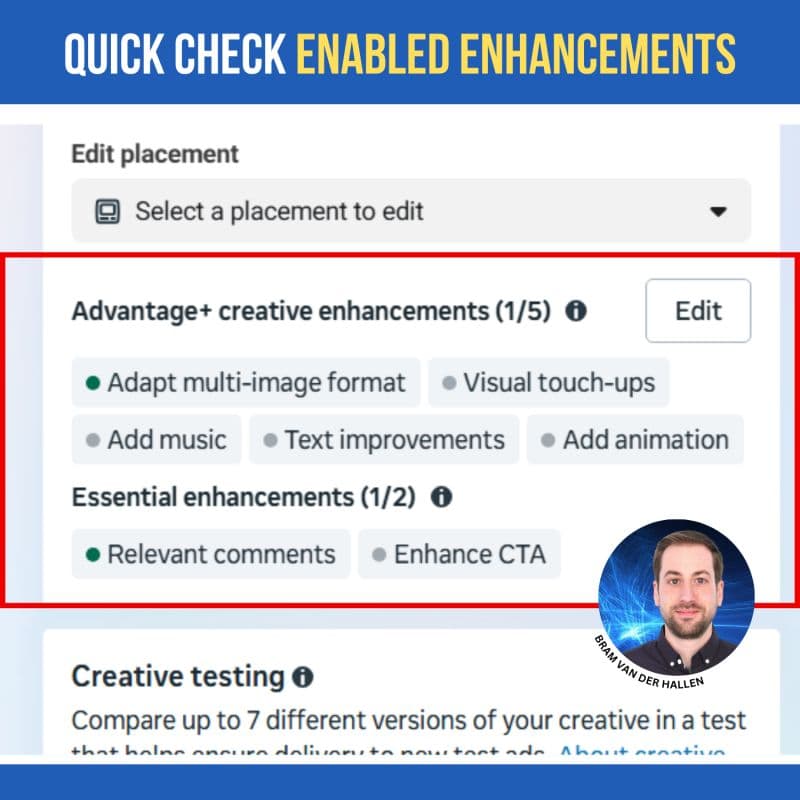
A practitioner observation shows status dots beside some Meta creative-enhancement options: green beside Adapt multi-image format and Relevant comments, and grey beside other options. The observed scope and effective date remain unknown.
What changed
Bram Van der Hallen’s 5 October post and branded image show a creative-enhancement settings view with green dots on Adapt multi-image format and Relevant comments, grey dots on other options, plus an Edit control. The image also shows counts for Advantage+ creative enhancements and essential enhancements. This supports an observation about account-level visibility of enabled states. It does not confirm a platform-wide default reduction, a permanent interface change, a rollout timetable or an official effective date.
The practical value of an enabled-state indicator is governance. Creative enhancements can affect how an asset is presented, so teams need a repeatable way to know which options are active when an ad enters review, performance analysis or incident investigation. A visible dot can make a setting easier to notice, but it should not replace a documented configuration record. Interface labels and availability may differ by account, objective, market or campaign setup.
Create a pre-launch enhancement checklist for each relevant campaign. Capture the options available, their observed state, the person who approved the configuration, the original assets, and any restrictions from brand, legal or client teams. Save a timestamped internal record where permitted by company policy. At review, compare the creative as supplied with live previews and any review-detail information already available. If a transformation affects a required claim, format, product depiction or approval condition, pause the affected asset through the normal governance route rather than assuming the dot reveals every applied effect.
Use measurement to evaluate individual changes carefully. Grouping many enhancement settings in one campaign makes it difficult to identify what changed. Where volume and risk justify it, test a limited set of settings against an otherwise comparable configuration, with stable creative and a clear observation period. Review delivery, quality feedback, landing-page behavior and downstream events, but avoid treating a short-term variation as evidence of a universal benefit. The indicator is most useful when it improves traceability, not when it encourages indiscriminate activation.
Why it matters for advertisers
Creative automation often creates a gap between asset approval and live execution. A simple status cue may reduce that gap for practitioners, but only if it is incorporated into normal controls. The observation is not enough to infer a change in Meta’s defaults or product strategy. It is enough to remind advertisers that configuration evidence should be available when explaining why a creative appeared in a particular form.
What to check next
- Check the enhancement panel in the relevant account and record which options are available and visibly enabled.
- Do not infer platform-wide defaults, rollout status or permanence from the observed screen.
- Add enhancement states to pre-launch approval and post-launch troubleshooting checklists.
- Compare supplied assets with previews and live execution where available, especially for regulated or tightly governed creative.
- Test a limited configuration change at a time when evaluating effects, and retain the campaign setup record.
Sources & contributor credit
- Original report · Bram Van der Hallen

Original creator unverified
Credits reflect the editor's latest changes. Original authorship has not been independently verified for this version.
Attribution evidence and limitations
Full attribution review pending.
A source link alone does not establish original authorship.
Original image and video creators have not yet been verified.
- Published on this site
- Article updated
This update reflects the dated source reporting. Availability may have changed. Further coverage of this same development will be added to this page.