Google Workspace · Status at source date: Newsletter archive
OpenAI launches Workspace Agents in research preview for ChatGPT Business
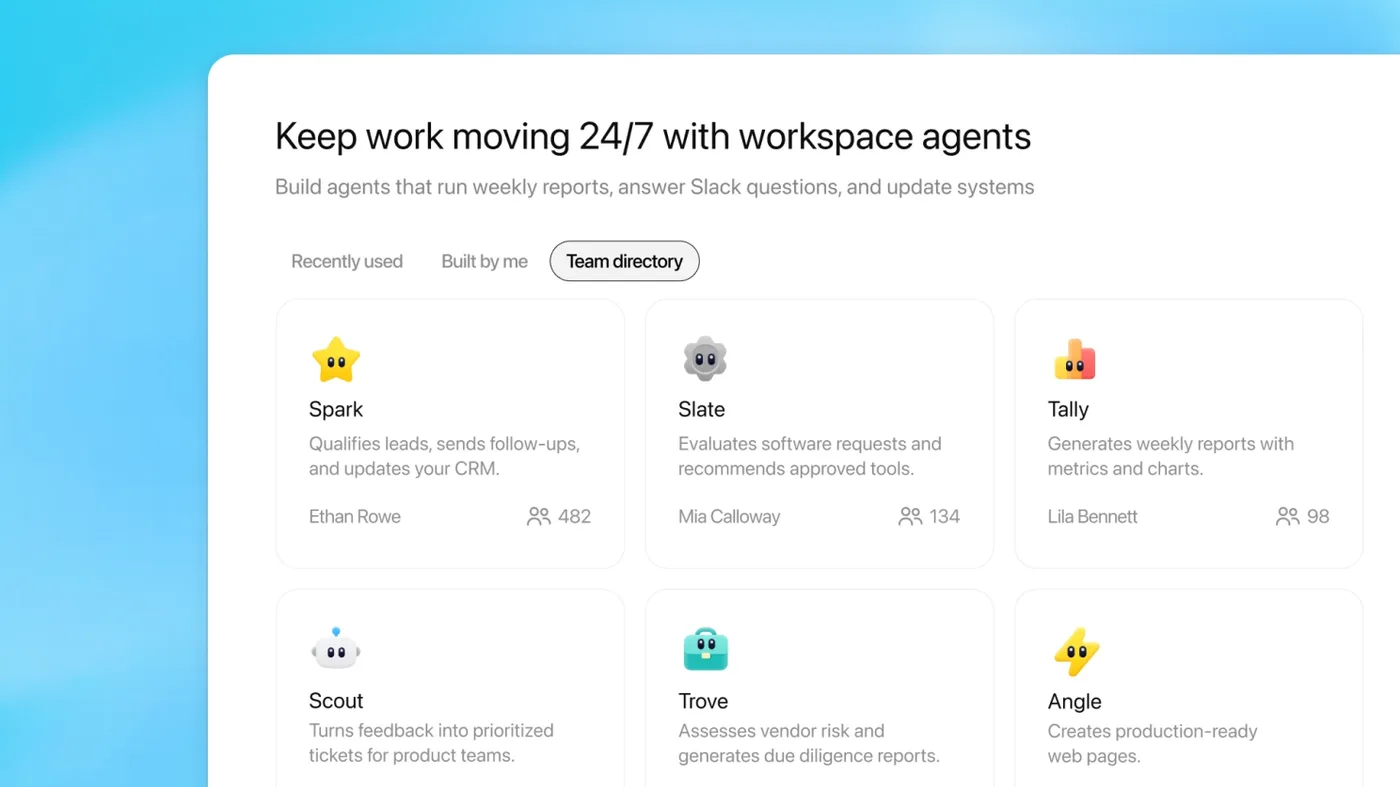
OpenAI has launched Workspace Agents in ChatGPT in research preview, available to ChatGPT Business, Enterprise, Edu, and Teachers plans. The feature is positioned as the next step beyond Custom GPTs: shared, long-running agents that can be built once, used together by a team in ChatGPT or Slack, and improved over time.
What changed
Workspace agents are powered by Codex and run in the cloud, allowing work to continue even when the user is away.
The agents can gather context across docs, email, chats, code, and connected systems, and can take action: creating documents, sending messages, updating records: with approval checkpoints. They run on schedules, on triggers (incoming messages, system updates), or on demand. Templates for finance, sales, and marketing are provided. Connected tools include Slack, Google Drive, Microsoft apps, Salesforce, and Notion. Admin controls cover which connected tools and actions user groups can access; a Compliance API provides auditability across agent configuration, updates, and runs. The feature is free until 6 May 2026, after which a credit-based pricing model applies.
Why it matters for advertisers
For you, this means a credible agentic platform alternative for marketing operations workflows that currently sit in custom-built scripts or Zapier-style automations. Particularly relevant for paid media reporting agents, search query analysis pipelines, and recurring asset QA: worth piloting before the credit-pricing model takes effect to establish a baseline cost profile.
Perspective from the original PMC newsletter.Sources & contributor credit
- Newsletter coverage · Paid Media Collective newsletter
Original newsletter text, contributor labels and media for this update.
- Source referenced in newsletterOpenAI
Linked from the original newsletter. The source publication date has not been independently confirmed.

Original creator unverified
The original creator has not yet been verified. Newsletter curation and publication do not establish original authorship.
Attribution evidence and limitations
Full attribution review pending.
A source link alone does not establish original authorship.
Original image and video creators have not yet been verified.
- Published on this site
This update reflects the dated source reporting. Availability may have changed. Further coverage of this same development will be added to this page.
Original newsletter text and archive evidence
OpenAI launches Workspace Agents in research preview for ChatGPT Business
OpenAI has launched Workspace Agents in ChatGPT in research preview, available to ChatGPT Business, Enterprise, Edu, and Teachers plans. The feature is positioned as the next step beyond Custom GPTs: shared, long-running agents that can be built once, used together by a team in ChatGPT or Slack, and improved over time. Workspace agents are powered by Codex and run in the cloud, allowing work to continue even when the user is away.
The agents can gather context across docs, email, chats, code, and connected systems, and can take action: creating documents, sending messages, updating records: with approval checkpoints. They run on schedules, on triggers (incoming messages, system updates), or on demand. Templates for finance, sales, and marketing are provided. Connected tools include Slack, Google Drive, Microsoft apps, Salesforce, and Notion. Admin controls cover which connected tools and actions user groups can access; a Compliance API provides auditability across agent configuration, updates, and runs. The feature is free until 6 May 2026, after which a credit-based pricing model applies.
For you, this means a credible agentic platform alternative for marketing operations workflows that currently sit in custom-built scripts or Zapier-style automations. Particularly relevant for paid media reporting agents, search query analysis pipelines, and recurring asset QA: worth piloting before the credit-pricing model takes effect to establish a baseline cost profile.
Source captured . No explicit first-contributor label was provided for this update.