OpenAI · Status at source date: Newsletter archive
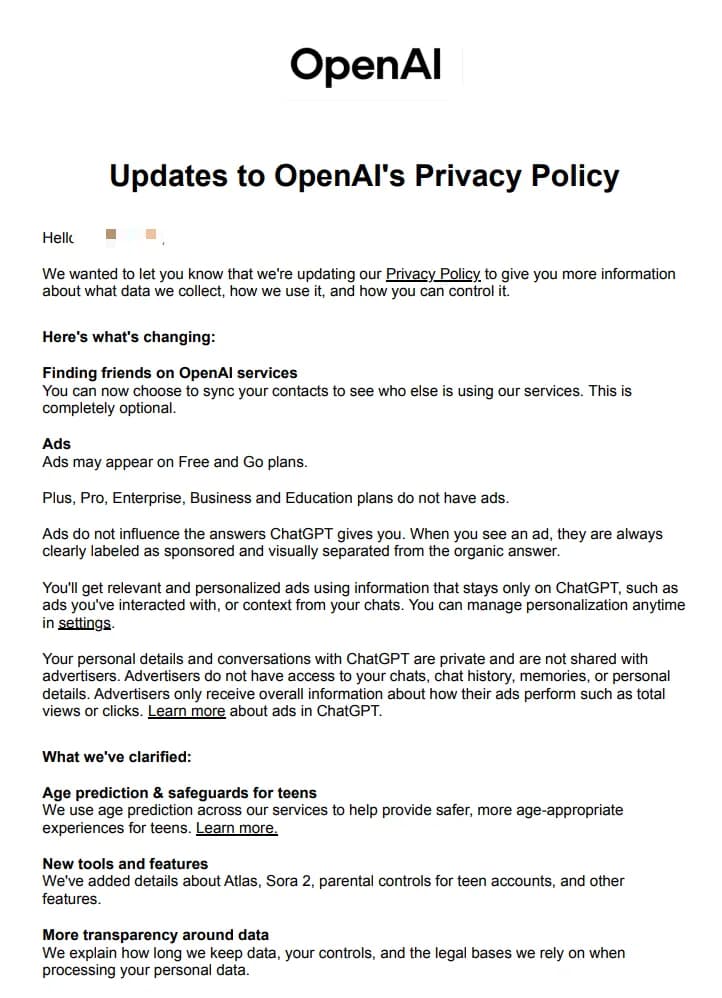
OpenAI updates privacy policy to share user data with advertisers
OpenAI has updated its privacy policy, effective 30 April 2026, to allow the sharing of user data with advertisers. The change lands as ChatGPT uninstalls have surged, and as OpenAI is in court with Elon Musk over allegations that the company has abandoned its founding principles.

What changed
Trishla Ostwal has surfaced the privacy policy update.
The advertising-relevant cut is what the data sharing enables. Combined with Juozas Kaziukėnas' separate finding that the OpenAI conversion-tracking pixel now accepts hashed first-party data: email, location, IP, browser version: the architecture for cookieless attribution and AI-driven targeting on ChatGPT inventory is materially more capable than it was a quarter ago. Meta and Google have used the same hashed-data workaround for years; OpenAI is now operating on the same playbook.
Why it matters for advertisers
For you, this means ChatGPT advertising is rapidly converging with mainstream paid search and paid social attribution capabilities. Worth re-baselining any planning that treats ChatGPT inventory as awareness-only: the targeting and attribution infrastructure for performance buying is now functionally in place. Particularly relevant for advertisers with privacy-sensitive customers, where the privacy policy change may trigger reputational or contractual review.
Perspective from the original PMC newsletter.Sources & contributor credit
- Newsletter coverage · Paid Media Collective newsletter
Original newsletter text, contributor labels and media for this update.
- Source referenced in newsletterAdWeek
Linked from the original newsletter. The source publication date has not been independently confirmed.
- Source referenced in newsletterLinkedIn
Linked from the original newsletter. The source publication date has not been independently confirmed.

Original creator unverified
The names below are source credits. The original creator and first-reporting priority have not yet been independently verified.
Attribution evidence and limitations
Full attribution review pending.
A source link alone does not establish original authorship.
Original image and video creators have not yet been verified.
- Published on this site
This update reflects the dated source reporting. Availability may have changed. Further coverage of this same development will be added to this page.
Original newsletter text and archive evidence
OpenAI updates privacy policy to share user data with advertisers
OpenAI has updated its privacy policy, effective 30 April 2026, to allow the sharing of user data with advertisers. The change lands as ChatGPT uninstalls have surged, and as OpenAI is in court with Elon Musk over allegations that the company has abandoned its founding principles. Trishla Ostwal has surfaced the privacy policy update.
The advertising-relevant cut is what the data sharing enables. Combined with Juozas Kaziukėnas' separate finding that the OpenAI conversion-tracking pixel now accepts hashed first-party data: email, location, IP, browser version: the architecture for cookieless attribution and AI-driven targeting on ChatGPT inventory is materially more capable than it was a quarter ago. Meta and Google have used the same hashed-data workaround for years; OpenAI is now operating on the same playbook.
For you, this means ChatGPT advertising is rapidly converging with mainstream paid search and paid social attribution capabilities. Worth re-baselining any planning that treats ChatGPT inventory as awareness-only: the targeting and attribution infrastructure for performance buying is now functionally in place. Particularly relevant for advertisers with privacy-sensitive customers, where the privacy policy change may trigger reputational or contractual review.
Source captured . No explicit first-contributor label was provided for this update.