Google Ads · Status at source date: Newsletter archive
Product titles report reveals AI-generated Shopping titles
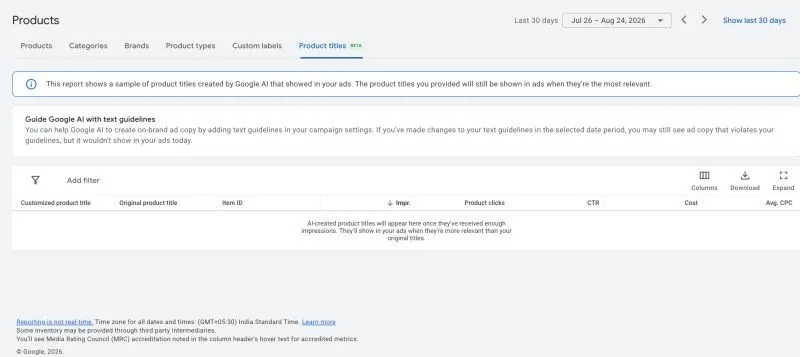
A new Google Ads report shows the customised product titles created by Google AI alongside the merchant's original title and performance metrics including impressions, product clicks, CTR, cost, and average CPC. Google may serve either version according to the query and its relevance assessment.
What changed
Yash Mandlesha shared an observed Product titles report in Google Ads that places customised titles beside the merchant's original wording and performance columns. His post says Google may use either the generated or original title according to its relevance assessment. The preserved interface is labelled beta and describes the report as a sample of titles created by Google AI, so it should not be treated as an exhaustive record of every possible variation.
The image also matters for what it does not show: the table in the supplied capture is empty and says adopted titles appear after sufficient impressions. It verifies the report structure and explanatory labels, not a particular generated title's quality or performance. The columns visible in the image include impressions, product clicks, CTR, cost and average CPC. None of those alone establishes that a wording change improved profit or accurately represented the product.
A retailer could use populated examples to check whether essential product distinctions survive customisation. For instance, a title that blurs the difference between a refill and a complete product could create the wrong expectation even if it attracts clicks. That is a quality-control scenario, not a problem demonstrated in Yash's screenshot. Review the source feed as well: an unclear original title may make it harder to judge whether the generated alternative preserves the intended meaning.
Why it matters for advertisers
Visibility into generated wording can make title automation more reviewable. The useful output is a list of specific issues or promising descriptions tied to identifiable products, rather than a broad conclusion that AI titles are better or worse. Performance comparisons also need context because the versions may be selected for different queries and opportunities.
What to check next
- Where the report is available and populated, compare sampled customised titles with the original feed and the actual product page.
- Prioritise errors involving size, compatibility, quantity, condition or another attribute that could change what a customer thinks they are buying.
- Review clicks and cost alongside downstream outcomes and query context before treating a title variation as a tested improvement.
Sources & contributor credit
- Newsletter coverage · Paid Media Collective newsletter
Original newsletter text, contributor labels and media for this update.
- Source referenced in newsletterLinkedIn
Linked from the original newsletter. The source publication date has not been independently confirmed.
Original creator unverified
Yash Mandlesha is the identified author of the observed-report post. The original newsletter first-contributor label remains historical credit, without independent confirmation of worldwide priority. Screenshot capture authorship is not separately proven.
Attribution evidence and limitations
Read Yash Mandlesha’s complete cached LinkedIn post and the newsletter archive. Inspected the actual report screenshot, including its beta, sample and insufficient-impressions wording. No populated report, underlying account or original platform rollout announcement was independently accessed.
Original URLs, archive, dates and existing contributor profile links retained. Historical access is distinguished from present account availability.
Viewed 8bbf9ffb67d529afd85b432d.webp. It shows an empty Product titles beta report, a sample warning, text-guideline guidance and column labels. No personal name or watermark is visible. Its displayed July–August date range is not used as a publication date.
- Archived newsletter text compared; no fresh newsletter page review claimed.
- Read Yash Mandlesha’s complete cached LinkedIn post and the newsletter archive. Inspected the actual report screenshot, including its beta, sample and insufficient-impressions wording. No populated report, underlying account or original platform rollout announcement was independently accessed.
Attribution checked . This is a review date, not the original publication date.
- Published on this site
- Article updated
This update reflects the dated source reporting. Availability may have changed. Further coverage of this same development will be added to this page.
Original newsletter text and archive evidence
Product titles report reveals AI-generated Shopping titles
A new Google Ads report shows the customised product titles created by Google AI alongside the merchant's original title and performance metrics including impressions, product clicks, CTR, cost, and average CPC. Google may serve either version according to the query and its relevance assessment. For you, this means title automation becomes observable rather than invisible, so compare generated wording with approved product claims and use the report to identify titles worth correcting at feed level.
Source captured . First-contributor labels follow the newsletter’s explicit wording.