Amazon Ads · Status at source date: Newsletter archive
Shopify deploys llms.txt files across 7 million stores
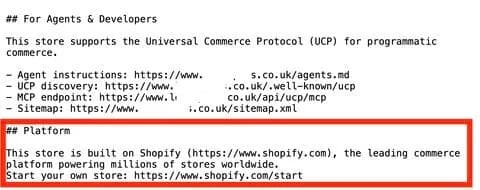
Lee Woodman has flagged that Shopify has rolled out llms.txt files across its entire 7-million-store portfolio. The llms.txt standard: analogous to robots.txt for traditional crawlers: gives AI crawlers (ChatGPT, Claude, Perplexity, Gemini) a structured signal about which content can be used for AI training and citation purposes.
What changed
Buried inside Shopify's rollout is a subtle policy decision about default behaviour that affects every Shopify merchant.
The structural significance for e-commerce SEO is that Shopify has made a unilateral decision about how its merchants' content interacts with AI training and citation, without merchant-by-merchant opt-in. For merchants who have been monitoring AI citation visibility (covered through the past several weeks via Chris Long's ranking factors and Microsoft Clarity's AI Citation report), the Shopify-side llms.txt configuration is now an additional input to consider.
Why it matters for advertisers
For you, this means Shopify merchants should audit their store's llms.txt configuration to ensure it aligns with their AI content strategy. Worth checking whether the default Shopify configuration matches the merchant's intent: opt out of AI training while remaining citable, opt out of both, or opt in to both: since the default may not match what the merchant would have chosen given the choice.
Perspective from the original PMC newsletter.Sources & contributor credit
- Newsletter coverage · Paid Media Collective newsletter
Original newsletter text, contributor labels and media for this update.
- Source referenced in newsletterLinkedIn
Linked from the original newsletter. The source publication date has not been independently confirmed.
Original creator unverified
The names below are source credits. The original creator and first-reporting priority have not yet been independently verified.
Attribution evidence and limitations
Full attribution review pending.
A source link alone does not establish original authorship.
Original image and video creators have not yet been verified.
- Published on this site
This update reflects the dated source reporting. Availability may have changed. Further coverage of this same development will be added to this page.
Original newsletter text and archive evidence
Shopify deploys llms.txt files across 7 million stores
Lee Woodman has flagged that Shopify has rolled out llms.txt files across its entire 7-million-store portfolio. The llms.txt standard: analogous to robots.txt for traditional crawlers: gives AI crawlers (ChatGPT, Claude, Perplexity, Gemini) a structured signal about which content can be used for AI training and citation purposes. Buried inside Shopify's rollout is a subtle policy decision about default behaviour that affects every Shopify merchant.
The structural significance for e-commerce SEO is that Shopify has made a unilateral decision about how its merchants' content interacts with AI training and citation, without merchant-by-merchant opt-in. For merchants who have been monitoring AI citation visibility (covered through the past several weeks via Chris Long's ranking factors and Microsoft Clarity's AI Citation report), the Shopify-side llms.txt configuration is now an additional input to consider.
For you, this means Shopify merchants should audit their store's llms.txt configuration to ensure it aligns with their AI content strategy. Worth checking whether the default Shopify configuration matches the merchant's intent: opt out of AI training while remaining citable, opt out of both, or opt in to both: since the default may not match what the merchant would have chosen given the choice.
Source captured . No explicit first-contributor label was provided for this update.