Industry · Status at source date: Useful reference
DataForSEO documents a Codex plugin for retrieved search data
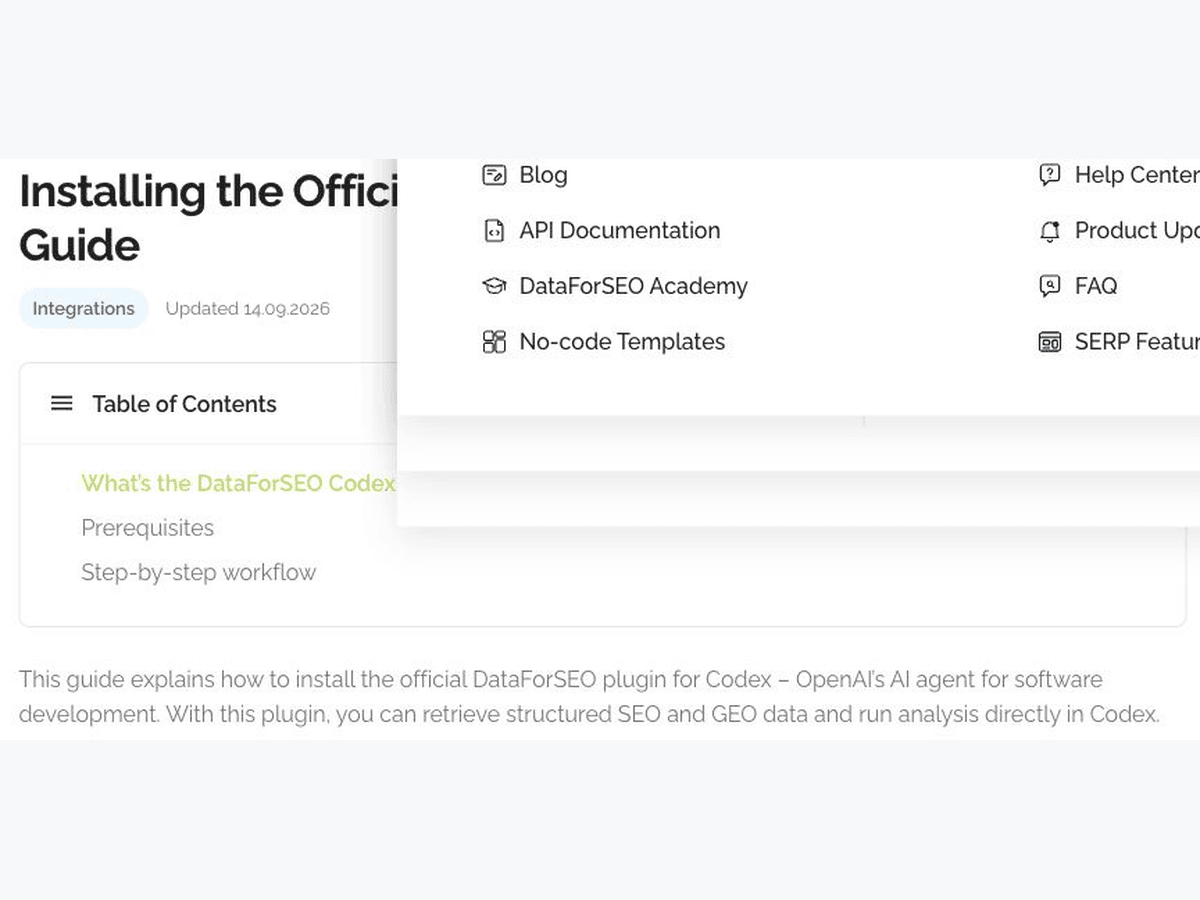
DataForSEO’s 14 September guide documents a Codex plugin for retrieving keyword, CPC, search-volume, SERP and competitor data through its APIs. This is a resurfaced reference, not a new October launch.
What changed
A documented research workflow
DataForSEO’s guide documents a Codex plugin for retrieving keyword, CPC, search-volume, search-results and competitor data through its APIs. The practical proposition is to ground AI-assisted research in retrieved data rather than relying on an unsupported generated answer.
A prompt may help frame or synthesise the research, while the connected data source supplies factual inputs that still need to be checked before they inform a decision. The evidence does not establish that every generated interpretation is correct merely because a connection is present.
Accounts and connection are prerequisites
The workflow requires the relevant accounts and connection. Before designing a process around it, teams should establish who may access the data and how retrieved results, analysis and recommendations will be reviewed or shared.
Prompts should define the research question, market or keyword set and desired output. Preserve enough of the retrieved result for another reviewer to distinguish source-backed observations from AI synthesis. This creates a clearer audit trail if conclusions are later challenged or refreshed.
Preserve the September chronology
The official guide is dated 14 September 2026 and predates this issue. It is a resurfaced workflow reference, not evidence of a new launch in October. That distinction should be maintained in change logs and stakeholder communications.
The evidence does not establish data freshness, coverage, pricing, account eligibility, query-level accuracy or suitability for every research purpose. Retrieved outputs and their API context still require validation.
Why it matters for advertisers
Connected retrieval can make AI-assisted research more accountable by linking analysis to returned data. Its benefit depends on appropriate access, precise questions and a visible separation between retrieved evidence and generated interpretation.
What to check next
- Confirm the required DataForSEO account and connection with the appropriate owner.
- Pilot one defined keyword or competitor question and use the retrieved data as the evidence base.
- Retain the underlying result and label AI-generated synthesis separately from source-backed observations.
Sources & contributor credit
- Reporting source · DataForSEO Help
Source reporting or observation date, not a universal launch date.
- Newsletter coverage · Paid Media Collective Week 41
Yoann Ferrand’s newsletter curation. Original reporting, account observations and visual credits are listed separately.

Original creator unverified
Original contributors and source authors are distinguished from later observations, visual credits and newsletter curation. An explicit observation credit does not establish first-ever discovery.
Attribution evidence and limitations
Published Week 41 copy and earlier event coverage reconciled.
Original work and earlier reporting evidence retained.
Story-specific image visually inspected and credited.
Attribution checked . This is a review date, not the original publication date.
- Published on this site
- Article updated
This update reflects the dated source reporting. Availability may have changed. Further coverage of this same development will be added to this page.