Industry · Status at source date: Policy announcement
The European Commission is examining whether Booking.com labels paid rankings as ads
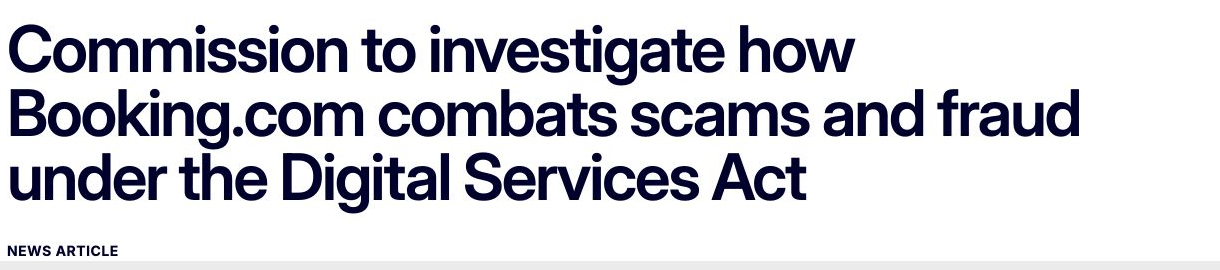
The Commission opened formal DSA proceedings against Booking.com on 21 October over fraudulent listings and phishing risks, and over Article 26(1): it "suspects that Booking.com did not clearly label as ads the listings whose providers paid for a higher ranking in search results". It will examine whether users can tell who is behind each ad, who paid and why they see it. Booking.com says it is cooperating fully; the opening does not prejudge the outcome. The case puts paid marketplace visibility and its labelling under scrutiny. It is an investigation, not a finding that Booking.com has broken the rules or a confirmed change to listings.
What changed
Week 43 follow-up: 2026-10-21
Earlier coverage and context (2026-10-21)
The European Commission's October announcement concerning Booking.com includes how the platform identifies listings whose higher position in search results is paid for. The Commission's own public post also addresses risks from fraudulent accommodation listings and phishing scams.
This is an investigation into compliance, not a finding that Booking.com has infringed the rules. The official announcement page was not fully readable during this review, but the Commission's original LinkedIn post was available and explicitly states the promoted-listing concern.
For travel marketers, the advertising connection is the distinction between organic placement and paid visibility inside a marketplace. Clear labelling helps a traveller understand why a property appears in a particular position; it does not by itself establish the quality of the property or the suitability of the offer.
A business buying marketplace visibility should understand the specific programme it uses and how that promotion is presented to customers. Keep the platform's own descriptions and any contractual terms separate from assumptions based on a search-results screenshot.
The story does not announce a new advertiser bidding control or a confirmed penalty. Follow the Commission's subsequent statements for changes in the investigation's status. The 21 October date refers to announcement coverage, rather than a deadline for every accommodation advertiser.
Travel advertisers should distinguish paid visibility from the platform's organic ranking and from consumer-protection concerns elsewhere in the investigation. A useful review checks whether a traveller can identify a promoted placement and understand why it appears in that position. The investigation itself does not show that a particular hotel campaign is unlawful. Keep any response tied to the Commission's stated questions and later findings, rather than treating the opening of proceedings as a final compliance verdict.
Sources & contributor credit
- Official sourceEuropean Commission
Original announcement dated 2026-10-21.
- Official sourceEuropean Commission
- Source referenced in newsletterEuropean Commission
Linked in Yoann Ferrand’s published Week 43 newsletter.
- Newsletter coveragePaid Media Collective
Published Week 43 edition; source for the approved credit, image and wording reconciliation.

Original creator unverified
Credits reflect the editor's latest changes. Original authorship has not been independently verified for this version.
Attribution evidence and limitations
Full attribution review pending.
A source link alone does not establish original authorship.
Original image and video creators have not yet been verified.
- Published on this site
- Article updated
This update reflects the dated source reporting. Availability may have changed. Further coverage of this same development will be added to this page.