ChatGPT Ads · Status at source date: Product update
ChatGPT Ads expands custom-audience management
OpenAI’s custom-audience update allows advertisers to add, remove or replace members without rebuilding an audience, mix supported identifiers and build lists beyond five million members.
What changed
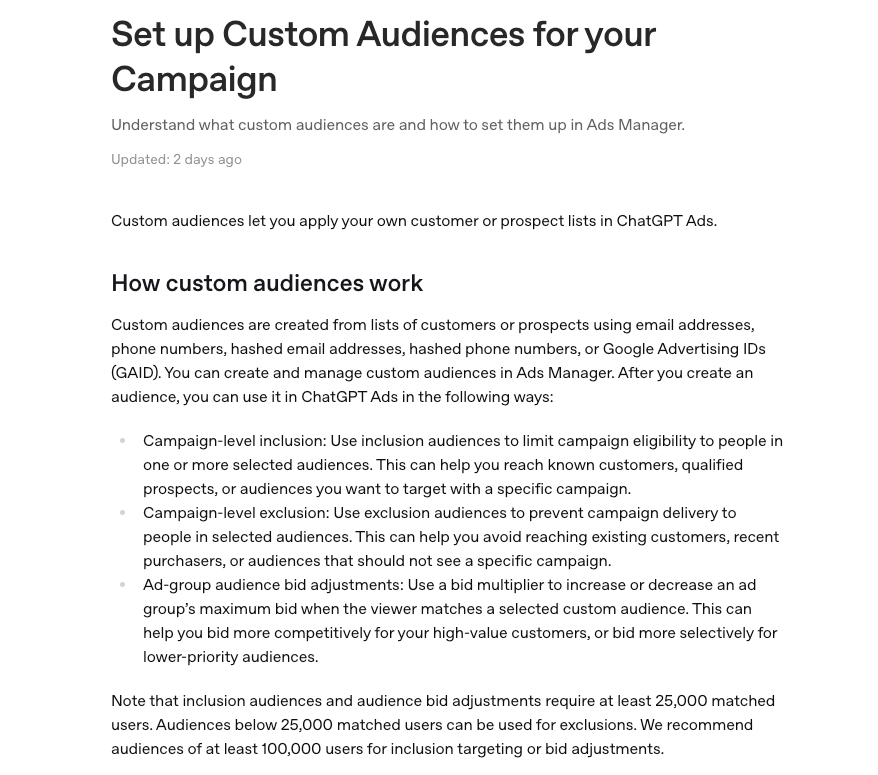
OpenAI's custom-audience instructions confirm that advertisers can maintain an existing audience by adding, removing or replacing members. The update reported by Barry Schwartz also includes mixed supported identifiers, audiences larger than five million members and support for Google Advertising IDs. Maintaining the same audience object can reduce the administrative work involved in refreshing a list already used by campaigns.
The distinction between uploaded records and matched people remains central. OpenAI's instructions require at least 25,000 matched users for inclusion targeting or audience bid adjustments, while smaller audiences can be used for exclusions. A file containing 25,000 rows therefore does not establish that it qualifies for inclusion. Invalid, duplicate or unmatched identifiers can reduce the usable audience, and processing must finish before the resulting list is ready.
An acquisition team could use the maintenance workflow to keep a recent-customer exclusion aligned with its customer database. A separate prospect list might have an entirely different purpose and activation threshold. These are illustrative uses: the update does not demonstrate an improvement in match rate, lower acquisition costs or permission to upload every identifier a business possesses. List purpose, data quality and the applicable data-use requirements remain separate decisions from whether the interface accepts a file.
Why it matters for advertisers
The most useful operational improvement is continuity. A named, maintained audience can stay attached to the campaigns that need it while its membership changes. That also makes a mistaken replacement more consequential, so audience names and update procedures should describe the business rule clearly. Treat a successful upload as one check in the workflow, then verify the intended audience status and campaign use.
What to check next
- Document whether each list is intended for inclusion, exclusion or a bid adjustment and maintain its customer-selection rule in the source system.
- Use the supported add, remove or replace operation deliberately, then check processing status and matched size rather than relying on file row count.
- Confirm that campaigns reference the intended audience after a refresh and assess downstream delivery against the list’s purpose before attributing performance changes to the update.
Sources & contributor credit
- Newsletter coverage · Paid Media Collective newsletter
Original newsletter text, contributor labels and media for this update.
- Source referenced in newsletterOpenAI Help
Linked from the original newsletter. The source publication date has not been independently confirmed.
- Source referenced in newsletterSearch Engine Roundtable
Linked from the original newsletter. The source publication date has not been independently confirmed.

Original creator unverified
OpenAI is the underlying product-information source; Barry Schwartz is the identified reporting author. No personal announcement author or screenshot maker is named in the reviewed material.
Attribution evidence and limitations
Read the full cached Search Engine Roundtable report, which explicitly says this update came from an OpenAI email. Recovered and read the complete OpenAI custom-audience help body through web after its cache was blocked. Compared threshold wording with the inspected local screenshot and newsletter archive.
Original source and profile URLs retained; archive and original dates unchanged. This review does not infer present account availability from historical reporting.
Viewed chatgpt-ads-custom-audience-management-expansion.png. It contains the OpenAI help title, supported identifiers and the 25,000 matched-user distinction. No person or watermark is credited; the screenshot’s relative updated label is not assigned a publication date.
- Archived newsletter text compared, not a new live newsletter review.
- Read the full cached Search Engine Roundtable report, which explicitly says this update came from an OpenAI email. Recovered and read the complete OpenAI custom-audience help body through web after its cache was blocked. Compared threshold wording with the inspected local screenshot and newsletter archive.
- Read the full cached Search Engine Roundtable report, which explicitly says this update came from an OpenAI email. Recovered and read the complete OpenAI custom-audience help body through web after its cache was blocked. Compared threshold wording with the inspected local screenshot and newsletter archive.
Attribution checked . This is a review date, not the original publication date.
- Published on this site
- Article updated
This update reflects the dated source reporting. Availability may have changed. Further coverage of this same development will be added to this page.
Original newsletter text and archive evidence
ChatGPT Ads expands custom-audience management.
OpenAI’s custom-audience update allows advertisers to add, remove or replace members without rebuilding an audience, mix supported identifiers and build lists beyond five million members. Google Advertising IDs are supported, and audiences with fewer than 25,000 matched users can be used for exclusions rather than inclusion targeting or bid adjustments. For you, this means more flexible audience maintenance. The same thresholds and permitted data use still determine how each list can be activated.
Source captured . No explicit first-contributor label was provided for this update.