Meta Ads · Status at source date: Newsletter archive
Meta needs 30–50% more revenue per user over five years to offset 2026 AI capex
Brendan Ashe has published a structural analysis of Meta's revenue trajectory: Meta needs to find 30%–50% more revenue per user over the next 5 years to offset rising AI infrastructure costs against its 2026 capex guidance of $116 billion. The math is sharp.
What changed
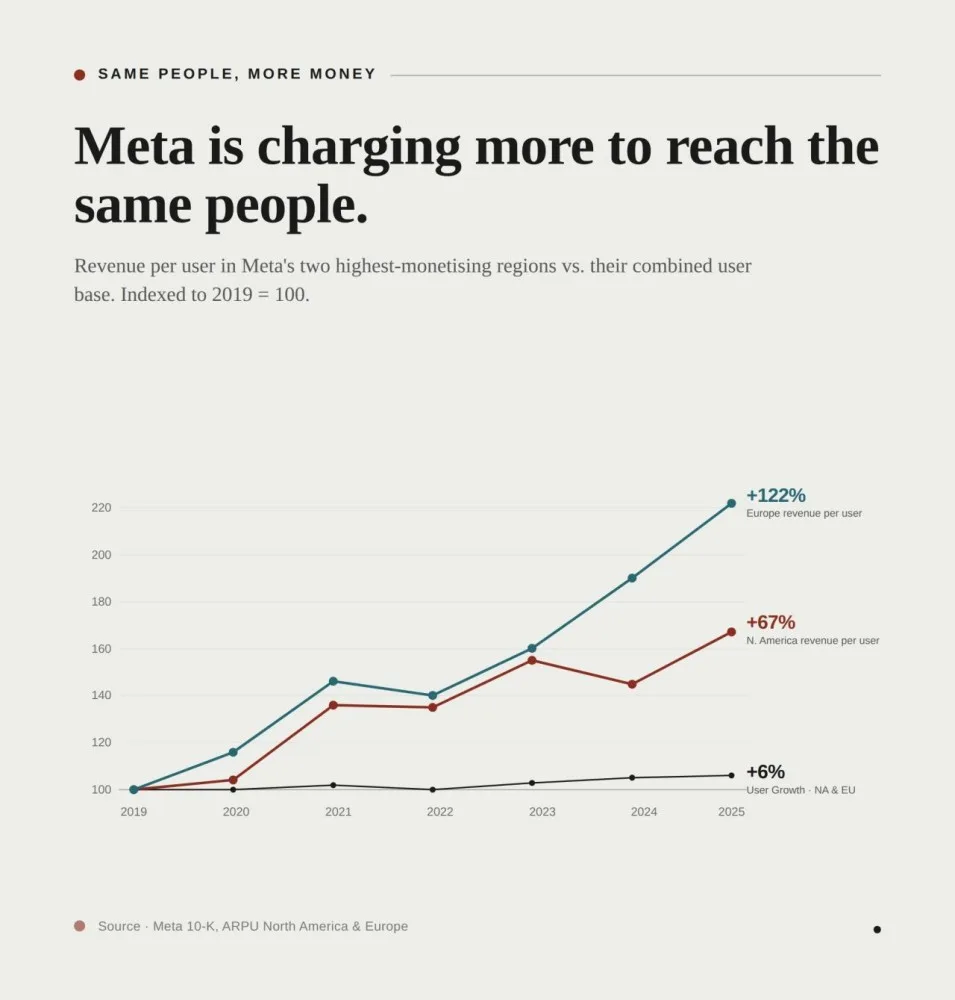
Since 2019, average revenue per active user has grown 77% globally, while the North America and Europe user base: which generates 62% of revenue: has grown only slightly. The pricing-up strategy has held because Meta's ad product works, and Advantage+ improvements have absorbed the price increases: but the runway for advertiser-side absorption is finite.
The strategic read for advertisers: Meta CPMs are not going down, and platform-level pressure to extract more revenue per impression will continue compounding through 2026 and beyond. The mitigation is not "stop using Meta": it's running tighter, better-optimised campaigns against creative that performs, rather than absorbing the price increase passively across underperforming inventory.
Why it matters for advertisers
For you, this means quarterly Meta efficiency audits should be a fixed calendar item for 2026, not an as-needed exercise. Worth running the analysis Brendan implies: revenue-per-impression trend, CPM trajectory by placement, and creative win rate against the rising price floor. Particularly relevant for e-commerce and DTC advertisers, where Meta is a primary acquisition channel and where CPM creep has been chipping at unit economics without a corresponding strategy refresh.
Perspective from the original PMC newsletter.Sources & contributor credit
- Newsletter coverage · Paid Media Collective newsletter
Original newsletter text, contributor labels and media for this update.
- Source referenced in newsletterLinkedIn
Linked from the original newsletter. The source publication date has not been independently confirmed.
Original creator unverified
The names below are source credits. The original creator and first-reporting priority have not yet been independently verified.
Attribution evidence and limitations
Full attribution review pending.
A source link alone does not establish original authorship.
Original image and video creators have not yet been verified.
- Published on this site
This update reflects the dated source reporting. Availability may have changed. Further coverage of this same development will be added to this page.
Original newsletter text and archive evidence
Meta needs 30–50% more revenue per user over five years to offset 2026 AI capex
Brendan Ashe has published a structural analysis of Meta's revenue trajectory: Meta needs to find 30%–50% more revenue per user over the next 5 years to offset rising AI infrastructure costs against its 2026 capex guidance of $116 billion. The math is sharp. Since 2019, average revenue per active user has grown 77% globally, while the North America and Europe user base: which generates 62% of revenue: has grown only slightly. The pricing-up strategy has held because Meta's ad product works, and Advantage+ improvements have absorbed the price increases: but the runway for advertiser-side absorption is finite.
The strategic read for advertisers: Meta CPMs are not going down, and platform-level pressure to extract more revenue per impression will continue compounding through 2026 and beyond. The mitigation is not "stop using Meta": it's running tighter, better-optimised campaigns against creative that performs, rather than absorbing the price increase passively across underperforming inventory.
For you, this means quarterly Meta efficiency audits should be a fixed calendar item for 2026, not an as-needed exercise. Worth running the analysis Brendan implies: revenue-per-impression trend, CPM trajectory by placement, and creative win rate against the rising price floor. Particularly relevant for e-commerce and DTC advertisers, where Meta is a primary acquisition channel and where CPM creep has been chipping at unit economics without a corresponding strategy refresh.
Source captured . No explicit first-contributor label was provided for this update.