Google Ads · Status at source date: Test
Search ads test another AI-generated review-summary label
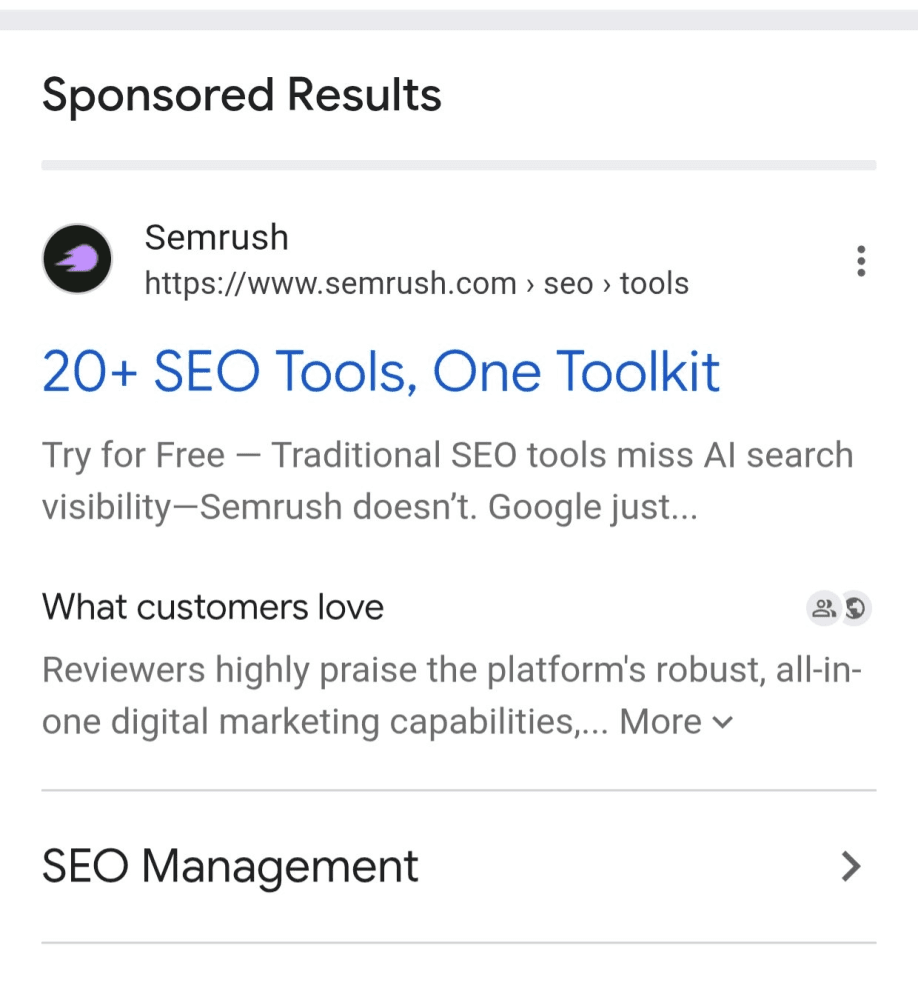
A reported Search ad test displays a “What customers love” summary drawn from store-rating reviews beneath the sponsored result.
What changed
Sachin Patel's retained X post links to his report of an AI-generated review-summary treatment in sponsored search results. The archived example shows a Semrush ad with a section labelled “What customers love” beneath its description. This is evidence of a reported presentation test. It does not establish a general launch, a control available to every advertiser or an uplift in clicks or conversions.
The visual is useful because the additional text appears in the ad's immediate context while being presented as a summary of customer opinion. An advertiser should therefore consider the whole result when checking what a prospective customer sees. A brand may have approved the headline and description without having written the review summary. The newsletter describes the text as drawn from store-rating reviews; the preserved screenshot confirms the label and the visible excerpt, but does not expose the complete review selection process.
The earlier “What people are saying” wording in the archive helps place this example as another treatment of review information. It should not be interpreted as proof that one label has permanently replaced the other. Similarly, the flattering excerpt visible for one software brand cannot establish that all summaries are favourable or equally accurate. The original linked article could not be reopened in this review, so its unavailable detail is not used to invent further rules.
Why it matters for advertisers
This expands the practical scope of an ad-quality check to information displayed around the advertiser's own copy. The sensible response is to inspect an observed summary for accuracy and relevance, while keeping any assumptions about conversion benefit separate from the observation. A concise record of a specific mismatch is more useful for escalation than a general objection to generated content.
What to check next
- If the treatment appears for your brand, capture the query, date, device context, complete result and review-summary wording.
- Compare the visible claims with the underlying customer feedback where accessible, distinguishing an inaccurate summary from a genuine service issue.
- Keep the observed format in test notes and avoid promising that it can be enabled, disabled or reproduced until an account control or official instruction is verified.
Sources & contributor credit
- Newsletter coverage · Paid Media Collective newsletter
Original newsletter text, contributor labels and media for this update.
- Source referenced in newsletterSachin Patel
Linked from the original newsletter. The source publication date has not been independently confirmed.
- Supporting primary sourceSearch Engine Watch
Original report linked by Sachin Patel on X; destination retained despite unsuccessful full-body recovery.

Original creator unverified
The cached post names Sachin Patel and links to his Search Engine Watch report. The archive misspelling Sachi is corrected in the new body. His existing newsletter first-contributor label is preserved as historical credit, without a new claim of verified priority.
Attribution evidence and limitations
Read Sachin Patel’s complete cached X post and extracted its original Search Engine Watch destination. Inspected the saved ad screenshot and archived newsletter. Two web opens of the original article failed; no full-article review is claimed. A Search Engine Watch category result corroborated the matching article title and Sachin Patel byline.
All existing source and profile links retained. Original publication metadata and archive remain unchanged. Access and recovery limitations are identified in sourceReview.
Viewed search-ads-what-customers-love-review-summary.png. It shows a Semrush sponsored result, the What customers love label and a partial review summary. No signature or personal watermark is visible. Sachin Patel is the post author; image capture authorship remains unproven.
- Archived newsletter text compared; not a fresh newsletter-page review.
- Read Sachin Patel’s complete cached X post and extracted its original Search Engine Watch destination. Inspected the saved ad screenshot and archived newsletter. Two web opens of the original article failed; no full-article review is claimed. A Search Engine Watch category result corroborated the matching article title and Sachin Patel byline.
Attribution checked . This is a review date, not the original publication date.
- Published on this site
- Article updated
This update reflects the dated source reporting. Availability may have changed. Further coverage of this same development will be added to this page.
Original newsletter text and archive evidence
Search ads test another AI-generated review-summary label
A reported Search ad test displays a “What customers love” summary drawn from store-rating reviews beneath the sponsored result. Sachi Patel's example follows an earlier “What people are saying” treatment; this is another observed presentation of review summaries rather than confirmation of a general launch. For you, this means checking how your store reviews are represented when the treatment appears and documenting inaccurate summaries for follow-up.
Source captured . First-contributor labels follow the newsletter’s explicit wording.