Industry Insights · Status at source date: Update
Five more states join the FTC's lawsuit alleging Hims & Hers shared health data with advertising platforms
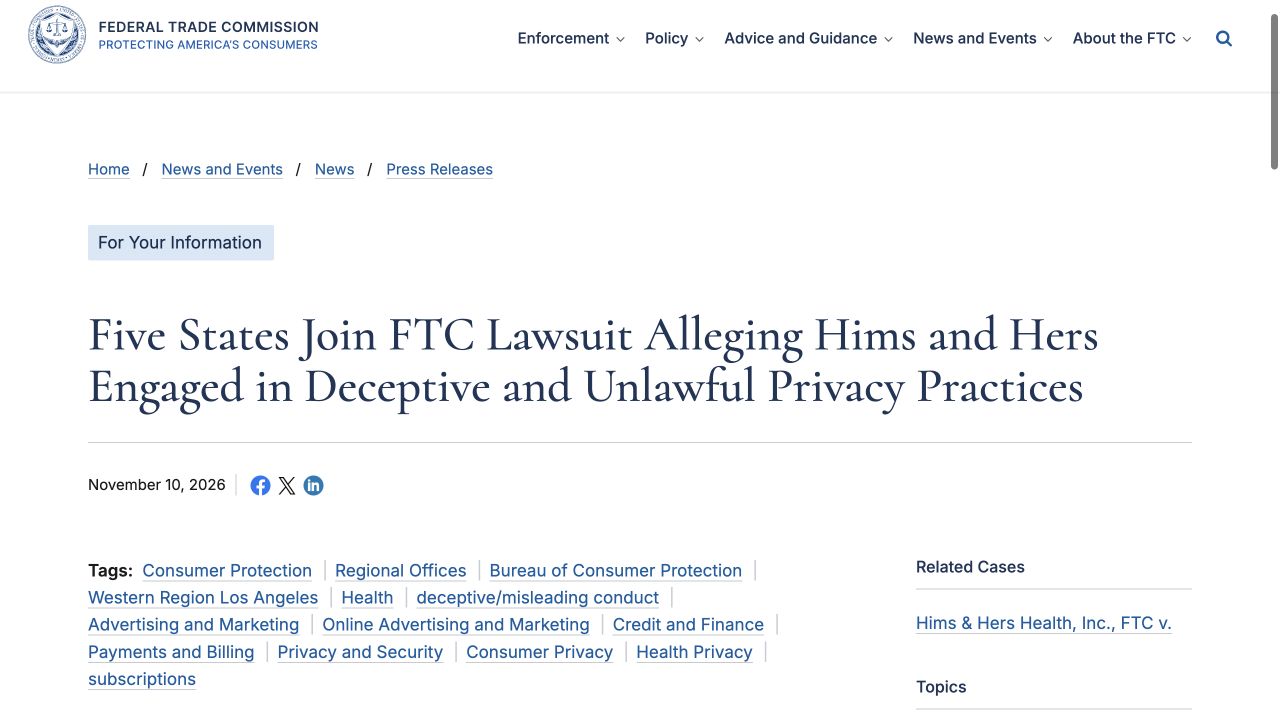
The FTC announced on 10 November that Arizona, Florida, Nebraska, Ohio and Wisconsin have joined Utah and Los Angeles County as co-plaintiffs in an amended complaint against Hims & Hers in the Northern District of California, which alleges the telehealth company shared consumers' sensitive health information with third-party advertising platforms, naming Meta and Snap, and violated the Restore Online Shoppers' Confidence Act in its billing and cancellation flows.
What changed
The original complaint was filed in July; these remain allegations. For you, this means health-adjacent advertisers face a widening multi-state front on pixel and conversions-API data, so audit what your event parameters contain before a regulator does.
Additional states joining a lawsuit changes the group bringing the case; it does not convert allegations into a final court finding. The reporting concerns alleged sharing of health data with advertising platforms, and that distinction should be retained throughout the summary.
For businesses handling sensitive customer information, the relevant operational question is what data reaches advertising and analytics systems. Review event payloads, URLs, form fields and integration mappings with the responsible technical and privacy teams. A familiar marketing tag does not make every piece of information appropriate to transmit.
Keep the review focused on the business's own implementation and applicable obligations. The existence of a lawsuit against another company does not establish wrongdoing by every advertiser in the category. It can, however, identify a type of data flow worth examining carefully rather than assuming that a standard integration handles every sensitivity correctly.
The source should remain the authority for the parties, allegations and procedural status. This entry does not predict the outcome, calculate liability or provide a business-specific legal conclusion. It reports the expansion of the case and the measurement-governance issue it raises without presenting unproven claims as settled facts.
Sources & contributor credit
- Original sourceFederal Trade Commission
Original creator unverified
Credits reflect the editor's latest changes. Original authorship has not been independently verified for this version.
Attribution evidence and limitations
Full attribution review pending.
A source link alone does not establish original authorship.
Original image and video creators have not yet been verified.
- Published on this site
- Article updated
This update reflects the dated source reporting. Availability may have changed. Further coverage of this same development will be added to this page.