Google Ads · Status at source date: Newsletter archive
AI Max introduces AI Brief and text disclaimers as the product turns one
Google has marked AI Max for Search's first anniversary with two practitioner-facing additions. AI Brief is a Gemini-powered control layer that lets advertisers steer AI Max in plain English across three dimensions: Messaging Guidelines (what ads should and should not say, e.g. "never mention prices"), Matching Guidelines (which searches to capture or avoid, e.g. "prioritise searches for healthy pantry staples"), and Audience Guidelines (tailored messages for specific cohorts).
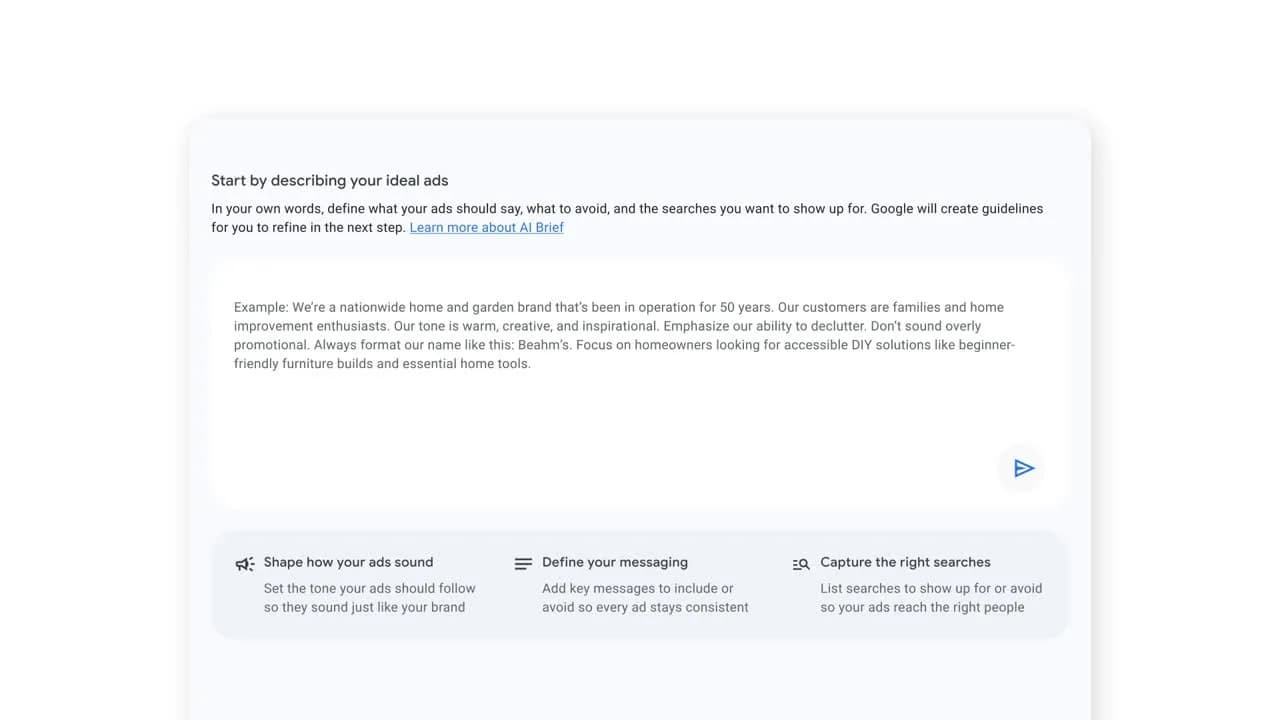
This video plays in the original LinkedIn newsletter.
What changed
The system surfaces sample assets and matched searches before commit, allowing iteration before changes go live. AI Brief rolls out in English on AI Max for Search first, then on Performance Max, and finally on AI Max for Shopping. Existing text guidelines automatically migrate into messaging guidelines.
Text disclaimers address a long-standing constraint for regulated industries. Advertisers in finance, healthcare and adjacent verticals could previously use text customisation to enforce mandatory disclosure language only if Final URL Expansion was disabled. The new disclaimers feature ensures that required text always appears in ads, even when Final URL Expansion is enabled, eliminating the trade-off between AI-driven landing-page routing and compliance copy.
Andrew Lolk has framed AI Brief as the strategic core of the update: the steering surface area is what makes AI Max workable for advertisers with strong brand or matching constraints. Separately, Aleksejus Podpruginas has spotted an AI Max with Brand Inclusion beta appearing on the recommendation page, which lets advertisers bias AI Max toward branded results.
Why it matters for advertisers
For you, this means the practical priority is testing the AI Brief on a controlled Search campaign as soon as it appears in your account. The steering surface area before rollout reaches Performance Max, and Shopping is much narrower, so iterating early on Search builds the muscle memory for the harder cases later.
Perspective from the original PMC newsletter.Sources & contributor credit
- Newsletter coverage · Paid Media Collective newsletter
Original newsletter text, contributor labels and media for this update.
- Source referenced in newsletterGoogle Ads & Commerce Blog
Linked from the original newsletter. The source publication date has not been independently confirmed.

Original creator unverified
The names below are source credits. The original creator and first-reporting priority have not yet been independently verified.
Attribution evidence and limitations
Full attribution review pending.
A source link alone does not establish original authorship.
Original image and video creators have not yet been verified.
- Published on this site
This update reflects the dated source reporting. Availability may have changed. Further coverage of this same development will be added to this page.
Original newsletter text and archive evidence
AI Max introduces AI Brief and text disclaimers as the product turns one
Google has marked AI Max for Search's first anniversary with two practitioner-facing additions. AI Brief is a Gemini-powered control layer that lets advertisers steer AI Max in plain English across three dimensions: Messaging Guidelines (what ads should and should not say, e.g. "never mention prices"), Matching Guidelines (which searches to capture or avoid, e.g. "prioritise searches for healthy pantry staples"), and Audience Guidelines (tailored messages for specific cohorts). The system surfaces sample assets and matched searches before commit, allowing iteration before changes go live. AI Brief rolls out in English on AI Max for Search first, then on Performance Max, and finally on AI Max for Shopping. Existing text guidelines automatically migrate into messaging guidelines.
Text disclaimers address a long-standing constraint for regulated industries. Advertisers in finance, healthcare and adjacent verticals could previously use text customisation to enforce mandatory disclosure language only if Final URL Expansion was disabled. The new disclaimers feature ensures that required text always appears in ads, even when Final URL Expansion is enabled, eliminating the trade-off between AI-driven landing-page routing and compliance copy.
Andrew Lolk has framed AI Brief as the strategic core of the update: the steering surface area is what makes AI Max workable for advertisers with strong brand or matching constraints. Separately, Aleksejus Podpruginas has spotted an AI Max with Brand Inclusion beta appearing on the recommendation page, which lets advertisers bias AI Max toward branded results.
For you, this means the practical priority is testing the AI Brief on a controlled Search campaign as soon as it appears in your account. The steering surface area before rollout reaches Performance Max, and Shopping is much narrower, so iterating early on Search builds the muscle memory for the harder cases later.
Source captured . No explicit first-contributor label was provided for this update.