Follow AI Max developments, keyword-priority guidance and campaign controls through dated reporting and original evidence.
Understanding the changes
AI Max coverage includes campaign behaviour, keyword priority and advertiser controls. Read the precise action described in each source: adding a keyword, changing an existing keyword and changing a campaign setting are different operations. The original report remains linked on every update.
Latest source coverage in this collection: . Open a story to see its reporting and publication dates.
Before you act
Read the source guidance for the exact setting or keyword operation being discussed.
Record the existing campaign setup before assessing a migration or test.
Distinguish announced capabilities from controls confirmed in your own account.
Google has announced support for seven additional languages in its closed beta of AI Brief. It also describes a unified view of search terms, creative and landing pages planned for later this year.
Bia Camargo’s account observation shows clearer options for all, branded and unbranded searches in AI Max. This is a change in the interface she observed, not evidence that a new underlying targeting capability has reached every account.
Google’s AI Max guidance now explains that broad keywords lose the special exact-match priority associated with the campaign-level broad match setting when that setting is disabled, or the campaign moves to AI Max.
Google released the non-breaking v25.1 update with support for Brand Lift and Conversion Lift resources, new AI Max migration date fields, text-disclaimer assets, benchmark services, loyalty segmentation, and additional reporting dimensions. Client libraries must be upgraded before the new capabilities can be used.
Microsoft Advertising is rolling out AI Max globally as an optional Search campaign suite, covering expanded query matching, text customisation, and final URL optimisation. Navah Hopkins surfaced the rollout first, with Barry Schwartz amplifying it.
Google notified advertisers that Search campaigns using Automatically Created Assets or campaign-level broad match would start migrating to AI Max from 1 September.
Microsoft Advertising is transitioning Predictive Matching to Search term matching within AI Max. The consolidation aligns Microsoft's query-expansion features under its AI Max umbrella.
Smarter Ecommerce analysed 383 million Search impressions with AI Max activated. Over 25% of exact match keyword impressions were served on AI Max's expanded matching rather than the keyword as written.
Shubham Soni has flagged a refreshed AI Max text customisation interface in Search campaign creation. Instead of describing the feature, Google now visually shows how AI rewrites headlines based on the user's query.
Google has published an FAQ for AI Max for Search campaigns, describing it as an evolution of DSA and Performance Max rather than a separate campaign type. It sets out how AI Max differs from each, how assets are generated, and what changes when a campaign turns it on.
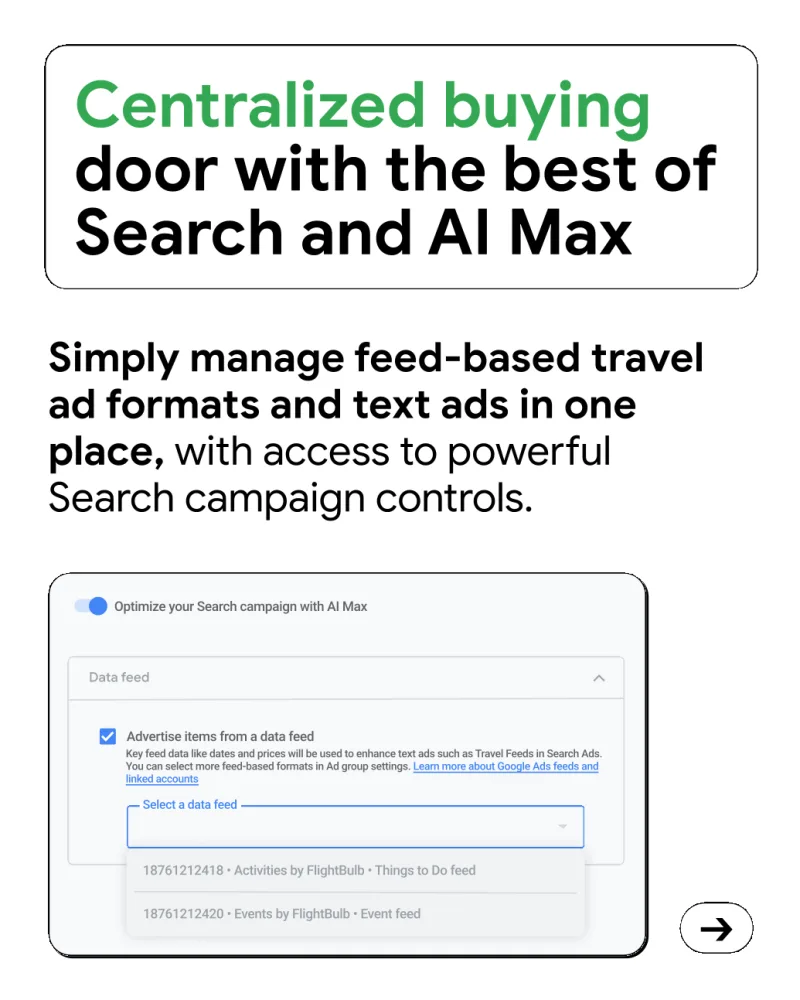
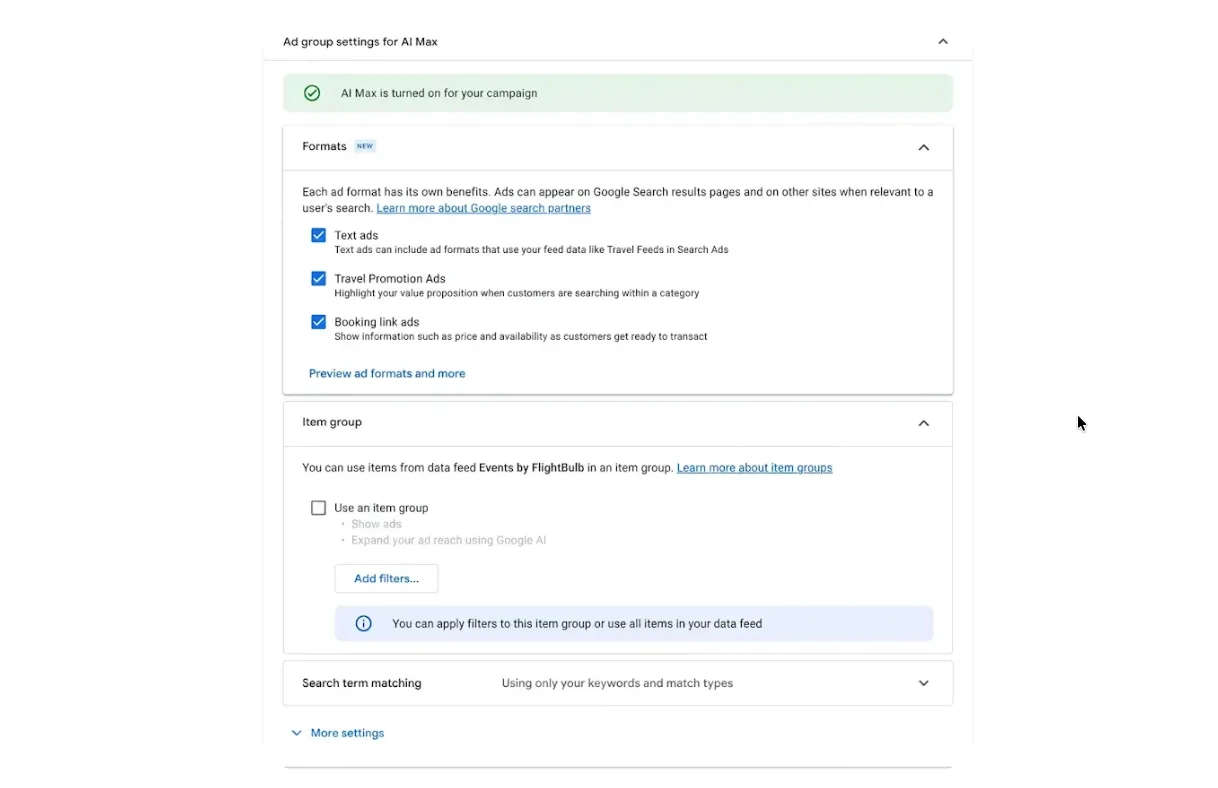
Google is expanding Search campaigns for Travel to an open beta covering the things-to-do and events verticals. The beta adds AI Max features such as search-term matching and item groups, central buying across feed formats and text ads, and unified search-term reporting.
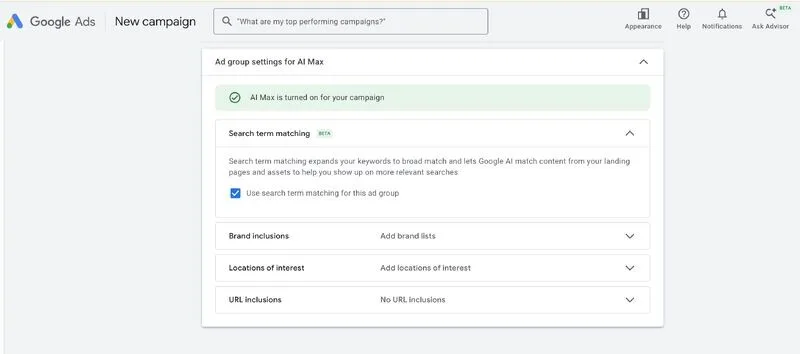
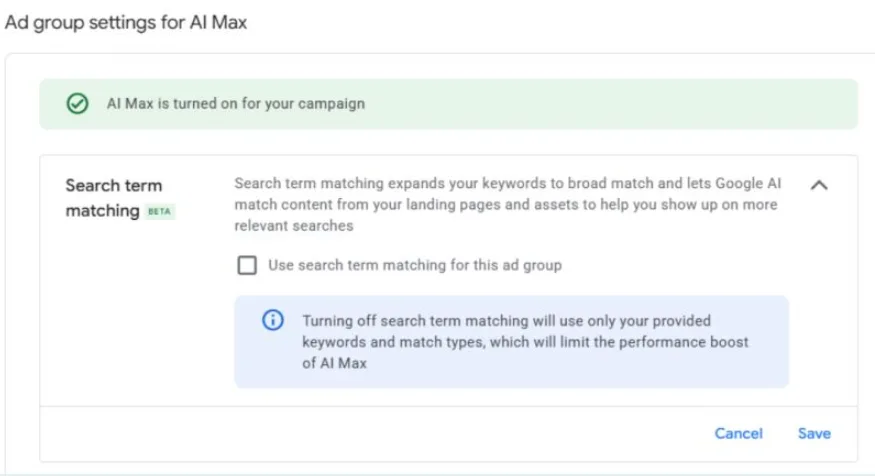
The new AI Max ad group settings now appear when building a Search campaign. They show campaign-level AI Max confirmation and a search-term-matching beta that expands keywords to broad match.
Google has pushed back the automatic migration of Dynamic Search Ads to AI Max from September 2026 to February 2027, as confirmed by Google Ads Liaison Ginny Marvin in response to advertiser feedback requesting more time. The ability to create new DSA campaigns is being restored from 15 June, reversing an earlier phase-out, and Google is adding account-level reporting for final URL expansion alongside a fuller slate of metrics.
Google has revised its Google Ads Terms of Service across the policy, payment, and liability sections, incorporating changes tied to the platform's shift toward AI-driven products. It is the first substantive update to the agreement since April 2018, and it lands alongside this year's wave of AI Max, Performance Max, and AI Mode launches.
Google Ads has given AI Max campaigns a dedicated Branded Searches control, surfaced by Thomas Eccel. Advertisers can now choose exactly how AI Max handles brand queries with three settings: show ads on all relevant searches (the default), control branded searches through brand inclusions and exclusions, or show ads only on unbranded searches.
AI Max for Search Campaigns is officially out of beta and generally available globally as of GML 2026. Helen Gietmann shared practitioner experience from running AI Max across multiple clients: text customisation and Final URL Expansion (FUE) have delivered strong results, while search-term matching has been the more variable component.
AI Brief is the structural new layer in AI Max that lets advertisers steer Gemini's targeting and creative customisation through natural-language guidelines: Messaging Guidelines (what your ads should and shouldn't say, e.g., "never mention prices" or "focus on my fall collection"), Matching Guidelines (which searches to capture or avoid, e.g., "avoid searches for in-person degrees"), and Audience Guidelines (how to tailor messaging for different segments, e.g., "for people who are health conscious, highlight our clean products"). The interface previews sample assets and searches; advertisers iterate the brief until the previewed output matches the intended direction.
Search campaigns for travel bring travel ad formats: Travel Promotion Ads, Booking Links, travel feeds: directly into the Search ecosystem with AI Max. The change consolidates what previously required multiple campaign types into a single buying door for all travel formats, with full access to AI Max's targeting and creative automation and a unified performance view across the SERP.
Three Search-side budget and bidding upgrades land alongside the AI Max GA. Demand-led budget pacing uses Google AI to optimise spend toward consumer demand peaks: capturing more volume on high-demand days and reducing spend on slow days, while respecting daily and monthly limits.
Google has released Google Ads API v24.1 on 13 May, with five practitioner-relevant additions. Mobile Device Platform segmentation lets queries segment campaign and customer reports by iOS or Android: a feature previously requiring workarounds for bid adjustments and OS-level performance analysis.
Google has officially introduced the Site Visits asset for Google Ads. You can see visit metrics in Search, Performance Max, and AI Max ads: boosting both ad performance and credibility by showing past visit volume to the advertised location or website.
Ginny Marvin (Google Ads Product Liaison) has detailed AI Max's URL-targeting capabilities in reply to Gabriele Benedetti's question about parity with DSA campaigns. The clarification corrects the assumption that AI Max lacks landing-page targeting: AI Max does support a combination of URL rule types: URLs, custom labels in page feeds, and URL combo rules: similar to DSA.
Google has launched Search campaigns for Travel, consolidating previously fragmented travel campaign types into a single AI Max-powered workflow. Travel advertisers had been managing different campaign types across separate interfaces: Hotel campaigns, Search ads with travel-specific feeds, and other vertical-specific formats: each with their own setup, reporting and optimisation patterns.
Google has marked AI Max for Search's first anniversary with two practitioner-facing additions. AI Brief is a Gemini-powered control layer that lets advertisers steer AI Max in plain English across three dimensions: Messaging Guidelines (what ads should and should not say, e.g. "never mention prices"), Matching Guidelines (which searches to capture or avoid, e.g. "prioritise searches for healthy pantry staples"), and Audience Guidelines (tailored messages for specific cohorts).
Google has launched AI Max for Shopping, extending the AI Max model from Search into the Shopping campaign type. The system uses Merchant Centre feeds to transform product data into dynamic Shopping ads that answer conversational queries: capturing the long-tail searches that standard Shopping campaigns historically miss because they fall outside literal product keyword matches.
Google has detailed product reporting changes in the Google Ads API for advertisers running upgraded Shopping campaigns. The changes affect how product-level data flows through the API once Shopping campaigns are migrated into Performance Max or AI Max, and adjust the resource model for product segmentation in reporting queries.