Amazon Ads · Status at source date: Seller policy update
Amazon adds insurance requirements for enhanced-safety listings
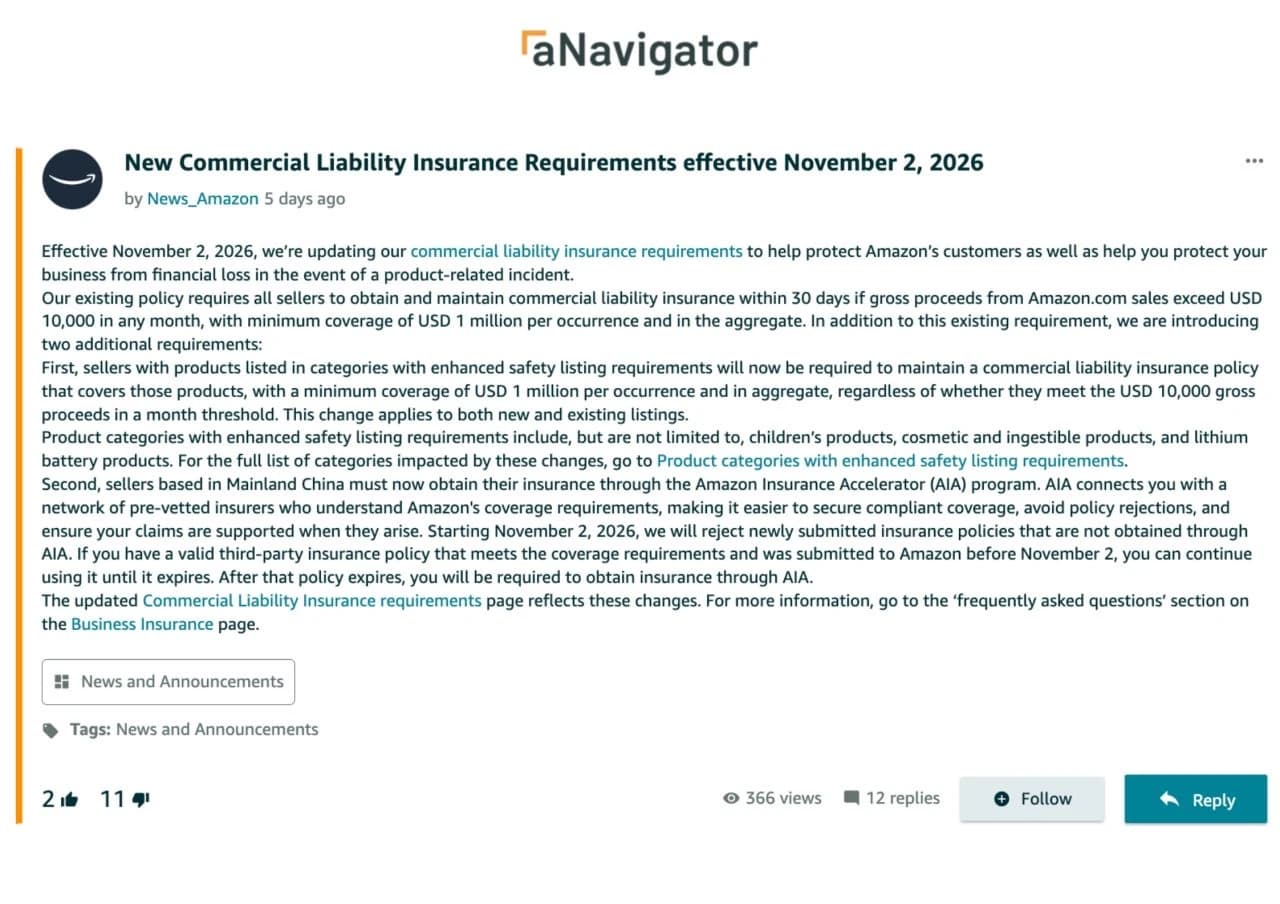
Amazon says sellers with products in enhanced-safety categories must hold USD 1 million in commercial liability cover from 2 November 2026, even if they do not meet the usual monthly sales threshold.
What changed
Amazon says its commercial-liability-insurance requirements will change on 2 November 2026. The familiar threshold remains: sellers must carry commercial liability insurance within 30 days if their Amazon.com gross proceeds exceed USD 10,000 in a month. The change adds a separate obligation for sellers with products in categories subject to enhanced safety-listing requirements. Those sellers must maintain at least USD 1 million of cover per occurrence and in the aggregate, even when they do not cross the sales threshold.
The notice names children’s products, cosmetic and ingestible products, and lithium-battery products as examples of categories that can fall within the enhanced-safety rules. It says the change applies to both new and existing listings. That makes this a catalogue-and-risk-management issue as well as a seller-policy update: an advertised ASIN can lose commercial readiness if its listing category, documentation or insurance position has not been checked.
Amazon also says sellers based in Mainland China must obtain newly submitted policies through Amazon Insurance Accelerator from the effective date. A qualifying third-party policy submitted before 2 November can continue until expiry; after expiry, the seller must use the Accelerator. The notice does not say that every insurance policy in every marketplace is changing, or identify every affected ASIN, so teams should not turn this into a blanket advertising claim.
For paid-media teams, the immediate task is a product-level review. Match planned peak-season ASINs to the affected-category guidance, confirm who owns insurance evidence, and record the cover expiry date. Compare that operational inventory with campaigns, promotions and retail-media budgets. If an offer cannot remain buyable or compliant, treating its previous advertising performance as a basis for additional spend will mislead the plan. Keep the marketplace scope, policy source and effective date attached to the checklist so that local teams can validate their own account notices.
Why it matters for advertisers
Retail teams should match advertised ASINs to affected categories and confirm coverage before committing peak-season spend.
What to check next
- Match promoted ASINs to the enhanced-safety category guidance.
- Confirm the responsible insurance owner, policy value and expiry date.
- Keep spend tied to products that remain buyable and compliant.
Sources & contributor credit
- Official announcementAmazon Seller Central

Original creator unverified
Credits reflect the editor's latest changes. Original authorship has not been independently verified for this version.
Attribution evidence and limitations
Full attribution review pending.
A source link alone does not establish original authorship.
Original image and video creators have not yet been verified.
- Published on this site
- Article updated
This update reflects the dated source reporting. Availability may have changed. Further coverage of this same development will be added to this page.