Meta Ads · Status at source date: Newsletter archive
Choosing an audience per ad creative is rolling out with documentation
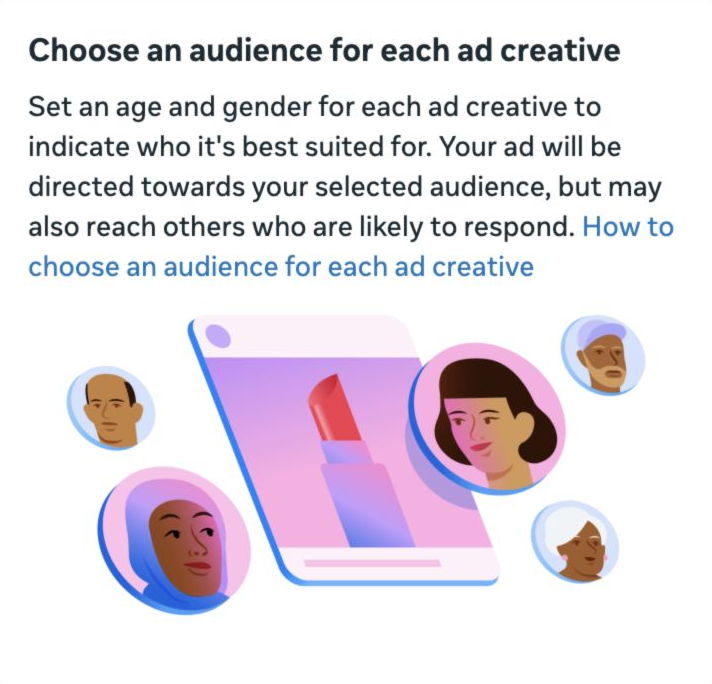
Jon Loomer reports that the ad-level audience option that Bram Van der Hallen spotted as a test in August now appears across every performance goal he tried, with a Meta help page: a toggle at ad-set level further limits reach, after which each creative gets its own age and gender setting. It is on by default for Sales once reach is limited and off for other objectives, and Loomer calls it a rollout rather than a test. One ad set can carry age-specific creative without splitting, so test it on a campaign with clearly segmented offers first.
What changed
Week 43 follow-up: 2026-10-20
Earlier coverage and context (2026-08-24)
Bram Van der Hallen spotted an option to choose age and gender signals for each creative within a single ad set. Meta can still deliver beyond the selected audience when it predicts a better response, so the setting is a signal rather than a strict targeting boundary. For you, this means persona-specific creative can be tested without duplicating ad sets, but compliance-sensitive age or gender restrictions should continue to use hard controls.
What this control does not guarantee
The age and gender choices describe the audience suited to a creative; they are not strict delivery exclusions. Loomer’s screenshots show wording allowing delivery to other people likely to respond. Treat this as creative guidance, not a substitute for any legally required audience restrictions. Availability is still account-dependent.
A practical test
For a retailer with several distinct product uses, keep the offer and conversion objective stable, then compare a consolidated ad set containing tailored creative against the existing structure. Record which images or videos have audience guidance, the settings before publication and the dates of any changes. Evaluate the resulting cost per qualified sale and total sales, rather than treating a higher click-through rate as proof of better business results.
This test addresses a specific operational question: can creative-level guidance replace unnecessary ad-set fragmentation without weakening the commercial outcome? A result from one account cannot establish that demographic guidance will be followed equally in every auction. Preserve the original August observation separately from this October documentation and availability follow-up.
Sources & contributor credit
- Newsletter coverage · Paid Media Collective newsletter
Original newsletter text, contributor labels and media for this update.
- Source referenced in newsletterLinkedIn
Linked from the original newsletter. The source publication date has not been independently confirmed.
- Source referenced in newsletterJon Loomer
Linked in Yoann Ferrand’s published Week 43 newsletter.
- Newsletter coveragePaid Media Collective
Published Week 43 edition; source for the approved credit, image and wording reconciliation.



Original creator unverified
Credits reflect the editor's latest changes. Original authorship has not been independently verified for this version.
Attribution evidence and limitations
Full attribution review pending.
A source link alone does not establish original authorship.
Original image and video creators have not yet been verified.
- Published on this site
- Article updated
This update reflects the dated source reporting. Availability may have changed. Further coverage of this same development will be added to this page.
Original newsletter text and archive evidence
Audience signals can be assigned to individual creatives
Bram Van der Hallen spotted an option to choose age and gender signals for each creative within a single ad set. Meta can still deliver beyond the selected audience when it predicts a better response, so the setting is a signal rather than a strict targeting boundary. For you, this means persona-specific creative can be tested without duplicating ad sets, but compliance-sensitive age or gender restrictions should continue to use hard controls.
Source captured . No explicit first-contributor label was provided for this update.