Google Ads · Status at source date: Documentation update
Google AI-label guidance now lists California, South Korea and Vietnam
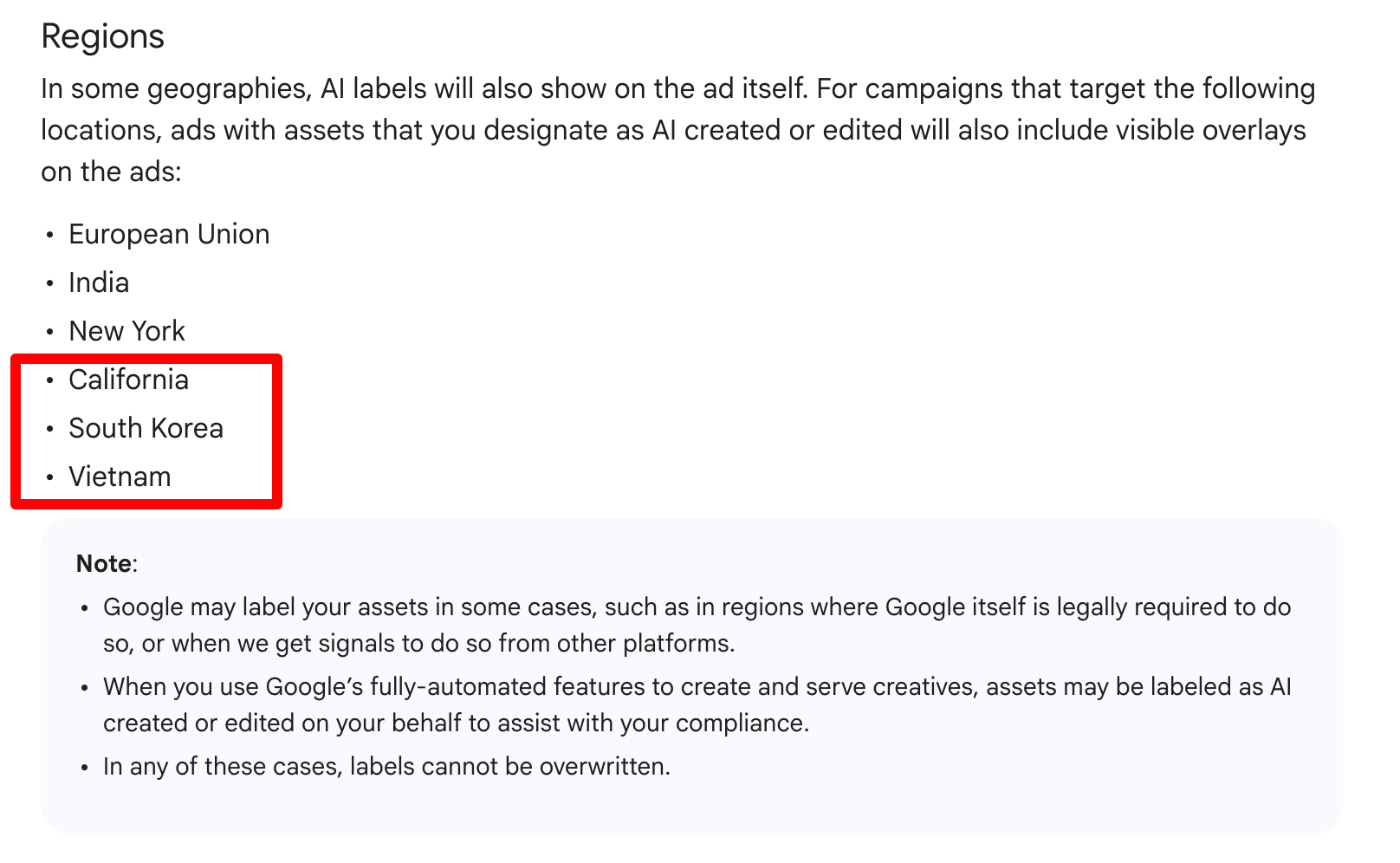
Google’s current AI-label guidance lists California, South Korea and Vietnam alongside the EU, India and New York for visible overlays on ads whose assets are designated as AI-created or edited. My Ad Center disclosure is described separately as global. This is a documentation follow-up, not a claim that every AI-assisted edit requires a label or that a new law began on the report date.
What changed
The current Google Ads help page lists California, South Korea and Vietnam alongside the European Union, India and New York in its regional overlay guidance. For campaigns targeting these places, ads containing assets designated as AI-created or edited can carry a visible disclosure on the ad itself. The page was checked on 6 November 2026; its precise revision date remains unknown.
Google distinguishes these overlays from the global disclosure in My Ad Center. Users can inspect how an ad was made through the ad menu, while the additional visible overlay applies to the listed targeting locations. These are separate presentation surfaces, so an advertiser should not assume that inspecting one establishes what appears in the other.
The documentation also explains that Google may apply labels when required or when receiving relevant signals, including for fully automated creative features. Labels applied in those circumstances cannot be overwritten. Advertiser-controlled settings and automatically applied labels therefore need to be distinguished when reviewing an asset.
For a creative team, the immediate task is to reconcile the asset's production history with its recorded label status. A practical review can group the same creative by destination market and note whether the disclosure is recorded at asset level, visible in My Ad Center or shown directly on the ad. That record is more useful than a single global checkbox saying that an AI review has been completed.
The help page describes label-status columns in asset reporting and the Asset library, as well as prompts during campaign creation. Teams can use those views to identify assets needing a decision and check the available controls. Where the status is automatic, investigate the source of the label rather than repeatedly attempting an unsupported override.
This is a follow-up on Google's documented regional coverage. It is not evidence that a new law began on 5 November, that every minor AI-assisted edit must be labelled, or that a label alone establishes regulatory compliance. Google expressly separates the setting from compliance with specific regulations. Barry Schwartz's 5 November report supplies comparison coverage; Google remains the original source for the current product guidance.
Sources & contributor credit
- Official sourceGoogle
Current Google guidance and region-list screenshot reviewed 6 November. Revision and enforcement dates unknown; no new legal deadline inferred.
- Reported by · Barry Schwartz

Original creator unverified
Credits reflect the editor's latest changes. Original authorship has not been independently verified for this version.
Attribution evidence and limitations
Full attribution review pending.
A source link alone does not establish original authorship.
Original image and video creators have not yet been verified.
- Published on this site
- Article updated
This update reflects the dated source reporting. Availability may have changed. Further coverage of this same development will be added to this page.