LinkedIn Ads · Status at source date: Useful references
LinkedIn Thought Leader Ads: use the guide, then validate the audience in your account
Andrew Hutchinson’s coverage of LinkedIn’s Thought Leader Ads guidance is useful planning material. A separate Kamel Ben Yacoub account observation on audience size should be read as practitioner context, not a universal threshold.
What changed
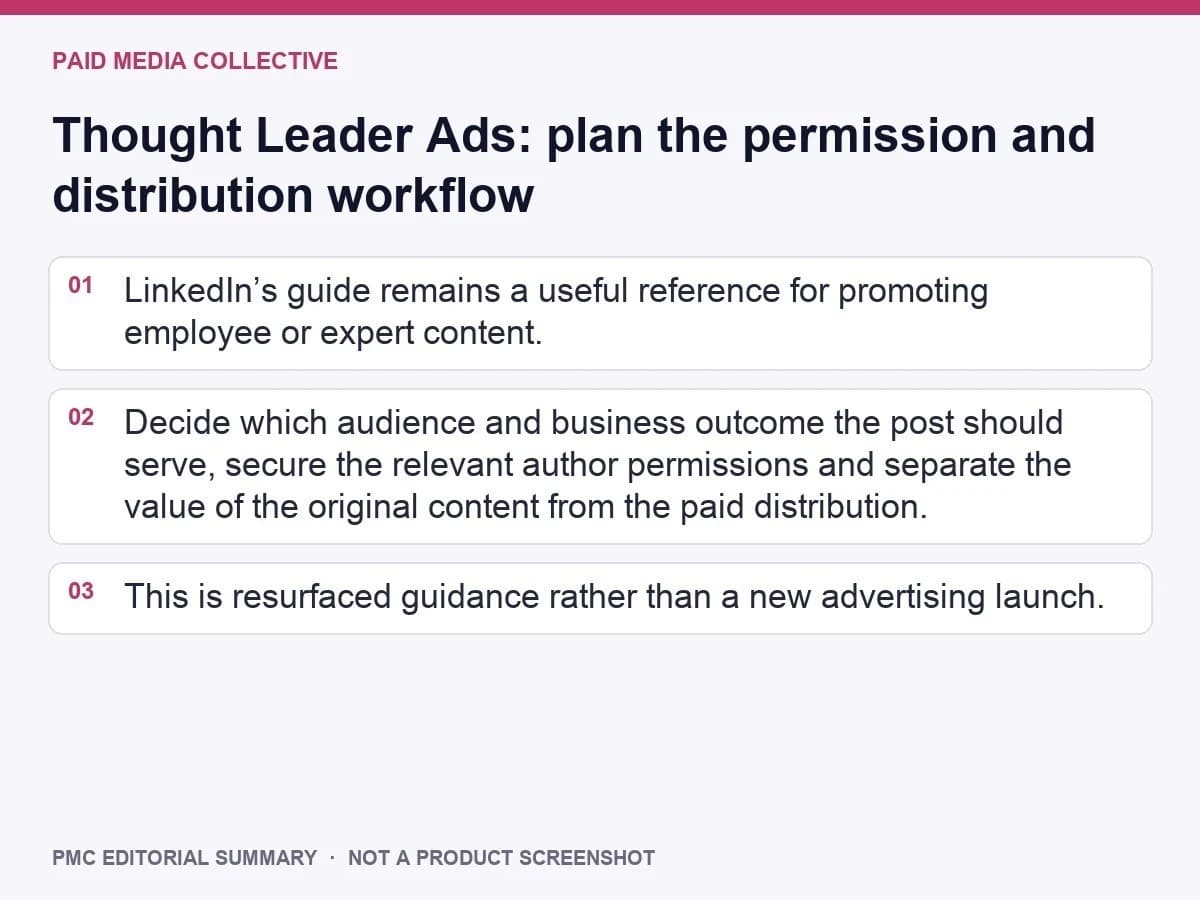
Thought Leader Ads can amplify qualifying member content, but the content owner, permissions, suitability and campaign objective all shape what can be promoted. A reported engagement multiple is not a forecast for a new account, vertical or creative format.
What this update covers
This article records a source-supported paid-media development surfaced by ADworld Experience’s 13–18 September news parade. The evidence supports the specific scope stated here. It does not confirm a universal rollout, a performance outcome or a commercial result beyond the cited material.
How to assess it in your account
Build the candidate-post process first: identify an authentic voice, obtain written permissions, define the claim and audience, and choose the measurement window. Then use projected reach and live delivery diagnostics to assess whether an audience is viable. Do not borrow a single audience-size rule without checking the campaign objective, geography and frequency in your own account. Start by checking the linked original material, including date, market and eligibility. Keep an announcement, an account observation and editorial analysis separate when deciding whether to change a live campaign. Record a baseline before testing so later results can be read against the prior workflow.
Practical next step
Write down one decision this information could improve, one success measure and one guardrail. Test only where the described access and conditions match your account. Keep the source link and its limitations next to any internal recommendation, especially where the source reports a limited observation or a third-party interpretation of platform data.
Source and credit
Andrew Hutchinson is credited for the published guide coverage. Kamel Ben Yacoub is credited for the linked practitioner observation. Their roles are distinct and neither is presented as LinkedIn’s product author. Paid Media Collective’s publication date is separate from the source date. The ADworld list is retained as discovery credit and does not replace the creators or reporters credited below.
Why it matters for advertisers
The cited material can inform a focused account review, but its stated scope and source limitations should shape any decision.
What to check next
- Read the original material and note its stated scope, date and conditions.
- Compare the recommendation or observation with current account evidence before changing a live setup.
- Retain the source link, contributor credit and limitations with the resulting decision.
Sources & contributor credit
- Original source · Andrew Hutchinson, Social Media Today
Published 14 September 2026.
- Original source · Checked Kamel Ben Yacoub account observation
Original source linked by ADworld; original publication date was not independently stated on the source page when checked.
- Newsletter coverage · ADworld Experience Top 10 PPC News-Parade
Discovery and publisher credit. ADworld linked the original sources; it is not treated as the original contributor.


Original creator unverified
The names below are source credits. The original creator and first-reporting priority have not yet been independently verified.
Attribution evidence and limitations
Full attribution review pending.
A source link alone does not establish original authorship.
Original image and video creators have not yet been verified.
- Published on this site
- Article updated
This update reflects the dated source reporting. Availability may have changed. Further coverage of this same development will be added to this page.