Meta Ads · Status at source date: Account observation
Meta adds outcome comparisons to Ads Manager’s activity history
Meta’s activity history is showing performance outcomes alongside account changes, as first reported by Adam Gerber and subsequently shared by Bram Van der Hallen and Sarath Sadanandan.
What changed
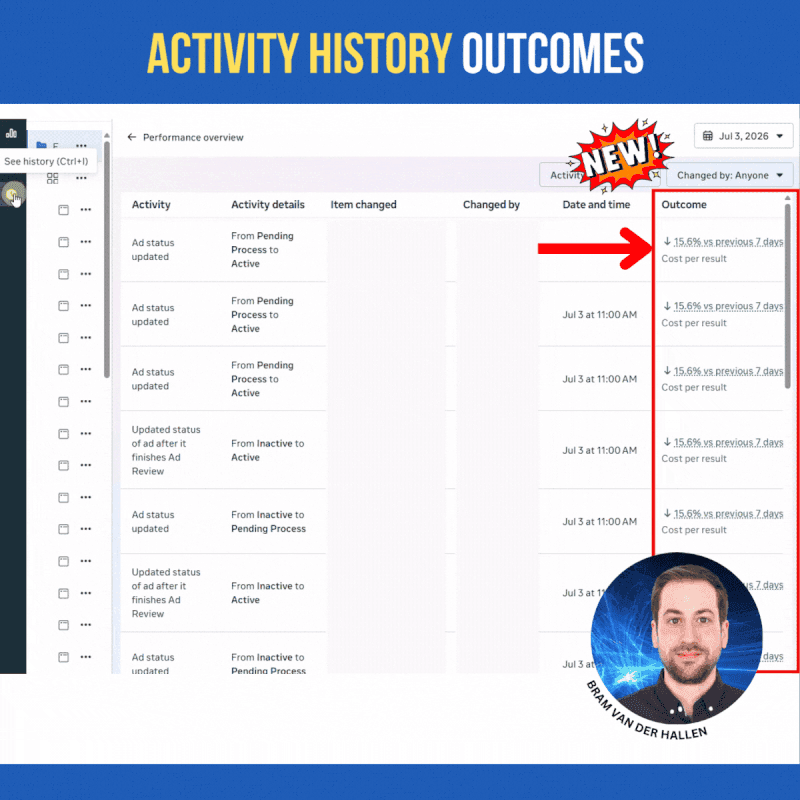
Adam Gerber's source post describes an outcome comparison in Meta's change history and includes a clarification he says he received from Meta: the display compares the seven days before a change with the seven days after it. Bram Van der Hallen subsequently illustrated the Outcome column and explicitly credited Adam for spotting it. The preserved graphic carries Bram's name, so the observation and the additional visual have distinct credits.
The comparison is useful as a starting point for an account investigation. It places a performance movement near a recorded edit, helping a reviewer identify which periods and settings to inspect. It does not isolate the effect of that edit. If several changes occur close together, their before-and-after windows can overlap; an improvement displayed beside each row is not evidence that every row independently produced the same gain.
A practical example is an account where new creative and a promotion launch during the same week. A lower cost per result after a status change may be consistent with better creative, the offer, a shift in demand or a combination of factors. The display alone cannot distinguish those explanations. That is why Adam's clarification matters more to interpretation than the visual's attention-grabbing new-feature label. The observed interface also does not establish universal account availability.
Why it matters for advertisers
The benefit is quicker investigation and a clearer connection between the optimisation log and reporting periods. It can help teams ask better follow-up questions, especially when reviewing an unfamiliar account. Use it to select a change worth examining, then decide whether the available evidence is enough for a practical judgement or whether an experiment is needed before repeating the action at scale.
What to check next
- For a material change, inspect the metric and the two seven-day windows shown rather than reporting only the percentage movement.
- Review other edits, promotions and delivery changes inside those windows and note plausible alternative explanations.
- Use controlled testing for a causal claim. In account notes, label an ordinary before-and-after comparison as directional evidence.
Sources & contributor credit
- Newsletter coverage · Paid Media Collective newsletter
Original newsletter text, contributor labels and media for this update.
- Original source · Checked LinkedIn: original observation
Linked and credited in issue 229. The newsletter text was reviewed for this summary; the original publication date is not independently established here. LinkedIn: original observation | LinkedIn: Bram Van der Hallen • 2 September 2026
- Source referenced in newsletterLinkedIn: Bram Van der Hallen
Linked from the original newsletter. The source publication date has not been independently confirmed.
- Source referenced in newsletterLinkedIn: original observation
Linked from the original newsletter. The source publication date has not been independently confirmed.


Original creator unverified
Adam Gerber is the original observer credited by Bram and supplies the clarification. Bram Van der Hallen is the additional commentator and visibly credited graphic creator. Relative source order supports that chain, without asserting global priority.
Attribution evidence and limitations
Read Adam Gerber’s complete cached post including the Meta clarification, and Bram Van der Hallen’s complete post including his explicit Adam credit. Duplicate slash and non-slash URLs contain the same Adam post. Inspected the attached branded graphic. No independent Meta help page or live account test is claimed.
All original source and contributor URLs retained. Original archive and publication metadata preserved. Any source access limitation is stated in sourceReview.
Viewed meta-ads-activity-history-outcome-comparisons.png. The graphic visibly credits BRAM VAN DER HALLEN beneath his portrait and highlights the Outcome column. Its July 3 interface date is an example account-history date, not a newly inferred article publication date.
- Archived newsletter text compared; not a fresh newsletter-page review.
- Read Adam Gerber’s complete cached post including the Meta clarification, and Bram Van der Hallen’s complete post including his explicit Adam credit. Duplicate slash and non-slash URLs contain the same Adam post. Inspected the attached branded graphic. No independent Meta help page or live account test is claimed.
- Read Adam Gerber’s complete cached post including the Meta clarification, and Bram Van der Hallen’s complete post including his explicit Adam credit. Duplicate slash and non-slash URLs contain the same Adam post. Inspected the attached branded graphic. No independent Meta help page or live account test is claimed.
- Read Adam Gerber’s complete cached post including the Meta clarification, and Bram Van der Hallen’s complete post including his explicit Adam credit. Duplicate slash and non-slash URLs contain the same Adam post. Inspected the attached branded graphic. No independent Meta help page or live account test is claimed.
Attribution checked . This is a review date, not the original publication date.
- Published on this site
- Article updated
This update reflects the dated source reporting. Availability may have changed. Further coverage of this same development will be added to this page.
Original newsletter text and archive evidence
Meta adds outcome comparisons to Ads Manager’s activity history
Meta’s activity history is showing performance outcomes alongside account changes, as first reported by Adam Gerber and subsequently shared by Bram Van der Hallen and Sarath Sadanandan. Gerber says Meta clarified that it compares the seven days before a change with the seven days after, providing a directional signal rather than evidence that the change caused the outcome. For you, this means using the comparison to guide investigation while retaining controlled tests for causal conclusions.
Source captured . First-contributor labels follow the newsletter’s explicit wording.