Google Ads · Status at source date: Newsletter archive
Performance Max creative edits gain one-click experiments
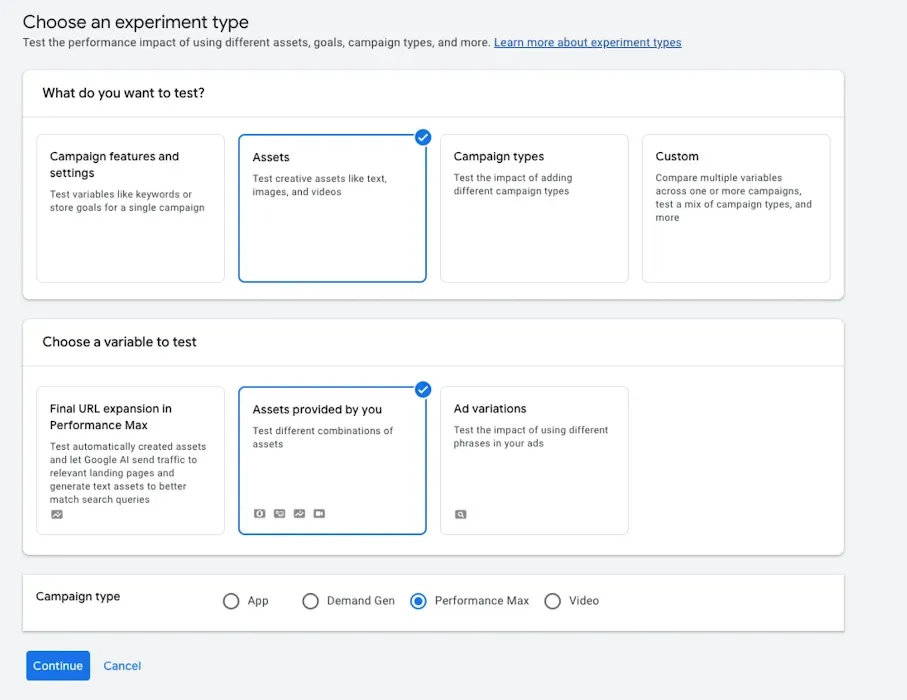
Google has documented a “Save and Set Experiment” option that turns a Performance Max ad or asset-group edit into an A/B test while retaining the previous version as a holdback. The same release adds creative diagnostics in Ask Advisor and AI-led fixes for issues such as logo placement, video trimming, and aspect-ratio coverage in Demand Gen.
What changed
Google's creative-experimentation announcement describes a Save and Set Experiment option for Performance Max ad or asset-group edits. It says the workflow retains a holdback of the previous version while applying the proposed change as a structured A/B test. The same announcement also describes asset diagnostics in Ask Advisor and suggested creative fixes in Demand Gen, but those are separate capabilities from the experiment workflow.
The benefit of easier setup is strongest when the team already knows what it wants to learn. A new image treatment, revised proposition or more complete aspect-ratio coverage are different hypotheses. Changing several of them at once may answer whether the combined replacement works better, while leaving the contribution of each part unclear. That can still be useful if the real decision is whether to adopt the whole package, provided the test is described honestly.
The announcement uses strong language about measuring performance lift but does not supply every design setting, eligibility rule or decision threshold. Check those details in the actual experiment before launch. A control is valuable, yet it does not make an underpowered, interrupted or prematurely judged test conclusive. The result also needs a business metric that fits the change; an improvement in engagement may not settle a decision whose purpose is profitable acquisition.
Why it matters for advertisers
Reducing experiment setup work can make creative learning a more regular part of optimisation. The practical discipline is to define the question before clicking save, record what differs between versions and agree when the evidence will be reviewed. Use diagnostics to identify candidates for a test, while keeping their suggested explanations separate from the experiment's eventual findings.
What to check next
- Write the creative hypothesis and specify whether the decision concerns one change or a combined asset-group revision.
- Check the available holdback, allocation and duration settings, then choose the primary business outcome before starting.
- Avoid unrelated edits during the study where possible and assess the completed result with its uncertainty before rolling out the winning version.
Sources & contributor credit
- Newsletter coverage · Paid Media Collective newsletter
Original newsletter text, contributor labels and media for this update.
- Source referenced in newsletterGoogle Accelerate
Linked from the original newsletter. The source publication date has not been independently confirmed.

Original creator unverified
Google is the original announcement publisher. The provided body does not identify an individual author or visual creator. No attribution is invented.
Attribution evidence and limitations
Read the complete cached Google announcement body, including all three capability descriptions. Compared with the newsletter archive. No experiment was created, and no animation or product demonstration was played. The source does not establish the full experiment configuration.
Original URLs, archive, dates and existing contributor profile links retained. Historical access is distinguished from present account availability.
No newsletterVisuals or sourceVisuals are attached to this record. The source includes an animation control, but the animation was not played or represented as reviewed evidence.
- Archived newsletter text compared; no fresh newsletter page review claimed.
- Read the complete cached Google announcement body, including all three capability descriptions. Compared with the newsletter archive. No experiment was created, and no animation or product demonstration was played. The source does not establish the full experiment configuration.
Attribution checked . This is a review date, not the original publication date.
- Published on this site
- Article updated
This update reflects the dated source reporting. Availability may have changed. Further coverage of this same development will be added to this page.
Original newsletter text and archive evidence
Performance Max creative edits gain one-click experiments
Google has documented a “Save and Set Experiment” option that turns a Performance Max ad or asset-group edit into an A/B test while retaining the previous version as a holdback. The same release adds creative diagnostics in Ask Advisor and AI-led fixes for issues such as logo placement, video trimming, and aspect-ratio coverage in Demand Gen. For you, this means creative changes can be evaluated against a control with less setup, but traffic splits, duration, and success metrics should still be agreed before the edit is applied.
Source captured . No explicit first-contributor label was provided for this update.