Google Ads · Status at source date: Documentation update
Asset Studio can prefill Performance Max asset groups
Google has documented a way to prefill Performance Max asset groups with material generated in Asset Studio, including headlines, descriptions, images and videos.
What changed
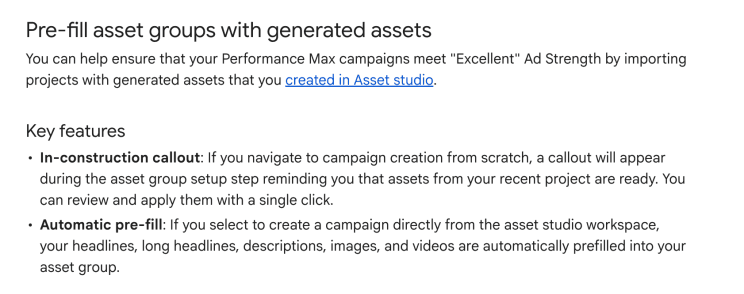
Google's help page describes two entry points for using an existing Asset Studio project. Starting a campaign from scratch can surface a reminder during asset-group setup that a recent project's material is available to review and apply. Starting campaign creation inside Asset Studio instead prefills the group's headlines, long headlines, descriptions, images and videos. Barry Schwartz reported the documentation change at Search Engine Roundtable; the underlying instructions are Google's.
The useful distinction is between moving approved work into a campaign and deciding whether that work is suitable for the campaign. Prefill addresses the transfer step. It does not establish that a product image is accurate, that an offer remains valid, or that every generated line can safely be combined with every other asset. Google's broader guidance describes an asset group as a collection whose components may be assembled together, so coherence within the group matters.
For example, a retailer reusing a project for a seasonal range should check whether its destination, prices and promotion language still match that range. An otherwise attractive headline about a discount could become misleading alongside imagery for an excluded product. That is an illustrative approval risk, not a defect reported in the new feature. The cited update also provides no measured setup-time saving or evidence of improved sales. Treat the promised convenience as something to assess in your own production process.
Why it matters for advertisers
The main opportunity is a shorter handoff between creative preparation and campaign assembly. A team can keep a small checklist at that handoff and measure how much manual re-entry it avoids. An Ad Strength assessment can help identify missing creative coverage, but it should sit alongside the team's own checks of accuracy, brand fit and business results.
What to check next
- Choose the project whose products, language and offer match the intended asset group, then inspect what actually carries across.
- Preview combinations of text and imagery and check the final URL before approving the group. Record edits needed after prefill to judge the workflow benefit.
- Compare production effort and subsequent campaign outcomes separately; faster assembly alone is not evidence of better advertising.
Sources & contributor credit
- Newsletter coverage · Paid Media Collective newsletter
Original newsletter text, contributor labels and media for this update.
- Source referenced in newsletterGoogle Ads Help
Linked from the original newsletter. The source publication date has not been independently confirmed.
- Source referenced in newsletterSearch Engine Roundtable
Linked from the original newsletter. The source publication date has not been independently confirmed.

Original creator unverified
Google is the source of the product instructions. The retained Search Engine Roundtable byline identifies Barry Schwartz as the reporting author. No evidence establishes first-reporting priority or the screenshot maker.
Attribution evidence and limitations
Read the complete accessible article-body extracts of https://support.google.com/google-ads/answer/10724748?hl=en and https://www.seroundtable.com/google-ads-pre-fill-asset-groups-41993.html. Compared them with the archived newsletter text. These are cached historical sources, not an account-level test or a confirmation of present availability.
Retained every original source and contributor profile URL. Read the linked source bodies listed in sourceReview; newsletter provenance remains the archived capture. No claim that every destination currently resolves.
Viewed the actual local PNG asset-studio-prefill-performance-max-asset-groups.png. It reproduces the Google help section and its two entry points. No personal name, signature or watermark is visible. Credit the underlying documentation to Google; the screenshot maker is not identified.
- Cached source body read individually and compared with this record; retrieval date and original paths remain in assigned.json.
- Cached source body read individually and compared with this record; retrieval date and original paths remain in assigned.json.
Attribution checked . This is a review date, not the original publication date.
- Published on this site
- Article updated
This update reflects the dated source reporting. Availability may have changed. Further coverage of this same development will be added to this page.
Original newsletter text and archive evidence
Asset Studio can prefill Performance Max asset groups
Google has documented a way to prefill Performance Max asset groups with material generated in Asset Studio, including headlines, descriptions, images and videos. Advertisers can reuse assets from a recent project when creating campaigns, reducing the amount of content that needs to be transferred manually. For you, this means a shorter setup process, with a final review of product accuracy, brand wording and creative suitability before launch.
Source captured . No explicit first-contributor label was provided for this update.