Microsoft Advertising · Status at source date: Announcements
Microsoft Advertising makes optimisation experiments generally available
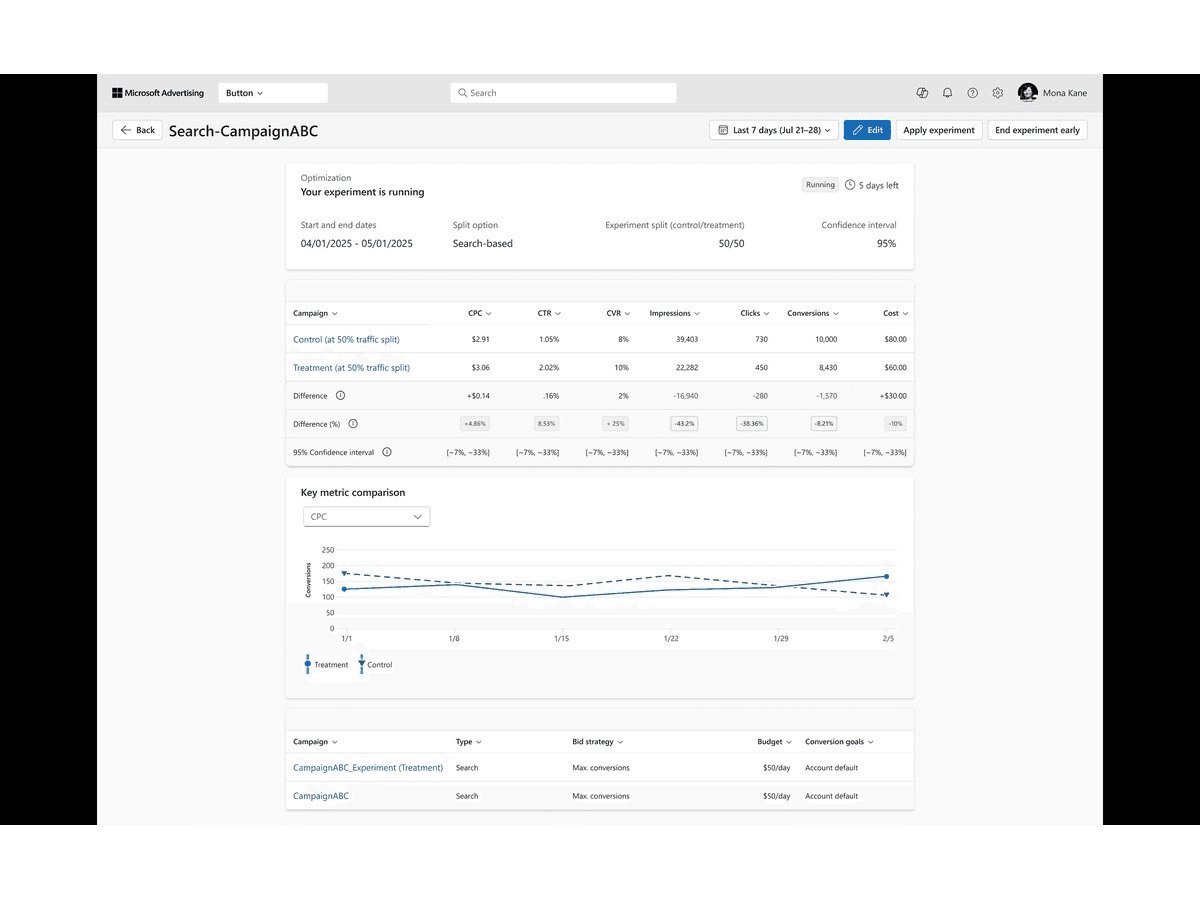
Microsoft says optimisation experiments are generally available for Search, Shopping, Audience and Performance Max, with control and treatment traffic splits.
What changed
Microsoft confirmed on 30 September that optimisation experiments are generally available for Search, Shopping, Audience and Performance Max campaigns. Each experiment splits budget and traffic between a control and a treatment, and a winning change can be applied to the original campaign.
General availability resolves earlier uncertainty
Week 39 treated the capability as documentation with an unresolved launch date. Microsoft’s 30 September post supplies the missing confirmation of general availability. That date relates to Microsoft’s confirmation, rather than necessarily identifying the first day any account could see the function.
This is stronger evidence than an isolated account control or undated help page. It still does not establish that every campaign will meet all eligibility conditions or that experiments guarantee an actionable result.
Keep the first hypothesis narrow
Microsoft says advertisers can test four bid or creative changes within the same traffic. The capacity to include several changes does not remove the need for interpretable design. If unrelated bid and creative changes are bundled, the treatment may win without revealing which decision should be repeated elsewhere.
Editorial suggestion: begin with one business hypothesis, one primary success measure and one principal difference between control and treatment. Record guardrails such as cost, lead quality or revenue where relevant. Use the broader four-change capacity only when the combined package itself is the decision being tested.
From experiment to implementation
Before applying a winning treatment, check whether promotions, seasonality, tracking changes or other external conditions shifted during the run. Confirm that the measured outcome matches the campaign’s business objective rather than relying on a convenient proxy alone.
The ability to apply a result to the original campaign is a workflow feature, not proof that performance will persist after the test. Preserve the experiment dates, settings and result so the later campaign can be compared with the conditions under which the treatment won.
Where the result is inconclusive, do not force a winner merely because the tool permits application. Revisit the hypothesis, detectable difference and stability of the test conditions.
Why it matters for advertisers
General availability gives Microsoft advertisers a structured way to compare bid or creative changes without relying only on before-and-after trends, provided the test remains interpretable.
What to check next
- Define one business hypothesis, primary success measure and relevant guardrails before launch.
- Keep the principal treatment difference narrow, even though the workflow supports several changes.
- Review external conditions and business relevance before applying a winning treatment.
Sources & contributor credit
- Original sourceMicrosoft Advertising Blog
Source cited in the published Week 40 newsletter. Article observation/reporting date is shown separately; this page’s original publication date is not inferred.
- Reporting or practitioner sourceSearch Engine Roundtable
Source cited in the published Week 40 newsletter. Article observation/reporting date is shown separately; this page’s original publication date is not inferred.
- Newsletter coverage · Paid Media Collective Week 40
Published edition used for story selection, copy, source credits and media; curation is distinct from original authorship.
Original creator unverified
Contributor roles follow the published newsletter and its linked evidence. Reporting, official discussion and visual authorship are kept separate; no independently unverified first-reporting priority is awarded.
Attribution evidence and limitations
Published story and credit line reconciled with the expanded article.
Original post, primary documentation and secondary reporting links retained.
Visible image content inspected for story relevance; image credit retained separately from reporting credit.
Attribution checked . This is a review date, not the original publication date.
- Published on this site
- Article updated
This update reflects the dated source reporting. Availability may have changed. Further coverage of this same development will be added to this page.