Google Ads · Status at source date: Correction
Google Smart Bidding guidance returns to one-to-two conversion cycles
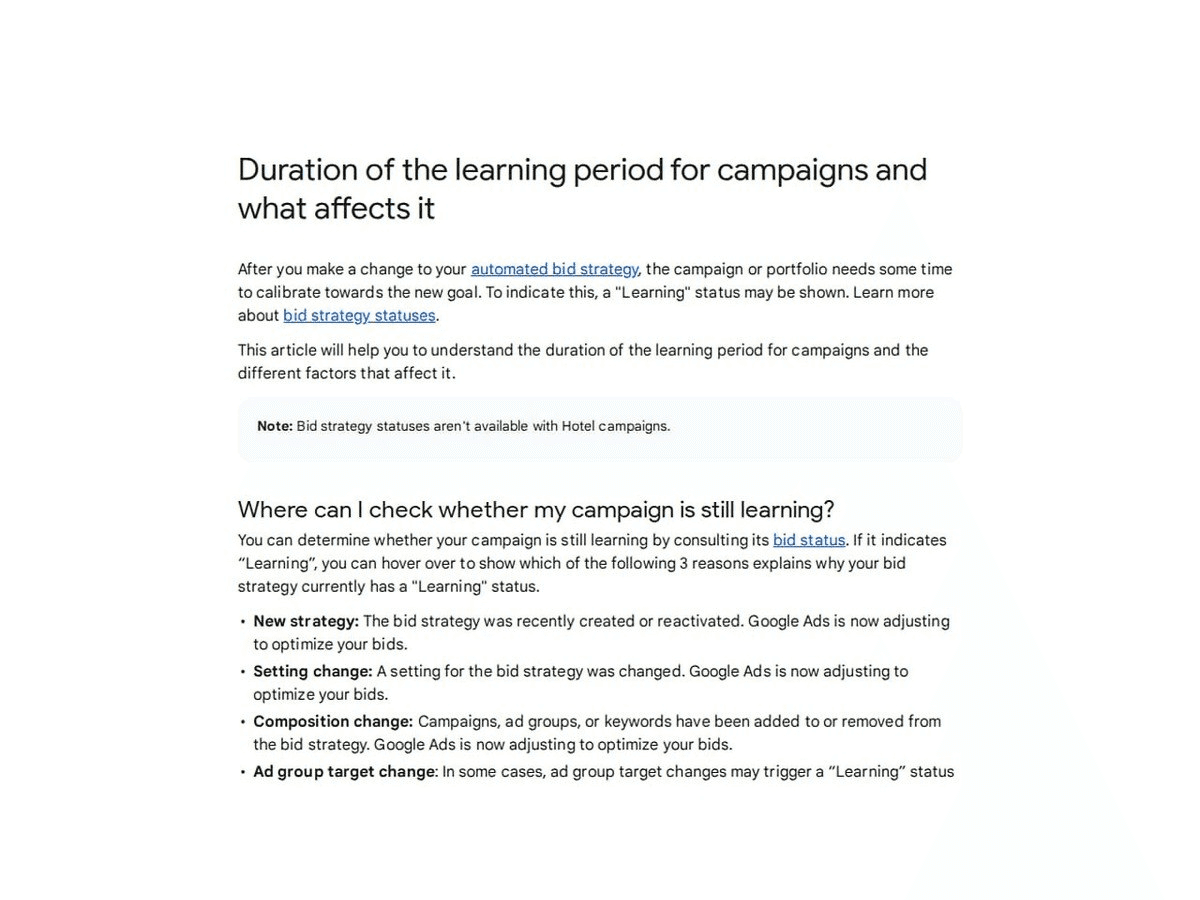
Google’s Smart Bidding page has returned to a typical one-to-two conversion-cycle learning period after briefly referring to roughly 50 conversion events.
What changed
Google’s current Smart Bidding guidance describes learning as taking “1-2 typically” in relation to conversion cycles, according to PPC News Feed’s report of the reverted page. This corrects the Week 39 account, which said Google’s guidance described one to two conversion cycles rather than 50 conversions. That interpretation was already inaccurate when published because Google had changed the wording on 22 September.
What changed and when
Search Engine Land reported that Google changed the page on 22 September to say learning could take “up to roughly 50 conversion events or three conversion cycles”. PPC News Feed later reported that the page had returned to “1-2 typically”. The Performance Max note cited previously also no longer appears. The dates describe different states of Google’s documentation, rather than two compatible rules: 22 September relates to the introduction of the roughly 50-event wording, while the 4 October report concerns its subsequent removal.
The earlier figure should therefore not be presented as Google’s current recommendation. Nor does the reverted wording prove that every campaign completes learning within two cycles. The sources document changes to a help page, not observed stabilisation across a representative set of campaigns.
An editorial test for campaign reviews
Editorial suggestion: define the account’s conversion cycle before selecting a review date. Record the typical interval between an ad interaction and the measured conversion, together with the attribution setting and the date of any material campaign change. A campaign with a long decision process should not be judged on the same calendar timetable as one with rapid conversions.
Use a change log to separate adjustments to bids, budgets, targeting and measurement. If several variables move during the same review window, a later performance change cannot confidently be attributed to Smart Bidding learning. The useful comparison is between equivalent periods containing complete conversion cycles, not progress towards a universal conversion count.
How to use the guidance
Check the live Google Ads Help wording when planning a test or explaining learning status. Treat the documentation as a planning reference and combine it with the account’s own lag and change history. Do not use either the removed 50-event formulation or the current typical range as a guarantee of an individual campaign’s outcome.
Why it matters for advertisers
Using a superseded 50-conversion benchmark could delay decisions or create false confidence about campaign readiness. Cycle-based planning better reflects differences in conversion lag, but it still requires account-level evidence and does not guarantee stabilisation.
What to check next
- Document each campaign’s conversion cycle, attribution setting and recent material changes.
- Check the current Google Ads Help wording before scheduling a learning-period read-out.
- Run review windows without simultaneous bid, budget, targeting and measurement changes where practicable.
Sources & contributor credit
- Original sourceGoogle Ads Help
Source cited in the published Week 40 newsletter. Article observation/reporting date is shown separately; this page’s original publication date is not inferred.
- Reporting or practitioner sourcePPC News Feed
Source cited in the published Week 40 newsletter. Article observation/reporting date is shown separately; this page’s original publication date is not inferred.
- Reporting or practitioner sourceSearch Engine Land (22 September)
Source cited in the published Week 40 newsletter. Article observation/reporting date is shown separately; this page’s original publication date is not inferred.
- Newsletter coverage · Paid Media Collective Week 40
Published edition used for story selection, copy, source credits and media; curation is distinct from original authorship.

Original creator unverified
Contributor roles follow the published newsletter and its linked evidence. Reporting, official discussion and visual authorship are kept separate; no independently unverified first-reporting priority is awarded.
Attribution evidence and limitations
Published story and credit line reconciled with the expanded article.
Original post, primary documentation and secondary reporting links retained.
Visible image content inspected for story relevance; image credit retained separately from reporting credit.
Attribution checked . This is a review date, not the original publication date.
- Published on this site
- Article updated
This update reflects the dated source reporting. Availability may have changed. Further coverage of this same development will be added to this page.