Google Ads · Status at source date: Documentation
AI Max guidance explains one-click tests and ad-group controls
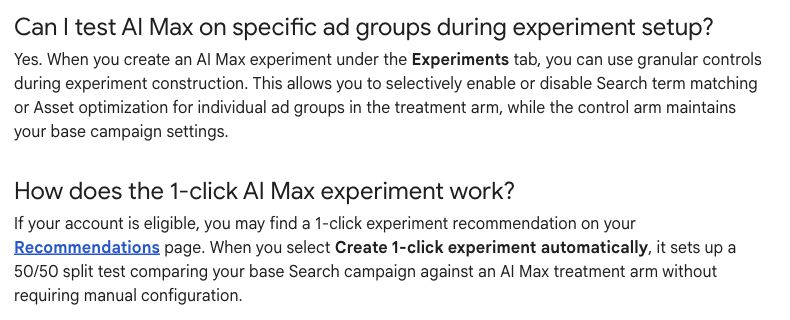
Google’s AI Max documentation describes eligible-account prompts for 50/50 experiments and treatment-arm controls at ad-group level.
What changed
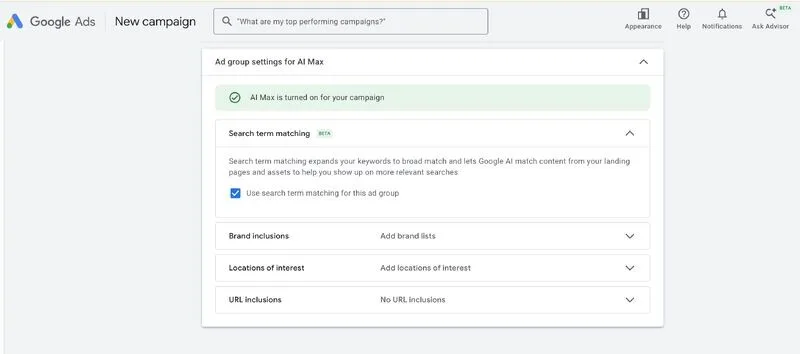
What the evidence shows: Google’s AI Max FAQ says eligible accounts may receive a Recommendations prompt to create a one-click experiment. The documentation describes a 50/50 split between a base Search campaign and an AI Max treatment. It also says Experiments can selectively enable or disable Search term matching or Asset optimisation for treatment-arm ad groups, while the control retains the base settings. The guidance is undated, so it does not establish that these controls launched in October or were newly introduced this week. It is documentation reference material, not launch confirmation.
PMC advertiser perspective: this is most useful as a way to frame a test question. Rather than asking whether AI Max is broadly “better”, an advertiser can identify which configuration is being compared and whether the comparison preserves a meaningful control. The documented setup could help teams separate campaign-level treatment effects from choices made for individual ad groups.
A hypothetical example: a retailer has Search ad groups for branded products, generic category searches and high-margin accessories. It could use the documented experiment structure, where available, then review whether search-term matching or asset optimisation is switched differently for the treatment ad groups. The test plan should specify what counts as success before launch, such as profitable orders, new-customer contribution or valid lead quality. It should also state exclusions and the minimum observation period appropriate to its traffic pattern.
Proposed checks include confirming account eligibility, reading the experiment setup screen before accepting defaults, and saving a record of the base campaign’s settings. Teams should check whether budget, conversion goals, locations, brand settings and measurement definitions remain comparable enough for the decision they want to make. They should review search-term patterns and landing-page relevance, not only top-line conversion volume. Where a result differs, diagnose whether the difference is plausibly due to the documented AI Max treatment or to another concurrent change.
This guidance complements, rather than replaces, existing coverage of cross-campaign budget and return-target experiments. It should be read as practical documentation for base-versus-treatment testing and ad-group controls, with the availability and recency of individual controls left unconfirmed.
Why it matters for advertisers
The documentation gives advertisers a clearer framework for evaluating AI Max experiments without treating it as evidence of a new October product launch.
What to check next
- Confirm whether the one-click experiment prompt is available in the account.
- Document base settings and treatment-arm changes before starting a test.
- Set business outcome criteria before reviewing experiment results.
Sources & contributor credit
- Official SourceGoogle
Undated official documentation. Google is the source organisation; no named documentation author established.
- Discovery source · PPC News Feed
PPC News Feed 17 October explicitly credits Hana Kobzová as documentation spotter; original spotting post and priority unverified.
- Related coveragePaid Media Collective: earlier related coverage
Live article compared 17 October. Different scope: cross-campaign budget/return-target experiments. Retain this as a separate undated practical reference, not a launch claim.


Original creator unverified
Credits reflect the editor's latest changes. Original authorship has not been independently verified for this version.
Attribution evidence and limitations
Full attribution review pending.
A source link alone does not establish original authorship.
Original image and video creators have not yet been verified.
- Published on this site
- Article updated
This update reflects the dated source reporting. Availability may have changed. Further coverage of this same development will be added to this page.