Apple Ads · Status at source date: Newsletter archive
AI monthly sessions are now 56% the size of search worldwide
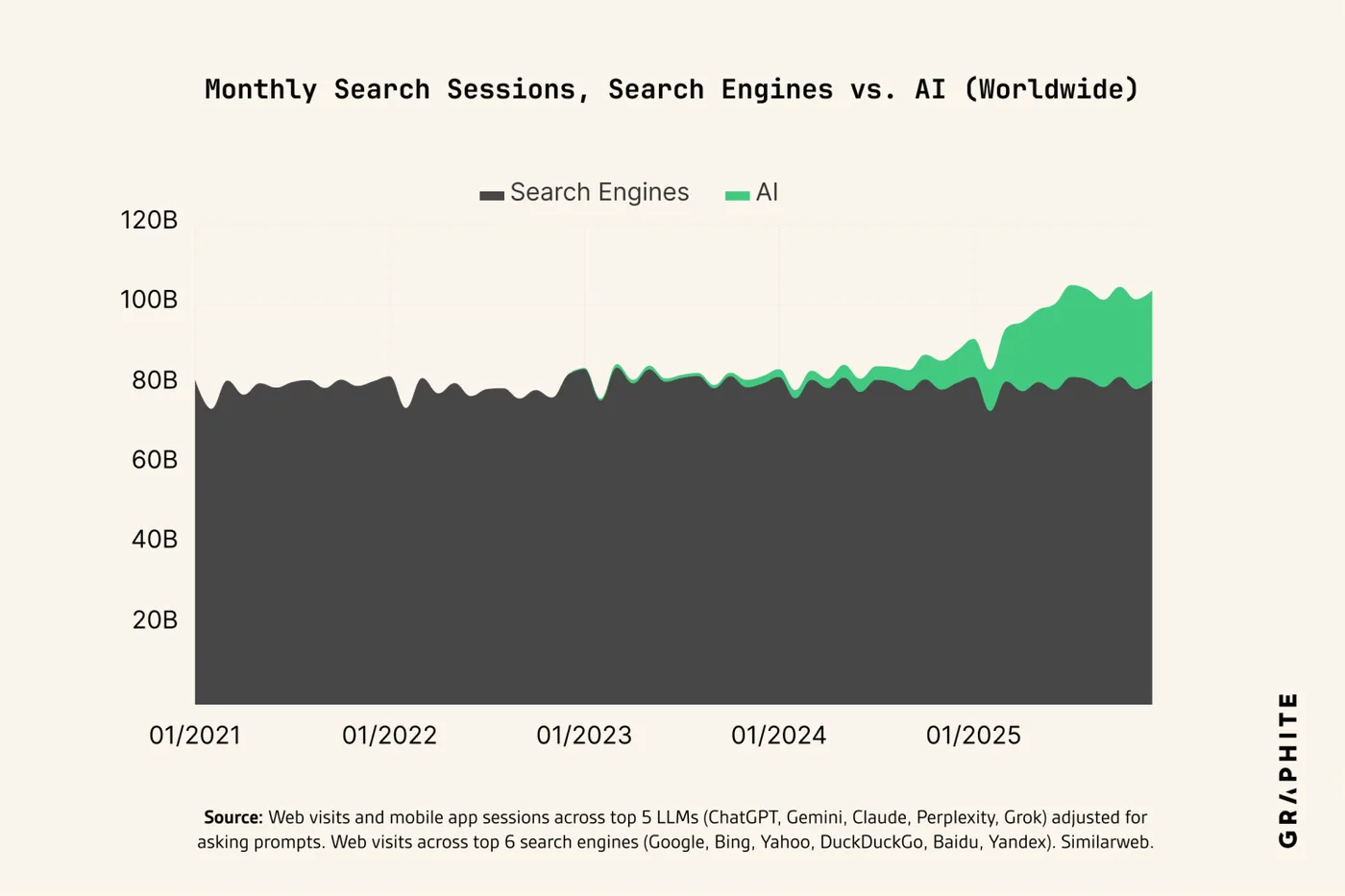
New research from Graphite.io, published this week, overturns the conventional view that AI usage data: typically drawn solely from web traffic: provides the full picture. Combining web visits and mobile app sessions across the top five LLM products (ChatGPT, Gemini, Perplexity, Grok, and Claude), the study finds that AI now receives 45 billion monthly sessions worldwide, equivalent to 56% of search engine sessions globally and 34% in the US.
What changed
The most striking methodological finding is that previous studies missed 83% of AI usage, which occurs in mobile apps rather than on the web, making web-only comparisons with Google systematically understated by a factor of 4 to 5. ChatGPT alone now holds a 20% share of global search-related traffic (asking prompts only), with Google's search market share falling from 89% in 2023 to 71% by Q4 2025 worldwide.
Critically, the research finds that search volume has not declined: the pie has grown. Total search usage across search engines and AI combined increased by 26% worldwide, from Q1 2023 to Q4 2025. AI is incrementally growing in demand rather than cannibalising existing search traffic.
Why it matters for advertisers
For you, this means budget allocation decisions should reflect AI search as a distinct and growing discovery surface, not a Google substitute: and channel strategy should evolve to include visibility in AI-cited content rather than relying solely on traditional SERP rankings.
Perspective from the original PMC newsletter.Sources & contributor credit
- Newsletter coverage · Paid Media Collective newsletter
Original newsletter text, contributor labels and media for this update.
- Source referenced in newsletterGraphite.io,
Linked from the original newsletter. The source publication date has not been independently confirmed.
- Source referenced in newsletterGraphite.io
Linked from the original newsletter. The source publication date has not been independently confirmed.

Newsletter curated by Yoann Ferrand. The earliest individual contributor has not been verified for this update.
Original creator unverified
The original creator has not yet been verified. Newsletter curation and publication do not establish original authorship.
Attribution evidence and limitations
Full attribution review pending.
A source link alone does not establish original authorship.
Original image and video creators have not yet been verified.
- Published on this site
This update reflects the dated source reporting. Availability may have changed. Further coverage of this same development will be added to this page.
Original newsletter text and archive evidence
AI monthly sessions are now 56% the size of search worldwide
New research from Graphite.io, published this week, overturns the conventional view that AI usage data: typically drawn solely from web traffic: provides the full picture. Combining web visits and mobile app sessions across the top five LLM products (ChatGPT, Gemini, Perplexity, Grok, and Claude), the study finds that AI now receives 45 billion monthly sessions worldwide, equivalent to 56% of search engine sessions globally and 34% in the US.
The most striking methodological finding is that previous studies missed 83% of AI usage, which occurs in mobile apps rather than on the web, making web-only comparisons with Google systematically understated by a factor of 4 to 5. ChatGPT alone now holds a 20% share of global search-related traffic (asking prompts only), with Google's search market share falling from 89% in 2023 to 71% by Q4 2025 worldwide.
Critically, the research finds that search volume has not declined: the pie has grown. Total search usage across search engines and AI combined increased by 26% worldwide, from Q1 2023 to Q4 2025. AI is incrementally growing in demand rather than cannibalising existing search traffic.
For you, this means budget allocation decisions should reflect AI search as a distinct and growing discovery surface, not a Google substitute: and channel strategy should evolve to include visibility in AI-cited content rather than relying solely on traditional SERP rankings.
Source captured . No explicit first-contributor label was provided for this update.