Google Ads · Status at source date: Newsletter archive
Data retention 37-month policy enforcement: final reminder before 1 June
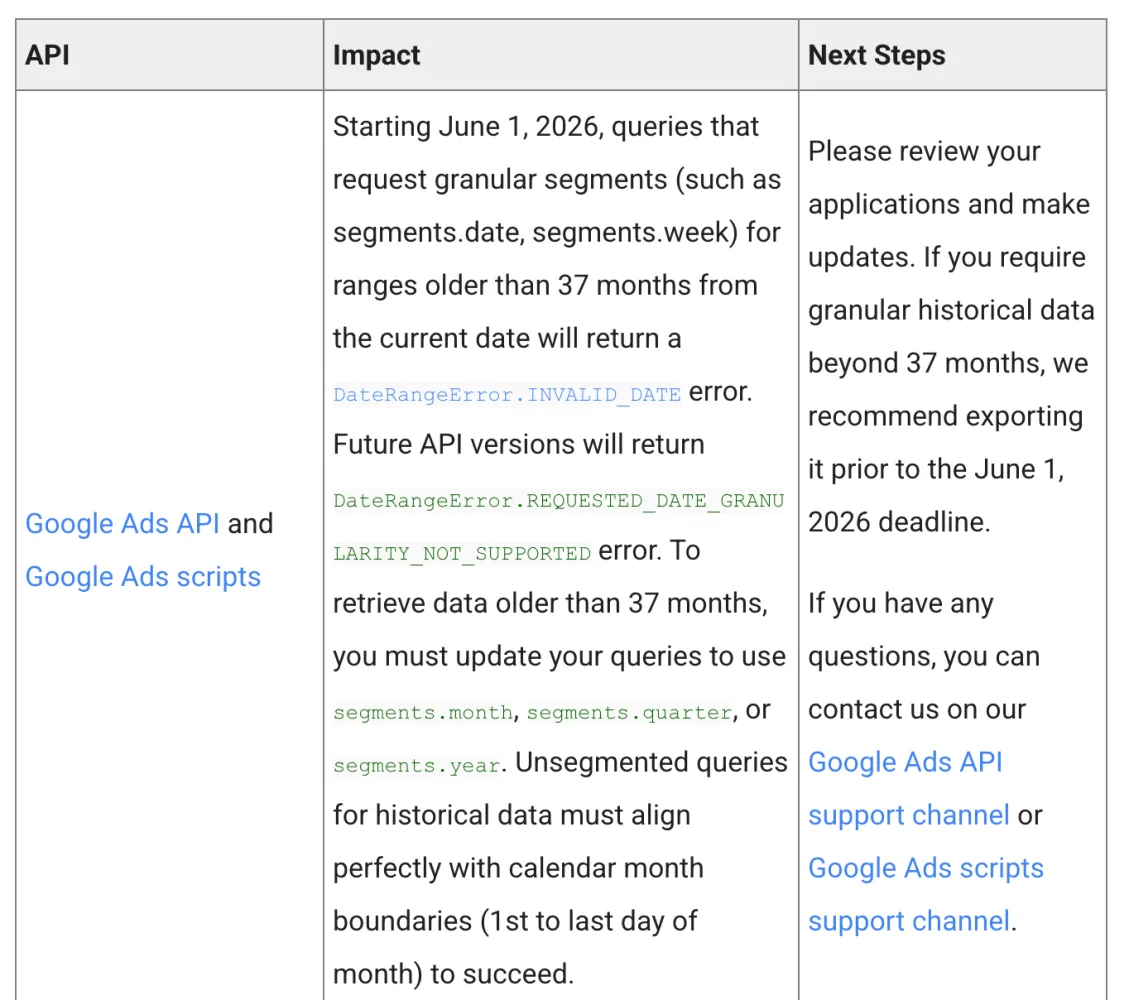
Google Ads will enforce the 37-month data retention policy from 1 June 2026, with VIVEK GUPTA flagging the deadline ahead of enforcement. The policy was officially confirmed in the Google Ads Developer Blog (covered in Week 19) and applies to the Google Ads API, Google Ads scripts, the Google Analytics Data API, and the BigQuery Data Transfer Service.
What changed
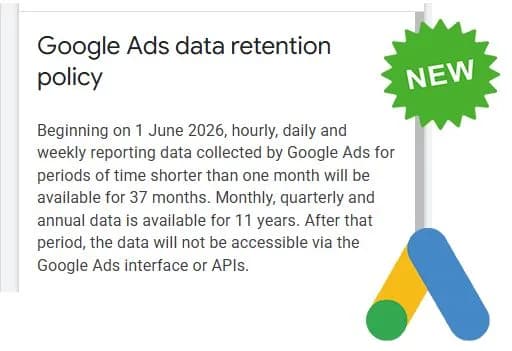
Granular performance statistics (daily, hourly, weekly) will be capped at 37 months; higher granularities (monthly, quarterly, yearly) remain available for 11 years. DV360 and CM360 APIs retain their existing 24-month windows: no change there.
The structural significance of the final two-week window: backfill runs for advertisers who want to retain granular pre-2023 history must be completed before 1 June. The export window is narrowing, and post-deadline manual transfers for affected date ranges will overwrite existing BigQuery data with empty values rather than preserving the historical granularity.
Why it matters for advertisers
For you, this means measurement teams running multi-year analysis should make the export-versus-accept decision this week. Particularly urgent for accounts older than 3 years, for agencies maintaining multi-client seasonality benchmarks, and for any pipeline where granular pre-2023 history is an input to attribution or forecasting models.
Perspective from the original PMC newsletter.Sources & contributor credit
- Newsletter coverage · Paid Media Collective newsletter
Original newsletter text, contributor labels and media for this update.
- Source referenced in newsletterLinkedIn
Linked from the original newsletter. The source publication date has not been independently confirmed.
Original creator unverified
The names below are source credits. The original creator and first-reporting priority have not yet been independently verified.
Attribution evidence and limitations
Full attribution review pending.
A source link alone does not establish original authorship.
Original image and video creators have not yet been verified.
- Published on this site
This update reflects the dated source reporting. Availability may have changed. Further coverage of this same development will be added to this page.
Original newsletter text and archive evidence
Data retention 37-month policy enforcement: final reminder before 1 June
Google Ads will enforce the 37-month data retention policy from 1 June 2026, with VIVEK GUPTA flagging the deadline ahead of enforcement. The policy was officially confirmed in the Google Ads Developer Blog (covered in Week 19) and applies to the Google Ads API, Google Ads scripts, the Google Analytics Data API, and the BigQuery Data Transfer Service. Granular performance statistics (daily, hourly, weekly) will be capped at 37 months; higher granularities (monthly, quarterly, yearly) remain available for 11 years. DV360 and CM360 APIs retain their existing 24-month windows: no change there.
The structural significance of the final two-week window: backfill runs for advertisers who want to retain granular pre-2023 history must be completed before 1 June. The export window is narrowing, and post-deadline manual transfers for affected date ranges will overwrite existing BigQuery data with empty values rather than preserving the historical granularity.
For you, this means measurement teams running multi-year analysis should make the export-versus-accept decision this week. Particularly urgent for accounts older than 3 years, for agencies maintaining multi-client seasonality benchmarks, and for any pipeline where granular pre-2023 history is an input to attribution or forecasting models.
Source captured . No explicit first-contributor label was provided for this update.