Google Ads · Status at source date: Operational reminders
Google government documents policy enforcement begins on 5 October 2026
Google begins enforcing its government documents and services policy on 5 October, requiring official authorisation, matching services and regional targeting.
What changed
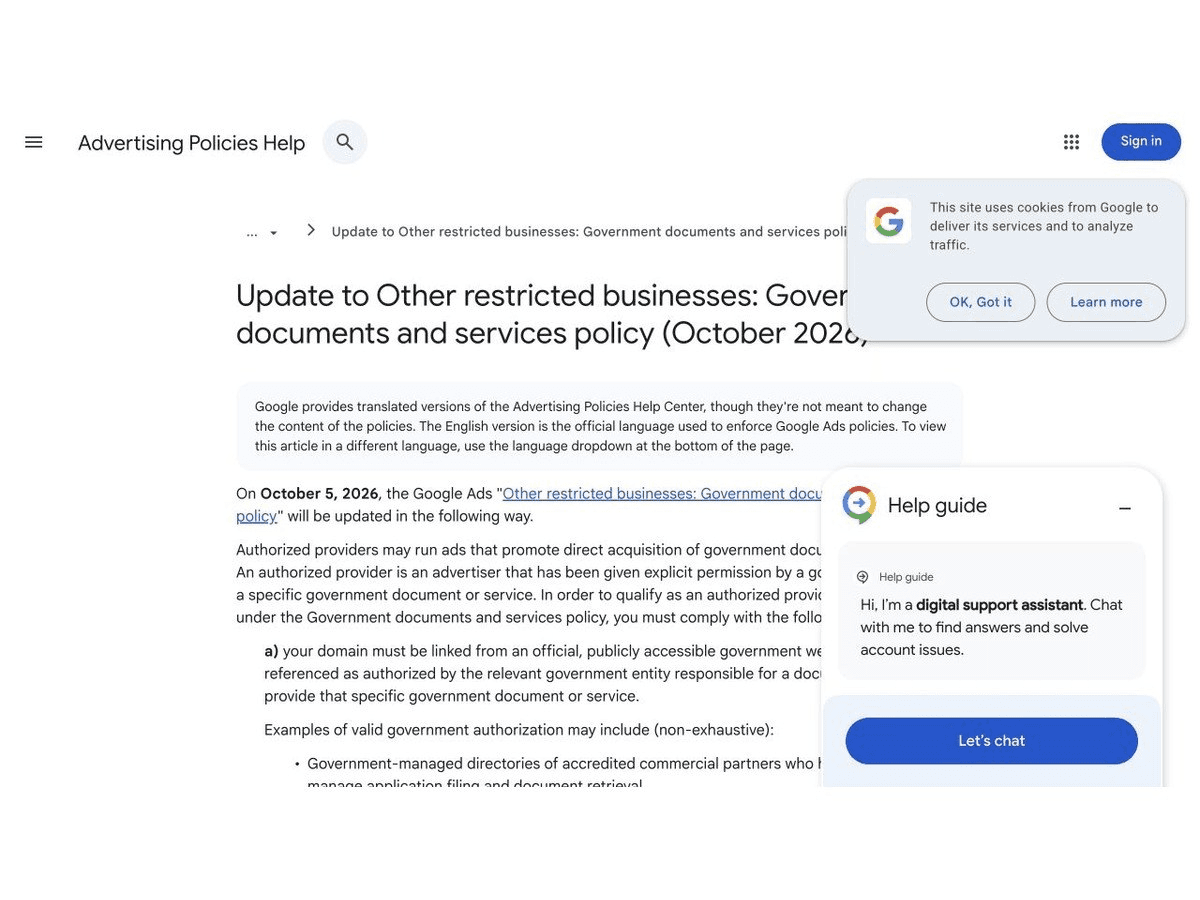
Google begins enforcing its updated government documents and services policy on 5 October 2026. Google posted the update on 4 August, so that earlier date is the publication date of the policy notice, not the start of enforcement. The requirements concern advertisers promoting government documents or services.
Evidence of authorisation
An authorised provider must be linked from an official government website that identifies it as authorised. The advertiser must promote only the document or service for which it is authorised and target the corresponding region. Google identifies exceptions for transnational services, including e-visas, where a single-region relationship may not describe the service appropriately.
The official link is a specific evidential requirement. Commercial contracts, trade licences, business-registry entries and government blog posts do not satisfy it. An organisation may therefore possess legitimate commercial credentials yet still lack the type of government-page connection Google requires for certification.
A domain-by-domain eligibility test
Editorial suggestion: assess each advertising domain separately. For every domain, record the official government page, the exact provider name shown there, the authorised document or service and the territory supported by the listing. Compare those fields with the advertiser name, landing-page offer and campaign targeting. A general reference to a parent company should not automatically be treated as support for every trading domain or service.
This comparison also helps distinguish a correctable campaign mismatch from a missing authorisation record. If the official page supports the provider but not the advertised service, narrowing the offer may be possible. If no qualifying page names the provider, general business credentials do not fill that gap under the stated policy.
Certification controls
Google may deny or revoke certification. Retain a dated record of the official listing and review it when domains, services or targeting change. Where a transnational exception may apply, document why the service fits that description rather than assuming that cross-border targeting is permitted.
The policy evidence does not explain every edge case or guarantee certification after the stated materials are provided. The operational decision is whether each domain has the precise authorisation, service and territorial alignment described by Google before advertising continues.
Why it matters for advertisers
Certification can determine whether affected advertising continues. The official government listing, rather than broad commercial legitimacy, is central to eligibility, and a mismatch between the named service and campaign targeting can put delivery at risk.
What to check next
- Map every affected domain to an official government page that names it as an authorised provider.
- Compare each advertised document or service and targeted region with the corresponding official listing.
- Record any claimed transnational exception and recheck certification evidence when domains or services change.
Sources & contributor credit
- Original source · Google Ads Policy
Source cited in the published Week 40 newsletter. Article observation/reporting date is shown separately; this page’s original publication date is not inferred.
- Newsletter coverage · Paid Media Collective newsletter
Original newsletter text, contributor labels and media for this update.
- Source referenced in newsletterGoogle Ads Policy
Linked from the original newsletter. The source publication date has not been independently confirmed.
- Newsletter coverage · Paid Media Collective Week 40
Published edition used for story selection, copy, source credits and media; curation is distinct from original authorship.

Original creator unverified
Contributor roles follow the published newsletter and its linked evidence. Reporting, official discussion and visual authorship are kept separate; no independently unverified first-reporting priority is awarded.
Attribution evidence and limitations
Published story and credit line reconciled with the expanded article.
Original post, primary documentation and secondary reporting links retained.
Visible image content inspected for story relevance; image credit retained separately from reporting credit.
Attribution checked . This is a review date, not the original publication date.
- Published on this site
- Article updated
This update reflects the dated source reporting. Availability may have changed. Further coverage of this same development will be added to this page.