Google Ads · Status at source date: Newsletter archive
View-through conversions: distinguish the documented contexts
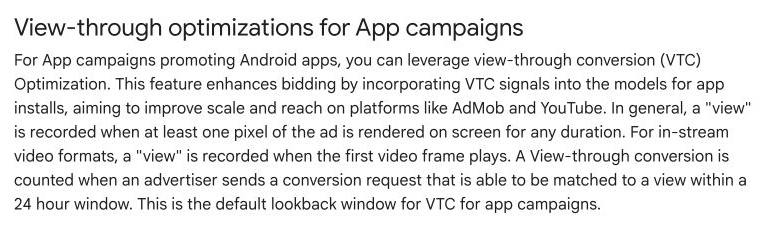
Google’s current Android App campaign VTC guidance uses a rendered-view definition of at least one pixel for any duration, including the first frame for in-stream video.
What changed
Week 47 update: Documentation checked 22 November 2026; revision date unknown
Separate reporting guidance covers Demand Gen on Display; App Connect Display guidance still uses an Active View threshold of 50% for one second. These are different contexts. A qualifying conversion must still happen: displaying one pixel is not itself a conversion, and the comparison does not establish a new universal rollout.
Before comparing view-through totals, identify the campaign type, inventory and measurement definition attached to each report. A threshold taken from Android App campaign guidance should not be generalised to every Display or Demand Gen placement. The impression qualification and the subsequent conversion are separate conditions.
For an advertiser evaluating performance, distinguish an attributed view-through conversion from a measured incremental sale. The attribution report does not on its own prove that the exposure caused the outcome. Record the attribution window and conversion action as well as the exposure definition when explaining a change in reported totals.
Earlier coverage, retained for historical context
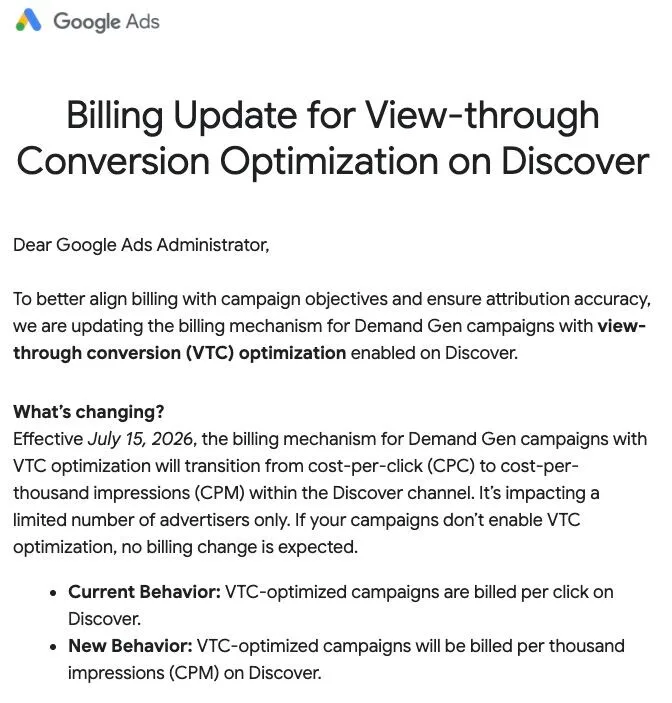
Google's advertiser email details three Demand Gen changes coming in the next months. VTC optimisation will apply to video assets only; image VTCs will still be reported in secondary columns but will no longer be biddable or appear in the main Conversions column. VTC also flips to on by default for new campaigns, requiring a manual opt-out, while existing campaigns keep their setting. Inventory support extends to Display, where billing for all video assets moves from CPC to CPM regardless of whether you opt in. For you, this means Demand Gen conversion counts, defaults, and even billing mechanics all shift together, so review VTC settings and re-baseline reporting before the auto-transition.
Sources & contributor credit
- Newsletter coverage · Paid Media Collective newsletter
Original newsletter text, contributor labels and media for this update.
- Mismatched link retained for historyLinkedIn
Attribution audit: this URL opens an unrelated Meta/Adobe Express post. It does not substantiate this Demand Gen story.
- Official SourceGoogle



Original creator unverified
Credits reflect the editor's latest changes. Original authorship has not been independently verified for this version.
Attribution evidence and limitations
Full attribution review pending.
A source link alone does not establish original authorship.
Original image and video creators have not yet been verified.
- Published on this site
- Article updated
This update reflects the dated source reporting. Availability may have changed. Further coverage of this same development will be added to this page.
Original newsletter text and archive evidence
Demand Gen view-through conversions go video-only and opt-in
Google's advertiser email details three Demand Gen changes coming in the next months. VTC optimisation will apply to video assets only; image VTCs will still be reported in secondary columns but will no longer be biddable or appear in the main Conversions column. VTC also flips to on by default for new campaigns, requiring a manual opt-out, while existing campaigns keep their setting. Inventory support extends to Display, where billing for all video assets moves from CPC to CPM regardless of whether you opt in. For you, this means Demand Gen conversion counts, defaults, and even billing mechanics all shift together, so review VTC settings and re-baseline reporting before the auto-transition.
Source captured . No explicit first-contributor label was provided for this update.