Google Ads · Status at source date: Documentation / availability
Google documents AI-generated summaries for advertising experiments
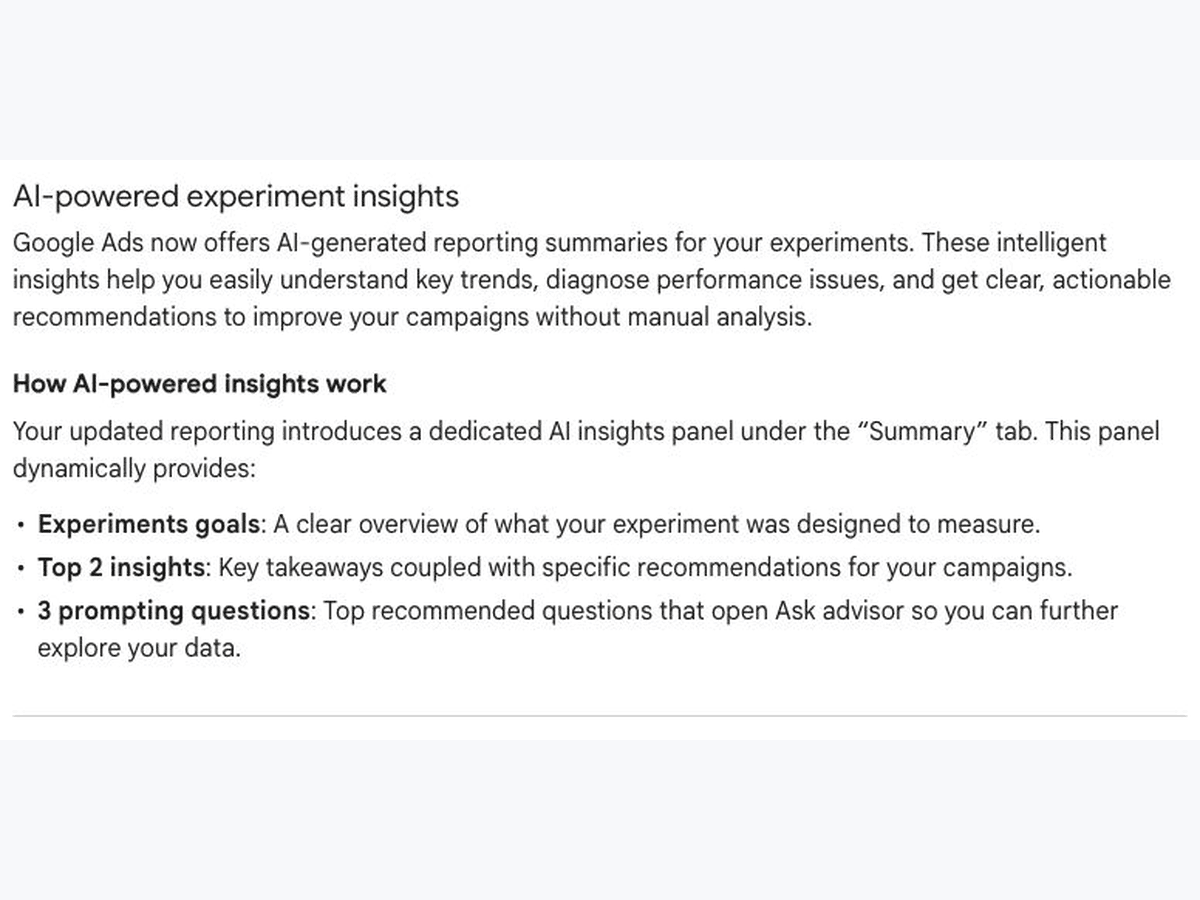
Google Ads documentation describes experiment summaries containing goals, two key insights and suggested questions for Ask advisor. The underlying design, results and uncertainty still require independent review.
What changed
A summary layer for experiments
Google’s help documentation describes AI-generated experiment summaries that include goals, two key insights and suggested questions for Ask advisor. These elements may provide a structured starting point for reviewing an experiment, but the documentation does not show that every advertiser has access or that each summary will be equally useful.
Open the underlying experiment before acting on a summary. Inspect how it was designed, what the results show and what uncertainty surrounds them. Suggested questions may direct further investigation, but their value depends on the quality and relevance of the underlying experiment.
Keep conclusions proportionate
A concise insight can be clear while remaining incomplete. Distinguish among the experiment’s direct findings, the points emphasised by the generated summary and the commercial decision under consideration. Before changing budget, creative or targeting, examine assumptions, constraints and plausible alternative explanations.
A useful check is to compare the generated summary with an independent human reading of the experiment. Differences should prompt investigation rather than an automatic conclusion that either interpretation is correct. This comparison is recommended research practice, not a procedure required by the documentation.
Why it matters for advertisers
Summaries can make experimental results easier to approach, but compression may conceal design choices and uncertainty. Decisions still need to rest on the experiment rather than the convenience of its summary.
What to check next
- Open and inspect the underlying experiment before acting on a generated summary.
- Review the design, results and uncertainty alongside the stated insights.
- Use suggested questions to guide investigation rather than treating them as conclusions.
Sources & contributor credit
- Original official sourceGoogle
Original source publication date unresolved; current documentation; no original publication day established.
- Newsletter coverage · Paid Media Collective Week 41
Yoann Ferrand’s newsletter curation. Original reporting, account observations and visual credits are listed separately.

Original creator unverified
Credits reflect the editor's latest changes. Original authorship has not been independently verified for this version.
Attribution evidence and limitations
Full attribution review pending.
A source link alone does not establish original authorship.
Original image and video creators have not yet been verified.
- Published on this site
- Article updated
This update reflects the dated source reporting. Availability may have changed. Further coverage of this same development will be added to this page.