Google Ads · Status at source date: Announcement
LSA migration: a limited historical-report download
Google’s migration guidance points advertisers to a historical Local Services Ads report download on the redirection page.

What changed
Week 47 update: Documentation checked 22 November 2026; revision date unknown
It includes lead spend and charged-lead counts split into phone, message and booking leads. It does not include impressions, clicks or every historical report. This is a useful recovery route within the existing LSA-to-PMax migration story, not a complete archive or a new migration announcement.
Use the download for the measures it actually contains. Lead spend and charged-lead counts can help reconcile historical lead costs, but they cannot reconstruct click-through rate or impression trends when those inputs are absent. Keep phone, message and booking leads separate when comparing lead mix over time.
For a before-and-after migration report, identify the common metrics before joining the files. A charged lead from the historical report and a conversion action in the newer campaign need not be interchangeable. State the definition used and retain the original export alongside any transformed reporting table.
This documentation follow-up does not change the original contributor credit for the migration announcement. The earlier coverage below remains a historical account of that announcement; the added recovery route is supported by the current official help page.
Earlier coverage, retained for historical context
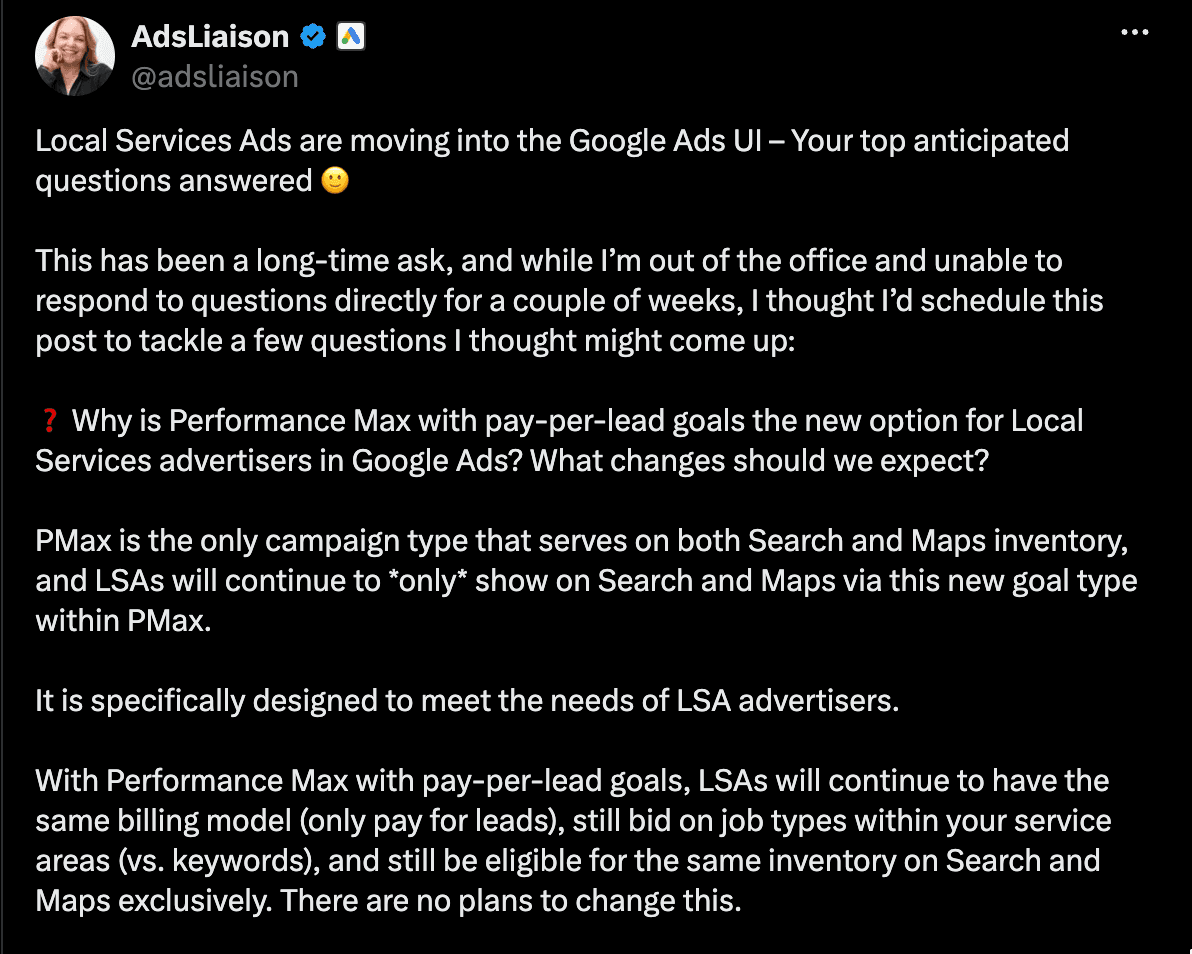
Ginny Marvin, posting through Google’s AdsLiaison account, explained how Local Services Ads would move into the Google Ads interface. The described destination is Performance Max with pay-per-lead goals. Her clarification says this specific setup continues to use Search and Maps inventory, job types and service areas, with advertisers paying for leads. It should not be read as a switch to the ordinary cross-channel Performance Max buying model.
The transition also affects reporting access. Ginny’s post warns that historical Local Services Ads reports and the old dashboard will no longer be accessible after an account transitions, and recommends downloading the reports beforehand. This is a concrete preparation task even where campaign settings transfer automatically. Teams handling accounts for several businesses should establish which client records have been saved and who can retrieve them.
The announcement described phased account integrations starting in August, with advance notification for each advertiser. Since that start date has passed, use the account’s own transition notice to determine the next step. If the migration has already happened, inventory the historical exports that exist and check the new campaign against them. If it is still pending, preserve reporting before the account-specific transition rather than relying on the general rollout month.
Why it matters for advertisers
The main operational risk is losing continuity between the old and new reporting views. Save enough context to interpret lead counts and costs, including the date range and the services advertised. After transition, verify the service areas, budget and customer-contact workflow. A local business can then assess whether enquiries are useful without confusing an interface change, a reporting gap and a real change in lead quality.
What to check next
- Check the account-specific transition notice and save historical reports if still available.
- Verify transferred service areas, job types, budgets and business details.
- Compare lead handling and business outcomes using a documented reporting baseline.
Sources & contributor credit
- Newsletter coverage · Paid Media Collective newsletter
Original newsletter text, contributor labels and media for this update.
- Source referenced in newsletterX
Linked from the original newsletter. The source publication date has not been independently confirmed.
- Official SourceGoogle


Original creator unverified
Credits reflect the editor's latest changes. Original authorship has not been independently verified for this version.
Attribution evidence and limitations
Full attribution review pending.
A source link alone does not establish original authorship.
Original image and video creators have not yet been verified.
- Published on this site
- Article updated
This update reflects the dated source reporting. Availability may have changed. Further coverage of this same development will be added to this page.
Original newsletter text and archive evidence
Local Services Ads migrate into Google Ads as a PMax pay-per-lead
Google confirmed Local Services Ads will move into Google Ads, starting August 2026 for select US home-service verticals such as plumbing and HVAC. LSA campaigns become a pay-per-lead option within Performance Max. For you, this means LSA management folds into your main account, so plan the migration for affected verticals now.
Source captured . No explicit first-contributor label was provided for this update.