Google Ads · Status at source date: Account observation
AI Max account shows a Search terms and ad combinations report
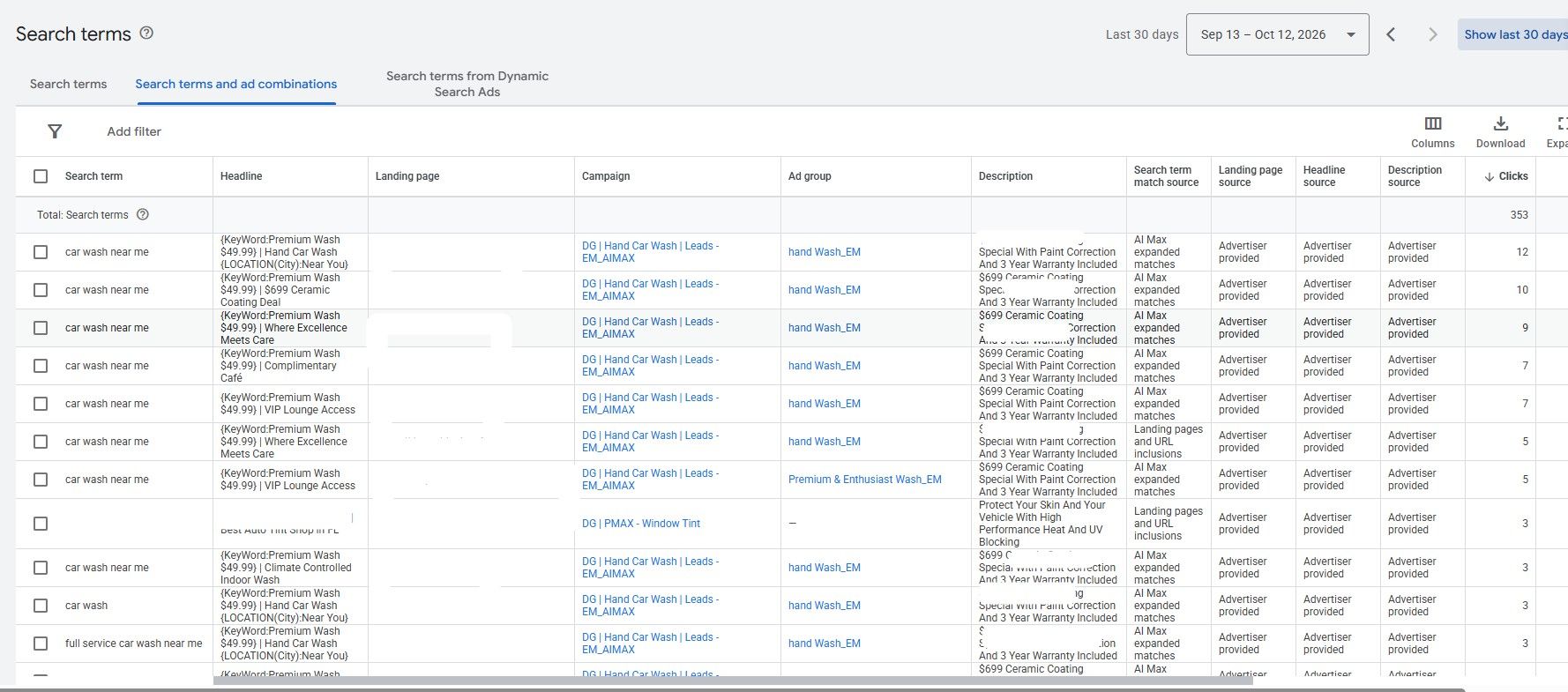
Natasha Kaurra’s original LinkedIn post shows a Search terms and ad combinations report in an AI Max account.
What changed
It brings queries together with the headlines, descriptions, landing pages and matching or asset sources used to serve ads. This is a useful account observation, not confirmation of a universal rollout. If the report appears, use it to inspect the relationship between a query, the message shown and the destination reached, then compare that with conversion quality. The original post is accessible and its public metadata records 13 October; this remains one account observation, not a general rollout date.
The useful question is whether an observed query, ad message and destination tell the same story. A search for a specific service could be paired with broad creative and a general landing page; a combined view may help a practitioner notice that mismatch. That example is an editorial illustration, not a result measured in Natasha’s account or a guarantee about the fields available to every advertiser.
If the report is visible, choose a bounded date range and inspect a small set of queries alongside their associated creative and destinations. Record the account, campaign type and exact column names before sharing conclusions with colleagues. Keep a copy of the original view so a later interface change is not mistaken for a change in campaign behaviour. Compare the findings with established search-term and landing-page reporting rather than assuming the new view replaces them.
A visible association does not establish why an auction was won, whether a particular asset caused a conversion, or what would happen if the destination changed. Use the view to formulate a specific test or identify a clear relevance problem. Avoid changing several targeting, messaging and landing-page variables at once if the aim is to understand which adjustment helped.
Why it matters for advertisers
The observed report may support query-to-message diagnosis without proving which element caused a conversion.
What to check next
- Check whether the view exists in the relevant AI Max campaign.
- Record the query, message and destination together.
- Treat associations as diagnostic evidence, not causal proof.
Sources & contributor credit
- Original account observation · Natasha Kaurra
Original account observation. Existing private review established the exact source timestamp. Source image subsequently retrieved and inspected for Week 42; no general rollout claimed.
- Supporting coverage · Search Engine Roundtable
Coverage credits Natasha’s original post; preserve one day between original observation and coverage. Image retrieved and inspected in Week 42 media review.

Source attribution checked
Natasha Kaurra is credited for her documented account observation on 13 October. This does not establish first-ever discovery or a general rollout.
Attribution evidence and limitations
The published text and credit roles were independently reviewed for this exact version. Natasha Kaurra is credited for her documented account observation on 13 October. This does not establish first-ever discovery or a general rollout.
Original sources and secondary discovery links are distinguished in the article. Unresolved first-reporting priority is not treated as confirmed authorship.
Selected media and displayed credits were inspected. Natasha Kaurra; reproduced by Search Engine Roundtable. Source access and credit do not establish ownership or permission to reuse.
Attribution checked . This is a review date, not the original publication date.
- Published on this site
- Article updated
This update reflects the dated source reporting. Availability may have changed. Further coverage of this same development will be added to this page.