Meta Ads · Status at source date: Newsletter archive
Meta Push delivery observations: original hands-on evidence and later account sightings
Jon Loomer documented hands-on use of Meta’s Push delivery control on 9 June. Thomas Eccel’s November sighting adds account context, but does not establish a universal rollout or guarantee a valid creative test.
What changed
Meta’s “Push delivery to this ad” control lets an advertiser assign a chosen ad a share of campaign or ad-set budget for a defined period. It is an account-level control, not evidence that every advertiser has access. Jon Loomer’s 9 June 2026 hands-on article documents his own testing; his 26 March overview described other advertisers’ sightings and said he did not yet have the feature.
What the original hands-on report establishes
Loomer found that the option required at least two ads in the ad set. The interface accepted a budget percentage and a duration. His tests found a one-to-thirty-day range despite tooltip wording referring to seven days. These are observations of that interface version, not a contractual delivery guarantee or a settled specification for every account.
The control directs budget within an existing campaign. More spend on one ad can reduce what is available to other ads, so assess the whole ad set alongside the chosen creative. If the purpose is to compare creatives, a forced allocation alone does not provide random assignment, comparable audiences or a statistically reliable experiment.
Week 46 follow-up
Thomas Eccel reported seeing the option on 12 November. This is a later account sighting of an already documented control. His statement about wider access has not been independently verified as a universal rollout. Confirm the option and its displayed limits in the account before acting.
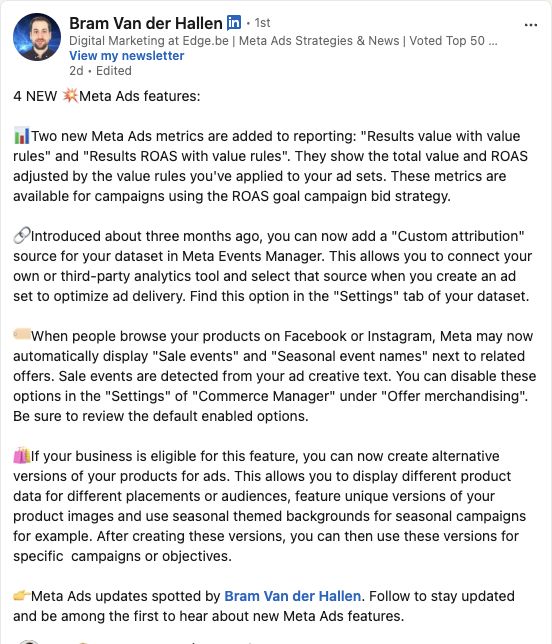
The existing June newsletter record credited Bram Van der Hallen and retains the newsletter source and image in its revision history. Jon Loomer is now credited for the earliest direct hands-on work verified in this review, dated 9 June. The March overview proves earlier public discussion but does not identify the first original observer, so worldwide first-discovery priority remains unresolved.
Record the chosen percentage, duration and baseline performance before changing delivery. Monitor the selected ad and the rest of the ad set, and distinguish a useful amount of exposure from proof that the creative caused incremental sales. This update corrects and extends the existing article rather than announcing the feature again.
Sources & contributor credit
- Original hands-on account report · Jon Loomer
Own-account testing, before the June newsletter. His 26 March overview described unidentified other observers; global first-discovery priority remains unresolved.
- Later account sighting · Thomas Eccel
Later visibility observation, not proof of universal availability or new first reporting.

Original creator unverified
Credits reflect the editor's latest changes. Original authorship has not been independently verified for this version.
Attribution evidence and limitations
Full attribution review pending.
A source link alone does not establish original authorship.
Original image and video creators have not yet been verified.
- Published on this site
- Article updated
This update reflects the dated source reporting. Availability may have changed. Further coverage of this same development will be added to this page.
Original newsletter text and archive evidence
Meta rolls out "Push delivery to this ad" to more accounts
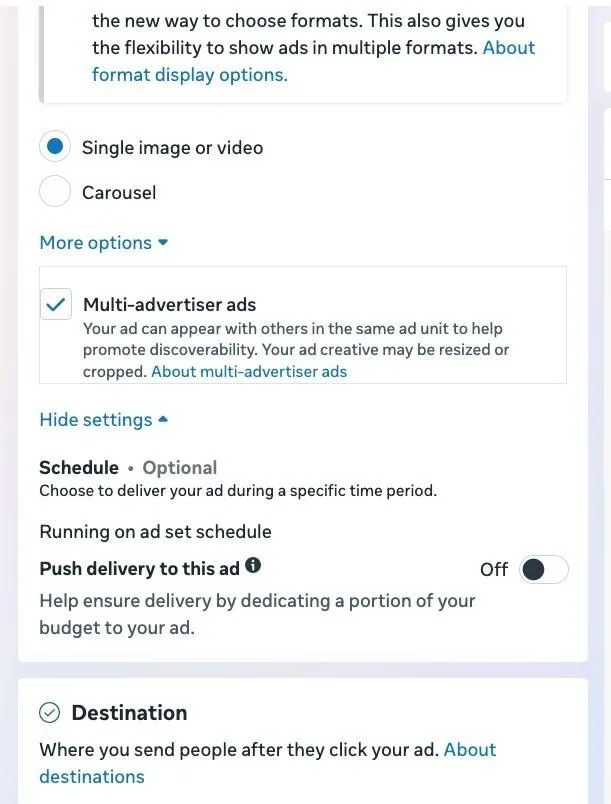
Meta is widening access to a "Push delivery to this ad" feature. At the ad level, when an ad set contains more than one ad, advertisers can select a specific ad, open "Show more options" beneath the multi-advertiser ads setting, and enable a toggle that pushes delivery to that ad. They set a percentage of the daily campaign budget for Meta to spend on the chosen ad, and a duration of 1 to 30 days.
Meta tends to concentrate its budget on certain ads within an ad set, leaving newer ads short of the spend they need to prove themselves. The control allows forcing enough delivery to a new creative to gather meaningful data, rather than pausing the rest of the ad set to give it room.
For you, this means advertisers can guarantee spend to a new creative for a defined window instead of leaving delivery entirely to the algorithm. Worth using it to test promising new ads that are being starved of impressions, running the push long enough to gather statistically useful data.
Source captured . No explicit first-contributor label was provided for this update.