Industry · Status at source date: Official announcement
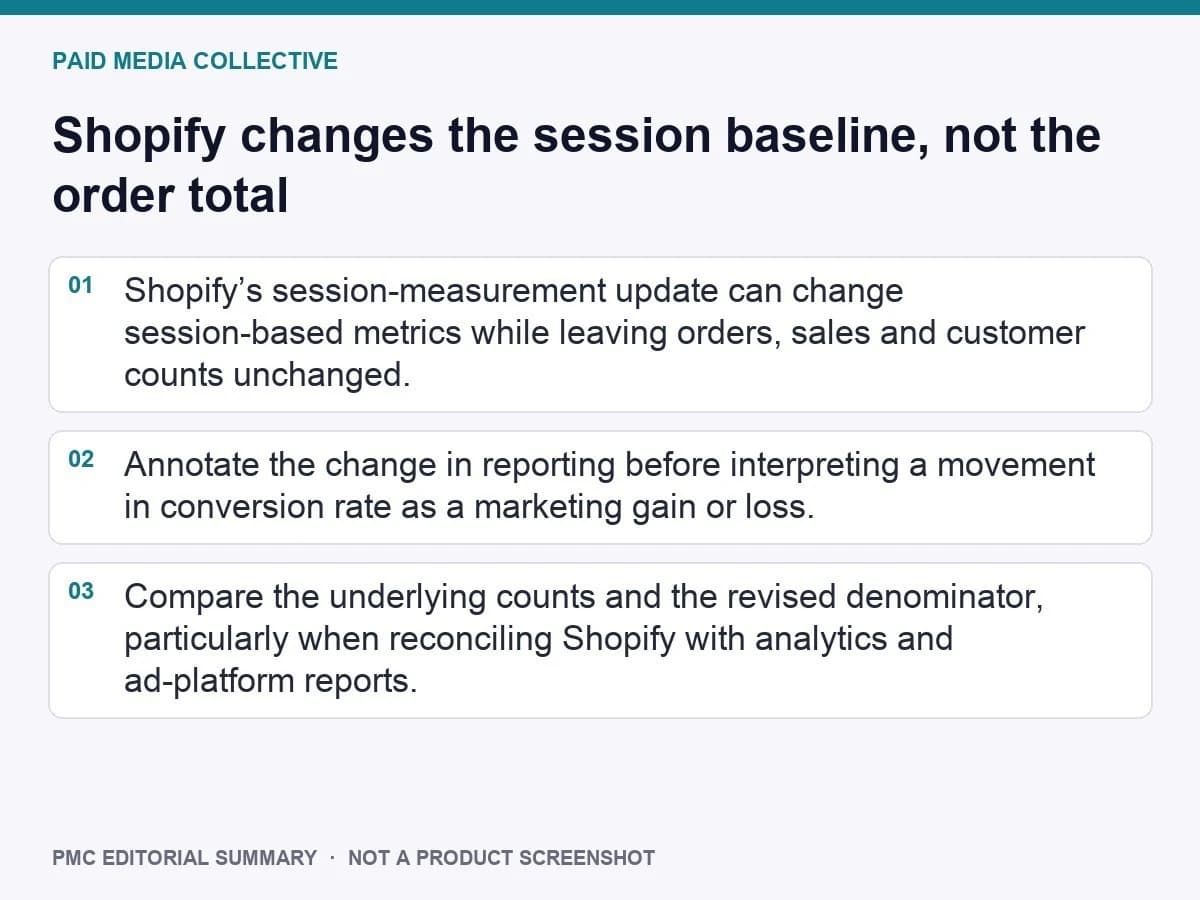
Shopify changes the session baseline, not the order total
Shopify’s session-measurement update can change session-based metrics while leaving orders, sales and customer counts unchanged. Annotate the change in reporting before interpreting a movement in conversion rate as a marketing gain or loss.
What changed
Compare the underlying counts and the revised denominator, particularly when reconciling Shopify with analytics and ad-platform reports.
Mark the measurement change in reporting and compare absolute orders and sales with session-derived metrics. Where a trend crosses the change, explain the break before calculating an improvement or decline. Keep internal forecasts and experiments on a consistent definition instead of silently joining two session baselines.
Session-based measures combine a business result with a definition of visits. Changing that definition can affect conversion rate, sessions per visitor and other derived comparisons even if transaction tracking is stable. Teams should explain the denominator change to people who consume dashboards but do not follow the analytics implementation, especially where the same chart is used to evaluate campaign or agency performance.
For a weekly report spanning the change, show the measurement boundary and avoid presenting a single percentage movement as a clean performance result. Where possible, use a consistent comparison window and include absolute commercial outcomes as context. Historical benchmarks, targets and automated alerts may also need a review if they depend on the earlier session definition. Recalibrating an alert is different from rewriting past data or claiming the business improved because the measured number of sessions changed.
Why it matters for advertisers
A change to the session denominator can move conversion rate without changing orders. Without an annotation, teams may mistakenly attribute the movement to creative, bidding or landing-page work launched around the same time.
What to check next
- Annotate 21 September in session-based reports and compare orders separately from the new session baseline.
Sources & contributor credit
- Original source · LinkedIn post
Original announcement or reported observation; scope retained in the summary.

Original creator unverified
The names below are source credits. The original creator and first-reporting priority have not yet been independently verified.
Attribution evidence and limitations
Full attribution review pending.
A source link alone does not establish original authorship.
Original image and video creators have not yet been verified.
- Published on this site
This update reflects the dated source reporting. Availability may have changed. Further coverage of this same development will be added to this page.