Google Ads · Status at source date: Release
Google Ads API v26 adds Search Lift reporting and campaign-management updates
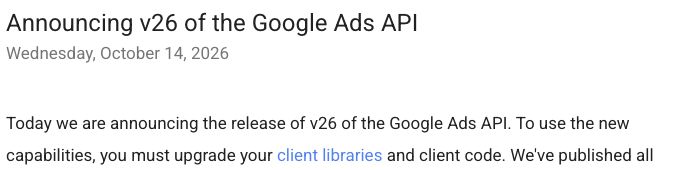
Google Ads API v26 was released on 14 October.
What changed
The release includes read-only Search Lift reporting, Local Services Performance Max creation and changes to enhanced-conversion settings, among other updates. A separate announcement says the API moves towards two releases a month from v26, while major releases and sunset planning remain important. Development teams should review the release notes and the versions used by their integrations. The schedule lists a projected February 2027 sunset for v23; check the current schedule when planning migration.
The release is distinct from Google’s earlier announcement about publishing API updates more frequently. A faster calendar does not mean every integration needs every new feature, and a new version does not automatically make a feature relevant to every account. Start with the functions your application actually uses, then compare those functions with the official v26 release notes.
For a reporting integration, read-only Search Lift access is a different implementation question from creating or changing campaigns. A team should verify available fields, account eligibility and expected output before promising a new dashboard to clients. For an integration that manages Local Services Performance Max, test the relevant creation workflow in an appropriate development environment before incorporating it into regular operations. These are implementation recommendations, not claims about universal access or a prescribed testing environment.
Conversion-setting changes deserve particular attention because a technically successful request can still encode a different business intention. Review the current setting, the intended post-migration setting and the mapping used by your application. Preserve a rollback plan for application changes and monitor errors after release. Use the current sunset schedule to plan migration; do not turn a projected month into an exact deadline.
Why it matters for advertisers
Integration owners can assess the feature release separately from Google’s faster publishing schedule.
What to check next
- Separate v26 feature work from release-cadence planning.
- Review the official release notes against the calls you use.
- Test conversion-setting mappings before changing production integrations.
Sources & contributor credit
- Official Source · Google

Source attribution checked
Anash P. Oommen is the named author of Google’s v26 announcement, not a claim of sole product authorship.
Attribution evidence and limitations
The published text and credit roles were independently reviewed for this exact version. Anash P. Oommen is the named author of Google’s v26 announcement, not a claim of sole product authorship.
Original sources and secondary discovery links are distinguished in the article. Unresolved first-reporting priority is not treated as confirmed authorship.
Selected media and displayed credits were inspected. Google Ads Developer Blog; capture by PMC. Source access and credit do not establish ownership or permission to reuse.
Attribution checked . This is a review date, not the original publication date.
- Published on this site
- Article updated
This update reflects the dated source reporting. Availability may have changed. Further coverage of this same development will be added to this page.