Google Ads · Status at source date: Announcement
Google schedules AI Max migration for ACA and broad-match campaigns
Google notified advertisers that Search campaigns using Automatically Created Assets or campaign-level broad match would start migrating to AI Max from 1 September.
What changed
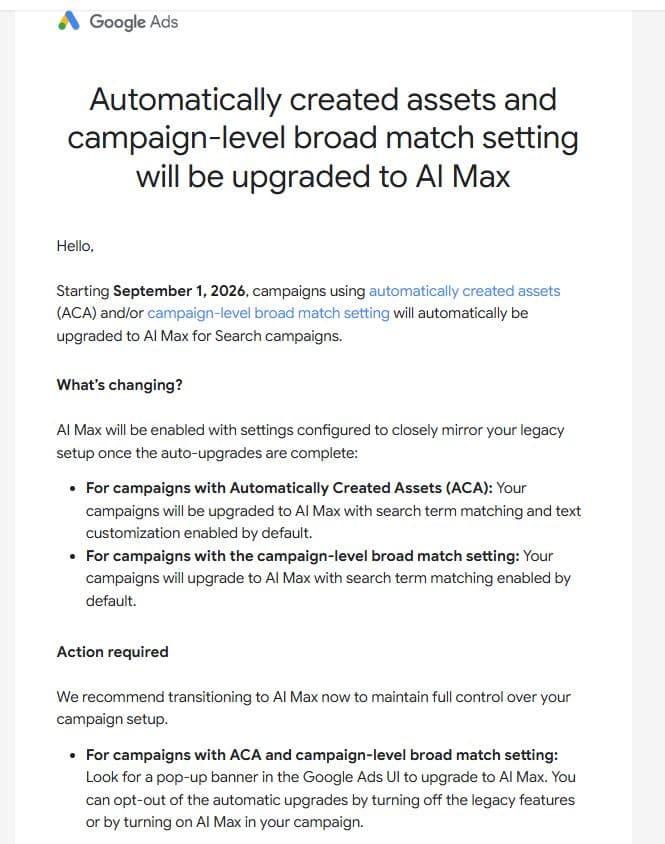
Natasha Kaurra shared a Google Ads email describing automatic upgrades beginning on 1 September 2026. The saved notice names two affected configurations: Automatically Created Assets and campaign-level broad match. It says the resulting AI Max setup is intended to resemble the legacy configuration. The notice should therefore be read against the campaign’s actual settings, rather than as a universal migration date for every Search campaign.
The screenshot distinguishes the defaults. Campaigns using Automatically Created Assets move with search term matching and text customisation enabled; those using the campaign-level broad-match setting move with search term matching enabled. This distinction is more useful than treating AI Max as one undifferentiated switch. A review should identify which capabilities were present before the upgrade and which are enabled afterwards.
Because the announced start date has passed, the immediate task is to inspect the account notice, change history and current configuration. A preparation checklist written before September should not imply that the same pre-migration choice is still available now. Where a team had already opted in or changed the legacy settings, retain those decisions as part of the record rather than assuming the platform made every change.
Why it matters for advertisers
The account’s labels may change while much of its intended behaviour is preserved, but that needs verification. Compare generated assets, matched queries and destinations with a saved baseline, then evaluate conversion quality. If another team changed budgets, tracking or landing pages during the same period, document that before explaining a movement in results. A migration review is most useful when it distinguishes platform changes from the advertiser’s own actions.
What to check next
- Identify which campaigns had either of the affected legacy configurations.
- Check the migration notice, change history and actual AI Max feature settings.
- Compare search terms, generated text and business outcomes with the pre-migration baseline.
Sources & contributor credit
- Newsletter coverage · Paid Media Collective newsletter
Original newsletter text, contributor labels and media for this update.
- Source referenced in newsletterLinkedIn
Linked from the original newsletter. The source publication date has not been independently confirmed.

Original creator unverified
The cited source authors and any separately identified visual or tool creators are credited for their documented roles. Independent first-reporting priority is not established.
Attribution evidence and limitations
Read Natasha Kaurra’s complete original post and visually read the Google notification screenshot. The screenshot supports different defaults for the two legacy configurations. Preserved Menachem Ani’s newsletter credit without inventing a first-reporting claim. Updated the practical advice to reflect that the reported start date has passed.
Original source links and verified profile links are retained. A missing profile remains unresolved rather than being inferred from a name match.
Viewed the complete saved email screenshot. It contains Google Ads branding and the two configuration-specific defaults, but no named sender or screenshot creator. Those unknown roles remain unresolved.
Attribution checked . This is a review date, not the original publication date.
- Published on this site
- Article updated
This update reflects the dated source reporting. Availability may have changed. Further coverage of this same development will be added to this page.
Original newsletter text and archive evidence
Search campaigns migrate to AI Max from 1 September
Google emailed advertisers that Search campaigns using Automatically Created Assets or campaign-level broad match will be automatically upgraded to AI Max for Search starting 1 September 2026. Affected campaigns gain search term matching and asset optimisation under AI Max's umbrella, and the timing gives holiday-season accounts under a month to react. For you, this means opting out requires disabling ACA and campaign-level broad match before the deadline, so audit which campaigns qualify now.
Source captured . No explicit first-contributor label was provided for this update.