Google Ads · Status at source date: Platform announcement
Google Data Strength Uplift: September announcement and October rollout follow-up
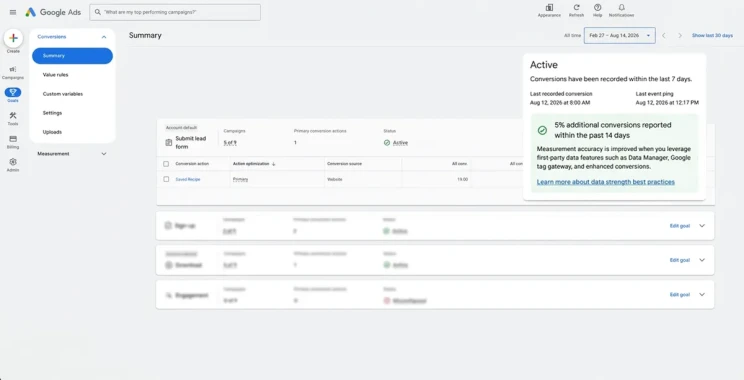
Google's 10 September measurement announcement introduces Data Strength Uplift, a metric for conversions recovered through first-party data. It gives advertisers another way to examine measurement coverage, with an important distinction between capturing a sale and creating one.
What changed
Nipoon Malhotra authored the announcement, which also describes Data Manager connections with Analytics and DV360 and enhanced conversions in those products. The new metric concerns additional conversions being reported through the data setup. Its interpretation should stay connected to that purpose when it appears in account reporting.
Imagine a retailer fixes an import problem and its advertising report begins recording orders that previously went missing. Reported conversions rise even though the warehouse ships the same number of orders. Better measurement is useful, but that movement alone does not show that customers bought more because of advertising. The example illustrates a reporting distinction; it is not a result claimed for the new feature.
A useful review compares the advertising report with a stable business record. Write down when a connection, matching process or conversion definition changed, and examine whether discrepancies become easier to explain. Where lead quality or returns matter, include those outcomes in the discussion instead of treating a larger reported conversion total as the entire business result.
October follow-up: Google’s 13 October Demand Gen update revisits Data Strength Uplift and the wider measurement rollout. Data Manager connections with Analytics and Display & Video 360, together with enhanced-conversion support, belong to the continuing measurement programme. These are follow-ups to the September announcement retained above, not three separate products first launched in this newsletter.
For teams reviewing this rollout, distinguish additional conversions recovered through measurement from additional sales caused by advertising. Better observable data can improve the information available for reporting and optimisation, but a recovered conversion is not, by itself, causal evidence of incremental revenue. Keep the vendor’s uplift research separate from a measured result in your own account.
Check which data connections and settings are available in the products you actually use. Map each connection to its owner and conversion source before making changes, then compare diagnostics and reporting consistency. When briefing stakeholders, describe the integration or measurement capability that changed and retain the date of the original announcement. A later rollout reminder should not erase the earlier source or its author, Nipoon Malhotra.
Why it matters for advertisers
The practical benefit is a clearer conversation about data completeness. Keep that conversation separate from an experiment designed to assess incremental sales. A team may need both better capture and stronger evidence about budget effectiveness. Changing historical targets or declaring improved acquisition efficiency before understanding a measurement break can lead to decisions based on incompatible periods.
What to check next
- Annotate the implementation date and conversion definition in weekly performance reports.
- Reconcile a sample of reported conversions against the original order or lead records.
- Explain recovered reporting separately from any claim about additional demand or profit.
Sources & contributor credit
- Official documentation or announcement · Nipoon Malhotra, Google
Drive profitable growth with new data and measurement tools. 10 September 2026. Original named announcement author; individual profile unresolved. The original Uplift Metric screenshot was retrieved and visually reviewed by Codex on 12 September 2026; 1200 × 614 pixels.
- Official follow-up · Google
Add dated rollout follow-up; retain September date, Nipoon credit and image; no new-launch claim.


Source attribution checked
Nipoon Malhotra remains credited as author of the 10 September Google announcement. The October rollout follow-up does not replace that authorship.
Attribution evidence and limitations
The published text and credit roles were independently reviewed for this exact version. Nipoon Malhotra remains credited as author of the 10 September Google announcement. The October rollout follow-up does not replace that authorship.
Original sources and secondary discovery links are distinguished in the article. Unresolved first-reporting priority is not treated as confirmed authorship.
Selected media and displayed credits were inspected. Google. Source access and credit do not establish ownership or permission to reuse.
Attribution checked . This is a review date, not the original publication date.
- Published on this site
- Article updated
This update reflects the dated source reporting. Availability may have changed. Further coverage of this same development will be added to this page.