Google Ads · Status at source date: Follow-up · account observation
Video Campaign Groups: supported Reservation formats clarified
Google documents supported Reservation formats inside Video Campaign Groups, including YouTube Select Lineups, CPM Masthead and Pause Ads.

What changed
Week 47 update: Documentation checked 22 November 2026; revision date unknown
Supported Reservation and Auction campaigns can be combined, with FROG optimisation also described for supported Reservation-only groups. Sponsorships, CPH Masthead and certain sensitive or publisher-buy formats are excluded. This is a compatibility clarification to existing coverage; the documentation does not date a new rollout or make every format eligible.
Build the group around the formats that the documentation actually supports. A buying label such as Reservation is not sufficient to establish eligibility: CPM Masthead and CPH Masthead, for example, are not interchangeable in the stated support list. Check the individual campaign and format before proposing a combined group.
For reporting, distinguish the intended reach-and-frequency coordination from a proven incremental outcome. The existence of a supported grouping does not by itself show that it improves an advertiser’s sales or reduces total cost. Retain the planned inventory mix and evaluation period when comparing results, especially if the mix changed at the same time as the grouping.
Earlier coverage, retained for historical context
Group-level controls are visible
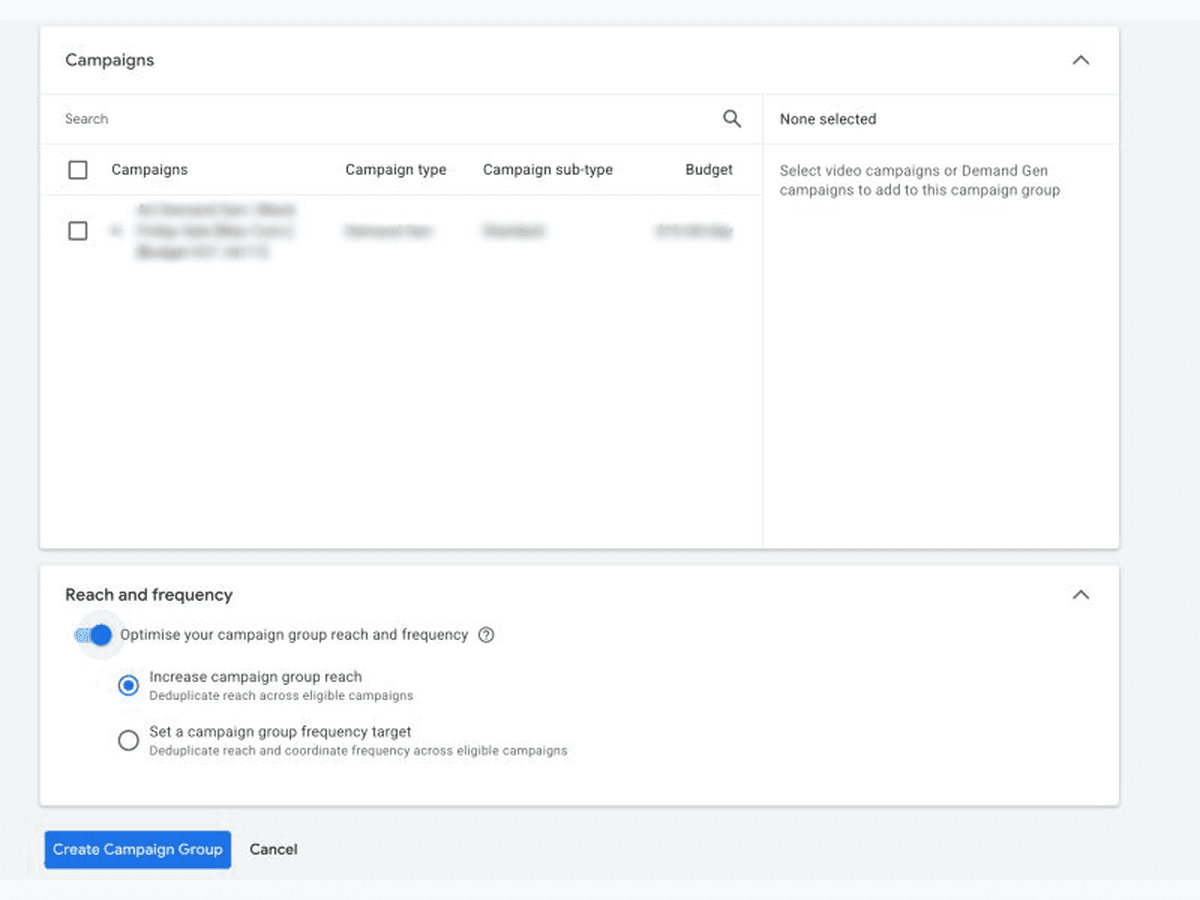
Bia Camargo observed a beta interface for grouping eligible Video and Demand Gen campaigns. The screen offers options to increase group reach or set a group frequency target. It supplies a current view of the workflow but does not show that all campaigns qualify or that every account has access.
If the controls appear in an advertiser’s account, first identify which campaigns are eligible. Do not restructure activity around the screenshot alone. Define the reach or frequency problem the group is intended to address and examine how delivery looks when the selected campaigns are considered together.
This is a follow-up observation
Video Campaign Groups appeared in earlier Week 29 coverage, so the 6 October 2026 observation is not evidence of a new launch or first-ever discovery. It adds interface detail and should be recorded as such.
A grouping control does not by itself demonstrate improved delivery. A limited evaluation could state the desired group-level outcome before use and compare subsequent combined reach or frequency with the previous approach. This is research guidance, not a performance prediction. Any assessment should also preserve the distinction between interface availability and measurable benefit.
The underlying Video Campaign Groups capability was covered in Week 29. Bia Camargo’s October screenshot is a fresh account view, rather than evidence of a first launch.
Why it matters for advertisers
Cross-campaign controls can change how reach and frequency are managed, but grouping is valuable only when it supports a defined objective and improves the decision process.
What to check next
- Check whether Video Campaign Groups are available in the relevant account.
- Identify which Video and Demand Gen campaigns are eligible for grouping.
- Compare combined reach or frequency with the predefined objective before judging benefit.
Sources & contributor credit
- Practitioner observation · LinkedIn post
Source reporting or observation date, not a universal launch date.
- Newsletter coverage · Paid Media Collective newsletter
Original newsletter text, contributor labels and media for this update.
- Source referenced in newsletterGoogle Ads & Commerce Blog
Linked from the original newsletter. The source publication date has not been independently confirmed.
- Newsletter coverage · Paid Media Collective Week 41
Yoann Ferrand’s newsletter curation. Original reporting, account observations and visual credits are listed separately.
- Official SourceGoogle


Original creator unverified
Credits reflect the editor's latest changes. Original authorship has not been independently verified for this version.
Attribution evidence and limitations
Full attribution review pending.
A source link alone does not establish original authorship.
Original image and video creators have not yet been verified.
- Published on this site
- Article updated
This update reflects the dated source reporting. Availability may have changed. Further coverage of this same development will be added to this page.
Original newsletter text and archive evidence
Video campaign groups coordinate reach and frequency
Google has introduced video campaign groups, which manage reach and frequency across multiple video campaigns while individual campaign settings stay in place. PPC News Feed reports the option is now available globally. For you, this means less audience overlap across YouTube campaigns, so evaluate grouping campaigns that target the same viewers.
Source captured . No explicit first-contributor label was provided for this update.