Google Ads · Status at source date: Practitioner beta observation
Google Ads Promotion Mode: Arpan Banerjee reports beta access
Arpan Banerjee's public post of 9 September describes receiving access to Google Ads Promotion Mode. His account observation adds practical detail to the Promotion Mode beta previously included in Google's broader bidding and budgeting announcement.
What changed
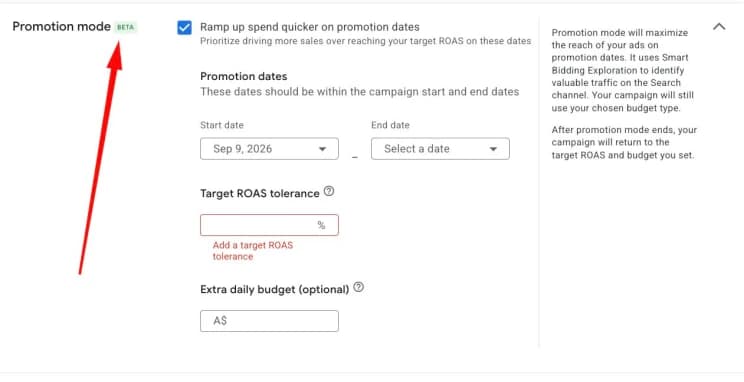
Arpan describes a scheduled period of ROAS tolerance and additional daily budget for Search and Performance Max, followed by a return to normal settings. He also flags a constraint on changing the underlying ROAS target once a promotion starts. These are the controls described in his post, not a verification that every advertiser has access or that every account behaves identically.
The earlier Google package also covered Bidding Target Optimization and Smart Bidding Exploration. Those remain separate elements of the original announcement, which PMC credited to Ginny Marvin. Arpan's contribution is the later Promotion Mode account observation. His post should not be recast as the product's first announcement, and later newsletter coverage should not replace his original timestamp.
For a business considering a test, define the promotion before configuring the campaign. An illustrative flash sale might have a clear start and finish but also lower margins and a limited stock position. Additional sales during that window would need to be assessed against those economics. Agree what commercial tradeoff is acceptable and check the actual account's controls before relying on the description in the post.
Why it matters for advertisers
A temporary setting is most useful when the team understands both entry and exit conditions. Record the planned window, the intended return to normal operation and any concurrent pricing or inventory changes. Review the outcome across the promotion and its aftermath rather than judging only the busiest day. This is test-planning guidance, not a promise that the beta will generate more profitable demand.
What to check next
- Verify the available controls and target-change restrictions in the advertiser account.
- Agree the promotion window, stock context and acceptable commercial outcome before testing.
- Check the return to normal operation and evaluate the whole promotion period.
Sources & contributor credit
- Original credited observation · Arpan Banerjee
Original Promotion Mode post. 9 September 2026, 10:40:21 UTC, from public post metadata. Original text retrieved without authentication.
- Subsequent reporting · PPC News Feed
Promotion Mode and daily budgets. 11 September 2026. Explicitly credits Arpan; secondary screenshot authorship remains unverified.
- Newsletter discovery · Adriaan Dekker
Google Ads news, Week 37. Published 12 September 2026 at 06:08:50 UTC; updated 06:09:21 UTC. Newsletter curator and discovery source. Sponsored sections are excluded from news selection.
- Newsletter coverage · Paid Media Collective newsletter
Original newsletter text, contributor labels and media for this update.
- Source referenced in newsletterLinkedIn
Linked from the original newsletter. The source publication date has not been independently confirmed.


Original creator unverified
Credits reflect the editor's latest changes. Original authorship has not been independently verified for this version.
Attribution evidence and limitations
Full attribution review pending.
A source link alone does not establish original authorship.
Original image and video creators have not yet been verified.
- Published on this site
- Article updated
This update reflects the dated source reporting. Availability may have changed. Further coverage of this same development will be added to this page.
Original newsletter text and archive evidence
Google bundles three bidding and budgeting updates, with the biggest change landing on 17 August
Google has announced three bidding and budgeting updates, confirmed by Google Ads Liaison Ginny Marvin, on the Accelerate with Google blog. The headline change is Bidding Target Optimisation: from 17 August 2026, campaigns that are budget-limited and use a target-based strategy, such as Target CPA or Target ROAS, will perform more consistently toward the target you set, rather than over-delivering against it. For accounts that have quietly been beating their targets, this is an automatic behavioural change, not an opt-in. Google says it will not adjust targets or budgets for you, and from 6 July, a Bid Target Adjustment Tool will surface historical performance in account notifications so advertisers can review and apply changes first.
The second update expands Smart Bidding Exploration, now globally available for all Performance Max campaigns without a product feed, with a separate beta for Shopping and Performance Max with feeds. It helps campaigns discover new search categories and customer segments by allowing a defined ROAS tolerance. The third is Promotion Mode, a new beta for Search and Performance Max that schedules temporary changes to ROAS tolerance and allocates additional daily budget during peak periods, such as seasonal events, flash sales, and product launches. The package rolls out across Google Ads, Search Ads 360, Display & Video 360, Google Ads Editor, and the Google Ads API.
For you, this means budget-limited campaigns that overdeliver on their targets will be automatically reined in from 17 August, so the weeks before matter. Worth auditing which campaigns currently beat their stated tCPA or tROAS, using the 6 July tool to model the impact, and deciding whether to adjust targets or accept the pullback before the change goes live.
Source captured . No explicit first-contributor label was provided for this update.