Google Ads · Status at source date: Announcement
Google Search language-setting removal reaches advertiser accounts
Thomas Eccel reports the Search language selector removed in his account on 3 November, following Google’s August announcement. The original language-signal explanation and chronology remain relevant.
What changed
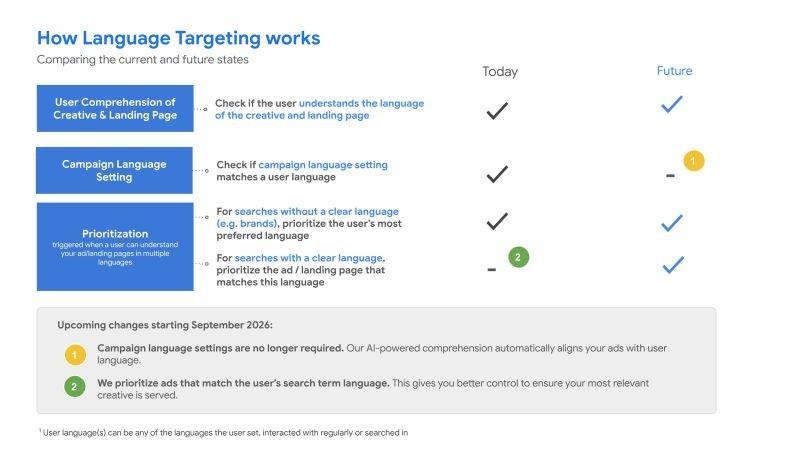
3 November 2026 account follow-up: Thomas Eccel reports that the language targeting setting is no longer available in Search campaigns. His post also distinguishes Performance Max Search inventory from YouTube and Display, where language settings still apply. This is an account observation following Google’s earlier announcement, not a new announcement or proof that every account changed on the same day.
The original announcement was published in August with a late-September timetable. The later sighting should not replace that chronology. Eccel’s report gives practitioners a reason to inspect the controls now available in their own campaigns, but it does not establish a requirement to rebuild all single-language campaigns.
Google’s explanation remains the relevant context: language signals in creative, destinations and the search interaction still matter. An absent manual setting does not mean that an advertiser’s text is automatically translated. Existing language-specific creative and landing-page quality checks remain useful even when the campaign interface changes.
Earlier reporting, retained for chronology
Ginny Marvin’s explanation makes a narrower point than the disappearance of a setting might suggest. Google will prioritise ads that fit the search term’s language when multiple eligible languages are present. It already considers several language signals, including creative, landing pages, the query and user preferences. Removing the manual Search setting does not mean that Google will translate the advertiser’s copy.
Ginny explicitly says existing single-language campaign structures can continue to function and do not need to be rebuilt solely because of this update. The recommended review concerns clear language in ads and their destinations. The newsletter also distinguishes Search inventory in Performance Max from its other channels. Keep that distinction when interpreting a change at campaign level; a single setting can have different relevance across the campaign’s inventory.
A practical review follows a customer through the whole journey. If a multilingual business serves a French ad, examine the destination, form, confirmation message and support route that follow it. This is an advertiser quality check, not a new Google requirement. It helps separate a language-selection concern from a landing-page or service problem that already existed before the targeting change.
Why it matters for advertisers
Avoid redesigning a multilingual account on the assumption that its previous segmentation has stopped working. Preserve a baseline of queries, destinations and business outcomes, then investigate observable mismatches. Developers should also review workflows that create or update Search language criteria, following the platform’s current API guidance. Document implementation changes so later reporting does not confuse a configuration cleanup with a change in customer demand.
What to check next
- Review ad and landing-page language without assuming campaign restructuring is required.
- Ask the owner of API-based setup tools to check how Search language criteria are handled.
- Monitor Search and other Performance Max inventory separately where the reports allow it.
Sources & contributor credit
- Source referenced in newsletterGoogle Ads Developer Blog
Linked from the original newsletter. The source publication date has not been independently confirmed.
- Newsletter coverage · Paid Media Collective newsletter
Original newsletter text, contributor labels and media for this update.
- Source referenced in newsletterLinkedIn
Linked from the original newsletter. The source publication date has not been independently confirmed.
- Week 45 follow-upThomas Eccel
- Week 45 follow-upPPC News Feed




Original creator unverified
Credits reflect the editor's latest changes. Original authorship has not been independently verified for this version.
Attribution evidence and limitations
Full attribution review pending.
A source link alone does not establish original authorship.
Original image and video creators have not yet been verified.
- Published on this site
- Article updated
This update reflects the dated source reporting. Availability may have changed. Further coverage of this same development will be added to this page.
Original newsletter text and archive evidence
Language targeting disappears from Search and Performance Max in late September
Google is removing the campaign-level language setting for Search and AI Max for Search in late September, with matching based on your ads' language instead. In Performance Max, the setting stops applying on Google Search but continues to guide delivery on other channels, per the developer blog. Ginny Marvin says the shift is smaller than it sounds, but multilingual structures built on language splits need to be rethought. For you, this means language stops being a lever you can control in Search, so review campaigns segmented by language and any API build flows that use language criteria before late September.
Source captured . No explicit first-contributor label was provided for this update.