Google Ads · Status at source date: Useful reference
Demand Gen Prefill campaign beta: review settings before publishing
Demand Gen’s Prefill campaign beta can draft settings and assets from an existing campaign. Review the draft before publishing and keep the earlier observation credit.
What changed
What Prefill campaign does
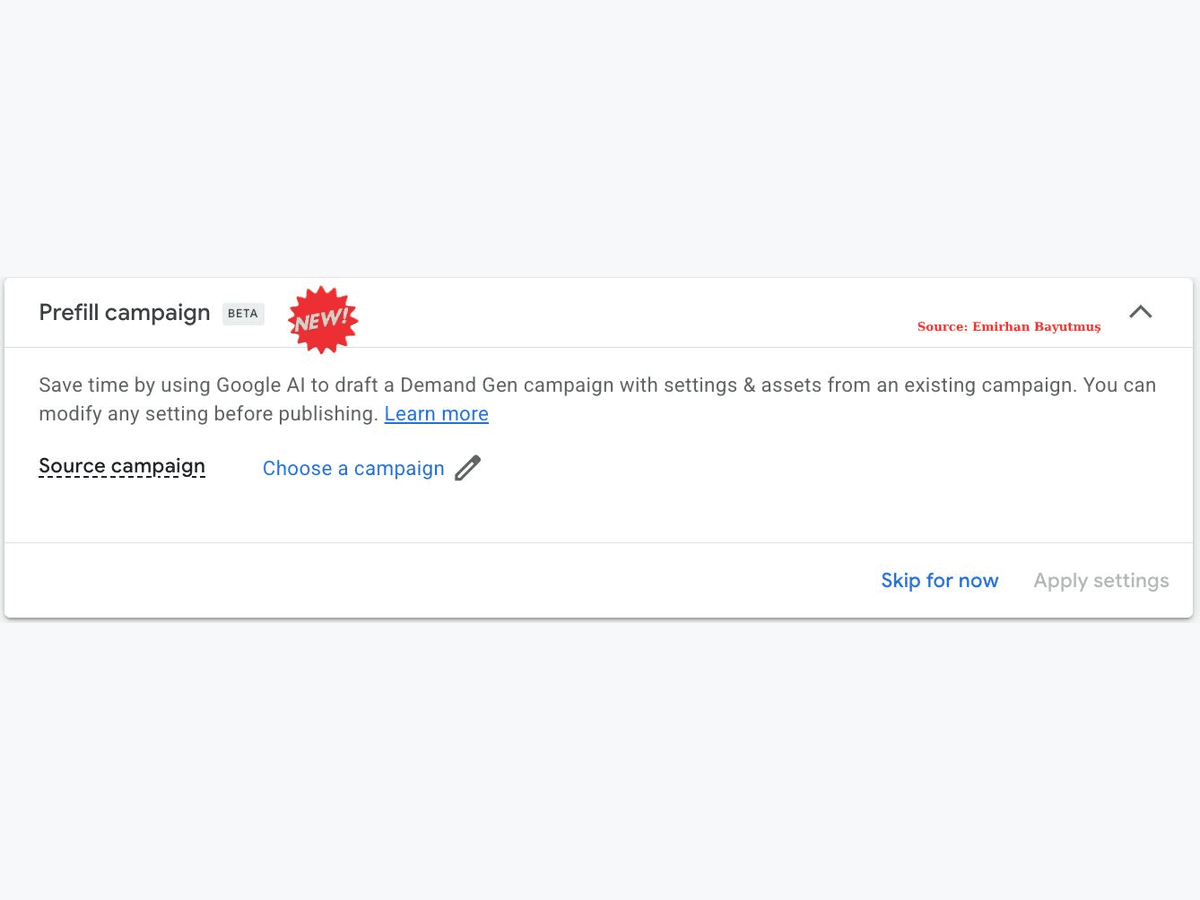
The observed Demand Gen interface labels Prefill campaign as a beta. Its explanatory text says Google AI can draft a Demand Gen campaign using settings and assets from an existing campaign. A source-campaign selector identifies the starting point, and the screen says settings can be modified before publication. This is campaign setup guidance, rather than a prewritten messaging feature.
Choose the starting campaign carefully
For an advertiser using the workflow, the useful question is whether the selected campaign is an appropriate starting point for the new brief. Similar assets do not necessarily imply the same objective or intended audience. Review the resulting draft against the new campaign’s requirements instead of treating inherited settings as a recommendation that must be accepted.
A practical QA record can compare the intended campaign brief with the resulting settings and creative. Note what was retained, what was changed and who reviewed it. This is a suggested review process; the screenshot does not establish which settings the beta transfers in every account or how consistently its output matches a particular brief.
An existing beta, with separate observation and image credits
Arpan Banerjee’s earlier post, dated 3 September 2026 in the reviewed public metadata, documents the Prefill campaign beta. Emirhan Bayutmuş’s later screenshot provides the visual used here. The later image does not establish a new October launch or displace the earlier observation. First-ever discovery across all public sources is not established.
The visible beta label and account screenshot support a limited observation. They do not prove universal account access, time savings of a specific size or improved advertising results. Treat convenience in setup and effectiveness after launch as separate questions, and validate each using the campaign actually being prepared.
Why it matters for advertisers
Reusing a campaign can reduce repeated setup work, but it can also carry assumptions into a different brief. The value lies in a reviewed starting point, with the advertiser retaining responsibility for the final configuration.
What to check next
- Choose a source campaign whose settings and assets are relevant to the new brief.
- Compare the generated draft with the intended objective, audience and approved creative before publishing.
- Record the account and date where the beta appears; avoid assuming the same access or output elsewhere.
Sources & contributor credit
- Practitioner observation · Arpan Banerjee: original Prefill campaign observation
Arpan Banerjee’s earlier original observation on 3 September 2026; later visual by Emirhan Bayutmuş. No new October launch established.
- Practitioner observationLinkedIn post
Supporting source linked in the published newsletter; source authorship and discovery roles are kept separate.
- Newsletter coverage · Paid Media Collective Week 41
Yoann Ferrand’s newsletter curation. Original reporting, account observations and visual credits are listed separately.


Original creator unverified
Original contributors and source authors are distinguished from later observations, visual credits and newsletter curation. An explicit observation credit does not establish first-ever discovery.
Attribution evidence and limitations
Published Week 41 copy and earlier event coverage reconciled.
Original work and earlier reporting evidence retained.
Story-specific image visually inspected and credited.
Attribution checked . This is a review date, not the original publication date.
- Published on this site
- Article updated
This update reflects the dated source reporting. Availability may have changed. Further coverage of this same development will be added to this page.