Google Ads · Status at source date: Newsletter archive
Short titles expand from Demand Gen into Performance Max
Google's Merchant Centre specification now states that the short_title attribute can be used in visual Performance Max formats such as YouTube and Discover, not only in Demand Gen. Google recommends placing the most important information first and aiming for fewer than 40 characters, with 65 characters as the practical maximum before truncation becomes likely.
What changed
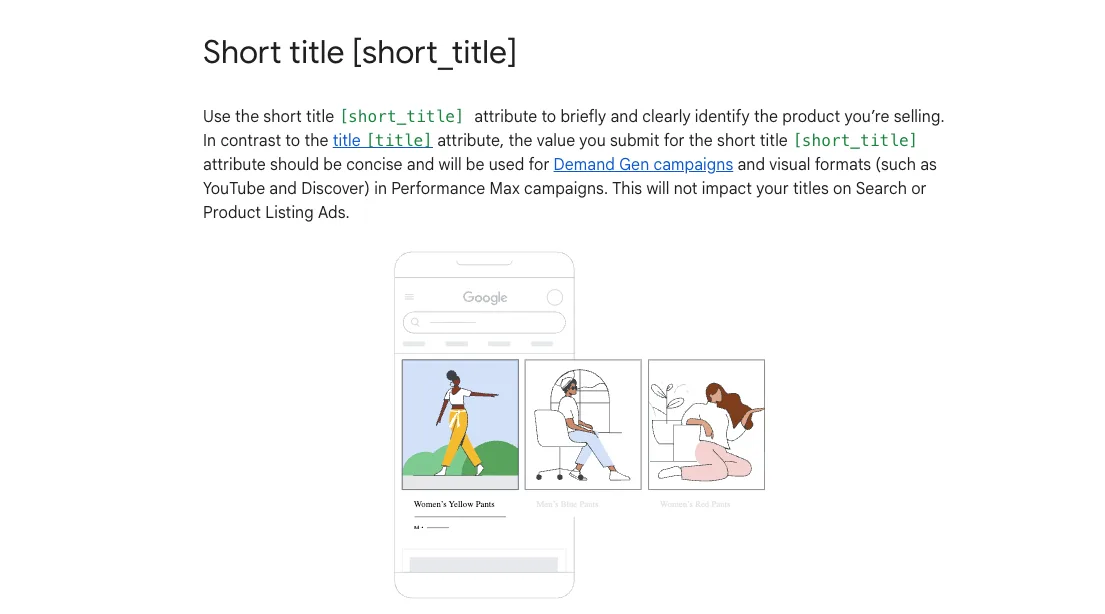
Google's Merchant Center specification describes short titles as usable in Demand Gen and visual Performance Max placements, including YouTube and Discover. It separately says the field does not change titles in Search or Product Listing Ads. This makes short-title coverage relevant to more visual placements while preserving the distinction from the main product title used elsewhere.
The reviewed help page recommends putting essential information first and aiming below 40 characters. Its length guidance is internally inconsistent: the format table permits 1–150 characters and recommends 5–65, while the best-practice section describes 65 as a maximum. The defensible editorial takeaway is to write concise, accurate titles and check the accepted specification in the intended workflow, rather than presenting one of those conflicting numbers as an unqualified system limit.
A useful retail review starts with meaning, not just character count. For a range of replacement filters, the product type and compatibility may be more important than a long promotional prefix. For apparel, the short title should still identify the garment even when variant detail is carried elsewhere. These are illustrative decisions. Removing words mechanically can create ambiguity, so review a sample against the landing pages and imagery before applying a rule across the feed.
Why it matters for advertisers
This field gives merchants a way to prepare product names for browsing contexts where space and attention are limited. Treat it as concise product communication with its own quality check. The source does not prove that a particular short-title formula improves conversion rates, and the extension into Performance Max does not justify overwriting useful full titles throughout the catalogue.
What to check next
- Audit short-title coverage for products used in visual campaigns and prioritise categories where long names are hard to read.
- Write concise versions that preserve product identity and the most important distinction; keep prices, delivery promises and other promotional text in their appropriate fields.
- Check accepted lengths and previews in the actual workflow, then review performance without assuming that a shorter title alone caused any change.
Sources & contributor credit
- Newsletter coverage · Paid Media Collective newsletter
Original newsletter text, contributor labels and media for this update.
- Source referenced in newsletterGoogle Merchant Centre Help
Linked from the original newsletter. The source publication date has not been independently confirmed.
- Source referenced in newsletterPPC News Feed
Linked from the original newsletter. The source publication date has not been independently confirmed.

Original creator unverified
Google is the specification publisher. Hana Kobzová’s existing newsletter first-contributor credit is retained as historical attribution; the unavailable secondary-source body does not establish independent priority.
Attribution evidence and limitations
Read the complete cached Merchant Center short_title specification and compared the format table with the best-practice section. Read the newsletter archive and inspected the documentation screenshot. The linked PPC News Feed cache was unavailable; no full publisher-body review is claimed.
All original source/profile URLs and original archive dates retained; additional recovered evidence is identified explicitly.
Viewed 7dd78b67eaf5d56958f5f9fe.webp. It shows the official short_title introduction including Performance Max visual formats and the Search/Product Listing Ads distinction. No personal signature or watermark is visible. It does not show the conflicting length sections.
- Archived newsletter text compared; not a fresh newsletter-page review.
- Read the complete cached Merchant Center short_title specification and compared the format table with the best-practice section. Read the newsletter archive and inspected the documentation screenshot. The linked PPC News Feed cache was unavailable; no full publisher-body review is claimed.
- Read the complete cached Merchant Center short_title specification and compared the format table with the best-practice section. Read the newsletter archive and inspected the documentation screenshot. The linked PPC News Feed cache was unavailable; no full publisher-body review is claimed.
Attribution checked . This is a review date, not the original publication date.
- Published on this site
- Article updated
This update reflects the dated source reporting. Availability may have changed. Further coverage of this same development will be added to this page.
Original newsletter text and archive evidence
Short titles expand from Demand Gen into Performance Max
Google's Merchant Centre specification now states that the short_title attribute can be used in visual Performance Max formats such as YouTube and Discover, not only in Demand Gen. Google recommends placing the most important information first and aiming for fewer than 40 characters, with 65 characters as the practical maximum before truncation becomes likely. For you, this means a previously optional feed field can shape more paid placements, so audit short-title coverage before Google automatically compresses longer product names.
Source captured . First-contributor labels follow the newsletter’s explicit wording.