Meta Ads · Status at source date: Spotted in the Wild
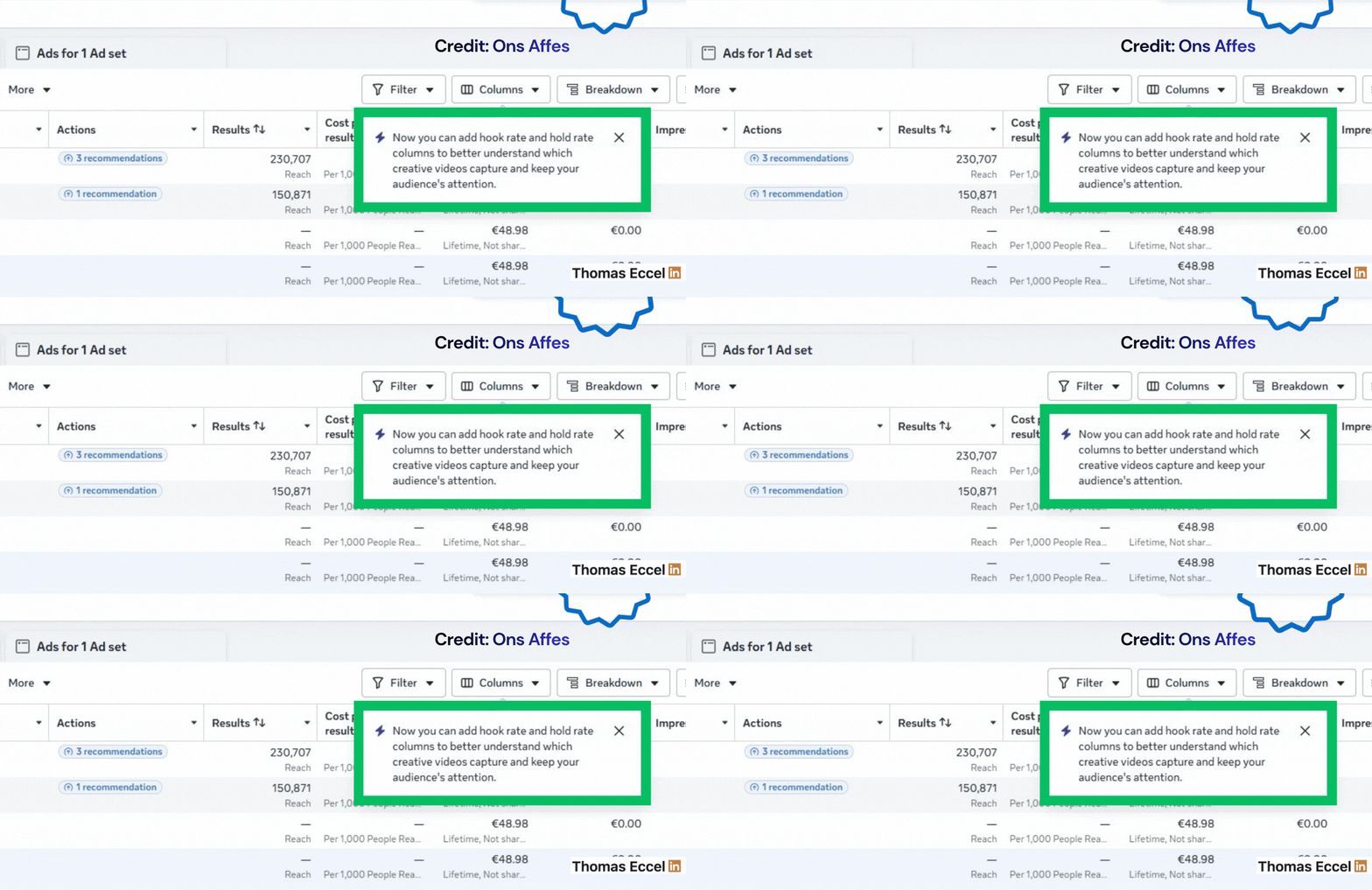
Hook rate and hold rate appear as native Meta columns
Ons Affes reported native hook-rate and hold-rate columns in Ads Manager, subsequently shared by Thomas Eccel. The visual below is Thomas’s reproduction, retaining Ons’s credit.
What changed
Compare native definitions with your custom metrics before replacing them. The exact formulas and wider availability remain unconfirmed.
Hook rate and hold rate are familiar creative-analysis concepts, but their usefulness depends on the formula and the population being measured. A native column with a familiar name is not necessarily identical to a custom metric created by an advertiser. The account observation establishes that the labels appeared, not that every existing formula can be replaced without checking.
Before changing a reporting template, compare the native column's description with the team's current numerator and denominator. Check which video views, impressions or viewing stages are included and whether the metric is available for the same formats and reporting level. If a definition is not shown, keep that uncertainty in the report rather than inventing a formula.
A practical comparison uses the same ads and date range in both views. Investigate material differences before deciding that a creative has improved or deteriorated. A change in how a percentage is calculated can look like a performance movement even when the underlying viewing behaviour is unchanged.
Use these indicators to identify questions for creative review, alongside delivery, cost and business outcomes. A strong early-viewing rate does not by itself establish incremental sales, and a lower rate does not prove that an ad is ineffective for its intended audience. The relevant interpretation depends on the creative's purpose and the campaign's measurement setup.
The final Week 44 edition identifies Ons Affes as First contributor and Thomas Eccel as the source of the reproduced visual. Those roles are preserved separately. The observation is dated 29 October; exact formulas and wider account availability remain unconfirmed.
Sources & contributor credit
- Original postLinkedIn
Source retained from Yoann Ferrand’s final Week 44 edition.
- Original postThomas Eccel
Source retained from Yoann Ferrand’s final Week 44 edition.



Original creator unverified
Credits reflect the editor's latest changes. Original authorship has not been independently verified for this version.
Attribution evidence and limitations
Full attribution review pending.
A source link alone does not establish original authorship.
Original image and video creators have not yet been verified.
- Published on this site
- Article updated
This update reflects the dated source reporting. Availability may have changed. Further coverage of this same development will be added to this page.