Google Ads · Status at source date: Newsletter archive
Optmyzr and Frederick Vallaeys publish State of Google Ads Q1 2026 study
Optmyzr has published its State of Google Ads Q1 2026 report, with Frederick Vallaeys analysing performance data across 21,425 Google Ads accounts. The headline finding: total impressions are down 11% year-on-year, but CTR is up 21%: traffic is becoming materially more intentional rather than higher in volume.
What changed
The report also highlights structural ROAS benefits accruing to accounts in the $10K–$50K spend range that smaller and larger accounts are not seeing, and analyses the migration from Video Action campaigns to Demand Gen.
The size of the dataset: 21,425 accounts, five quarters of data: makes this one of the most credible industry benchmarks published this year. The headline takeaway is consistent with Google's own framing of AI-driven matching: fewer, better-qualified clicks rather than more, lower-quality clicks. Whether that translates into improved conversion rates depends on the specific industry and account size band.
Why it matters for advertisers
For you, this means a credible external benchmark to validate or challenge your own account performance trajectory. Worth comparing your year-on-year impression and CTR shifts against the report's findings, particularly if your account sits in the $10K–$50K spend band where the structural ROAS advantage appears to concentrate.
Perspective from the original PMC newsletter.Sources & contributor credit
- Original research · Checked Optmyzr, research and contributor credits
Inspected for attribution on 11 September 2026. This date is the review date.
- Newsletter coverage · Paid Media Collective newsletter
Original newsletter text, contributor labels and media for this update.
- Source referenced in newsletterOptmyzr
Linked from the original newsletter. The source publication date has not been independently confirmed.






Source attribution checked
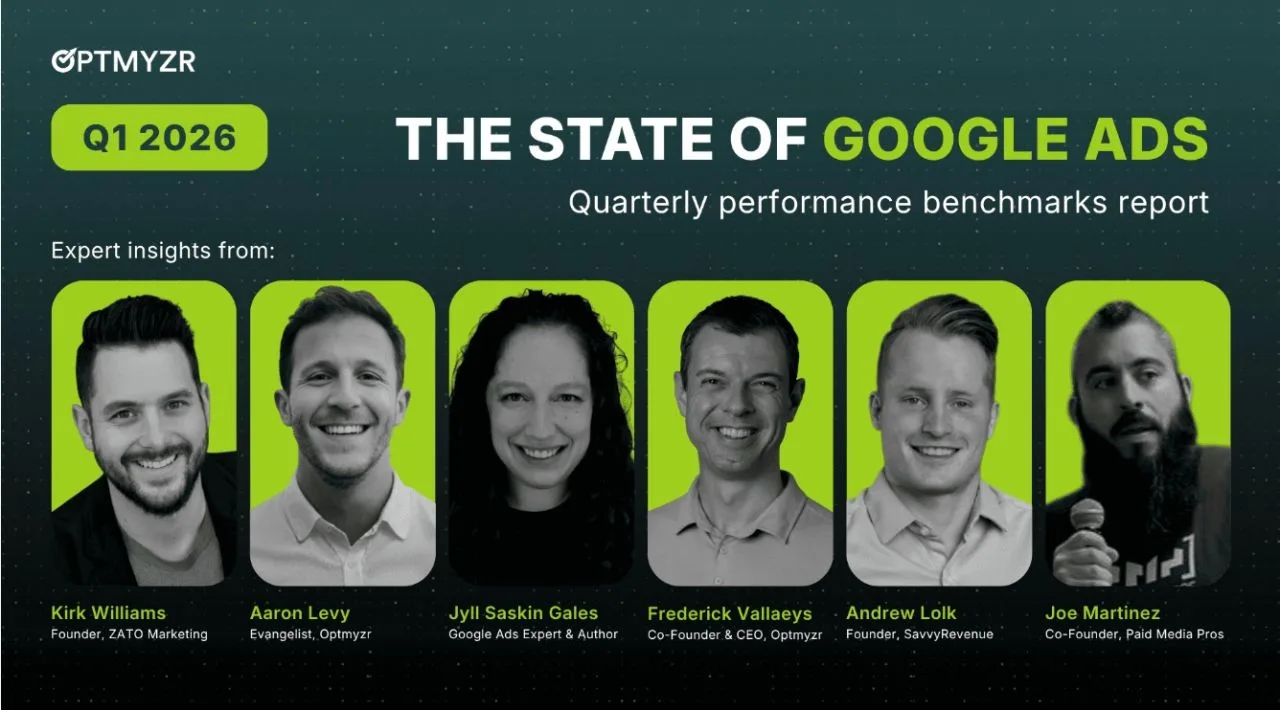
Optmyzr published the benchmark research with expert commentary from Frederick Vallaeys, Jyll Saskin Gales, Kirk Williams, Aaron Levy, Andrew Lolk and Joe Martinez. The report is not attributed solely to one commentator.
Attribution evidence and limitations
Read Optmyzr’s original post and public report landing page. The page explicitly lists all six expert contributors and describes Optmyzr’s research.
Followed the report link in the original publisher’s comment. Full report access requires registration; no form was submitted and the full report was not reviewed.
Visually confirmed the cover’s “Expert insights from” labels and all six names. These identify commentary contributors, not the designer of the cover or sole authorship of the dataset.
Attribution checked . This is a review date, not the original publication date.
- Published on this site
This update reflects the dated source reporting. Availability may have changed. Further coverage of this same development will be added to this page.
Original newsletter text and archive evidence
Optmyzr and Frederick Vallaeys publish State of Google Ads Q1 2026 study
Optmyzr has published its State of Google Ads Q1 2026 report, with Frederick Vallaeys analysing performance data across 21,425 Google Ads accounts. The headline finding: total impressions are down 11% year-on-year, but CTR is up 21%: traffic is becoming materially more intentional rather than higher in volume. The report also highlights structural ROAS benefits accruing to accounts in the $10K–$50K spend range that smaller and larger accounts are not seeing, and analyses the migration from Video Action campaigns to Demand Gen.
The size of the dataset: 21,425 accounts, five quarters of data: makes this one of the most credible industry benchmarks published this year. The headline takeaway is consistent with Google's own framing of AI-driven matching: fewer, better-qualified clicks rather than more, lower-quality clicks. Whether that translates into improved conversion rates depends on the specific industry and account size band.
For you, this means a credible external benchmark to validate or challenge your own account performance trajectory. Worth comparing your year-on-year impression and CTR shifts against the report's findings, particularly if your account sits in the $10K–$50K spend band where the structural ROAS advantage appears to concentrate.
Source captured . No explicit first-contributor label was provided for this update.