Google Ads · Status at source date: Documentation coverage
Smart Bidding Exploration is documented for Performance Max and Shopping
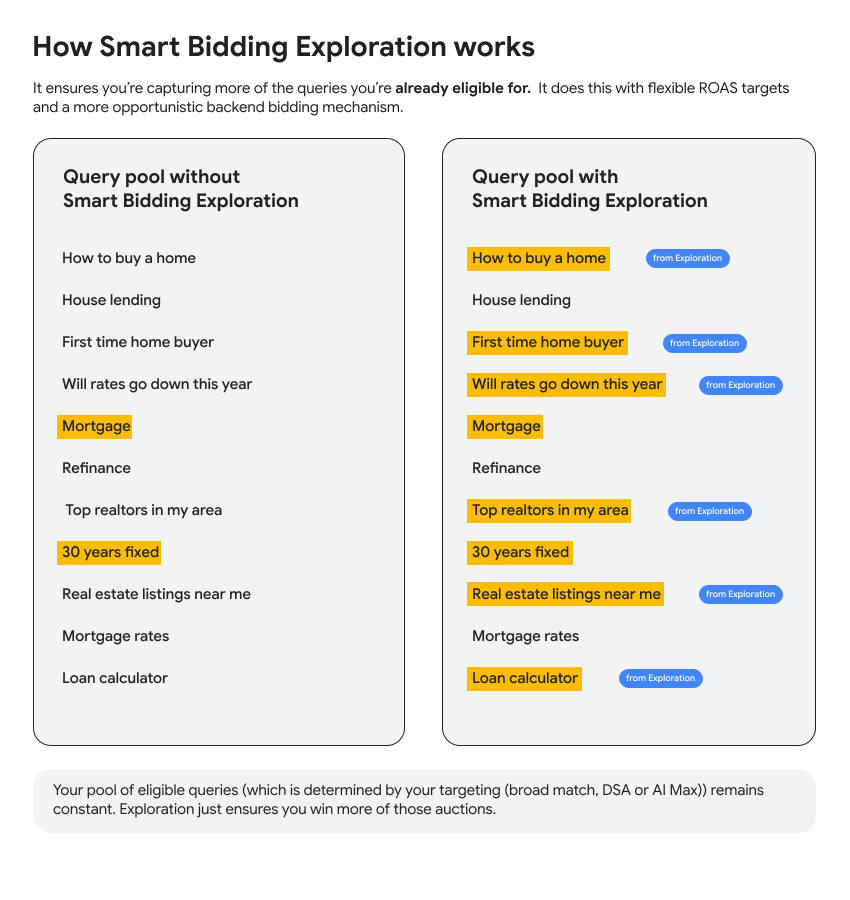
A new help page explains how Smart Bidding Exploration works beyond Search: it needs a target ROAS, lets the system bid 5–30% below target to find new converting queries, covers Search and Shopping traffic with one toggle on feed-based Performance Max, and Search traffic only on campaigns without a feed. Campaigns should not be budget-limited, and moving Shopping or Performance Max into a portfolio strategy turns exploration off. Google announced the Shopping expansion at Marketing Live in May. The ROAS tolerance now applies to Shopping queries too, so set the target with that headroom in mind.
What changed
Week 43 follow-up: 2026-10-22
Earlier coverage and context (2026-10-22)
Google’s current Smart Bidding Exploration documentation includes eligible Performance Max and Shopping campaigns using target ROAS, alongside Search. PPC News Feed covered this scope on 22 October and credits Hana Kobzová for spotting the documentation.
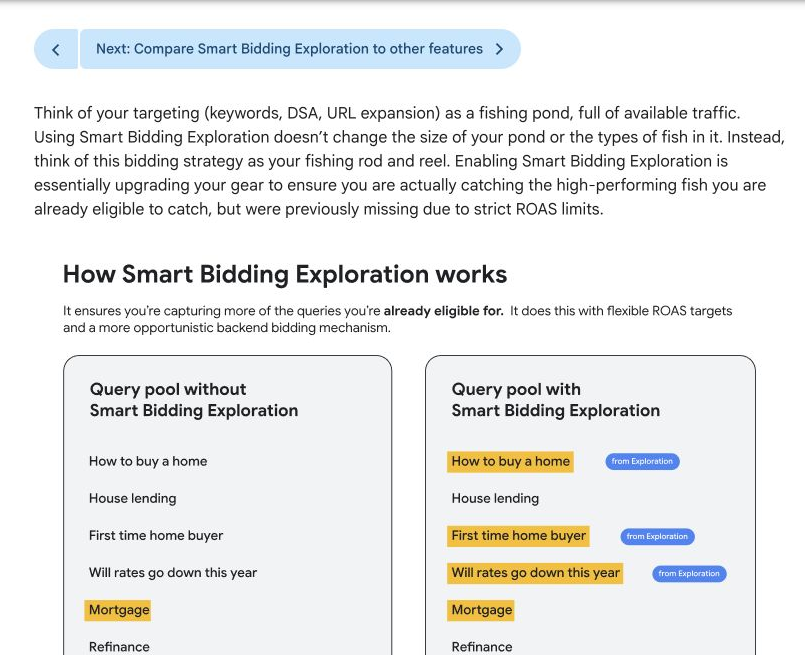
Exploration allows a campaign to pursue additional eligible opportunities by relaxing its return-on-ad-spend constraint within a selected tolerance. Google documents a tolerance range of 5% to 30%. It does not expand the campaign’s targeting or remove its existing eligibility restrictions.
The scope varies by campaign. In Performance Max, a product feed enables exploration across Search and Shopping; without a feed, exploration applies to Search. Portfolio bid-strategy support is limited to Search, and campaigns must meet Google’s stated conditions, including not being budget constrained.
What this means for campaign reviews
Treat tolerance as a bidding decision with a potential efficiency trade-off. Before enabling an experiment, record the existing ROAS target, conversion-value definition and recent spending pattern. That makes it easier to distinguish deliberate exploration from an unrelated change in tracking or demand.
A useful review would compare value, cost and business outcomes over a suitable observation period, rather than judging the feature from traffic growth alone. Campaigns with unreliable conversion values need that measurement problem addressed before a more flexible bidding constraint can be interpreted sensibly.
The source supports the currently documented functionality. It does not establish the date the help page changed or a single global launch date for every campaign type. Accordingly, 22 October is shown as the coverage date, not a verified release date.
Record the selected tolerance with the experiment notes so a later reviewer can reproduce the bidding decision.
Sources & contributor credit
- Official sourceGoogle
Coverage dated 22 October; documentation revision and feature-launch date remain unconfirmed.
- Supporting coveragePPC News Feed
Coverage dated 22 October; documentation revision and feature-launch date remain unconfirmed.
- Newsletter coveragePaid Media Collective
Published Week 43 edition; source for the approved credit, image and wording reconciliation.

Original creator unverified
Credits reflect the editor's latest changes. Original authorship has not been independently verified for this version.
Attribution evidence and limitations
Full attribution review pending.
A source link alone does not establish original authorship.
Original image and video creators have not yet been verified.
- Published on this site
- Article updated
This update reflects the dated source reporting. Availability may have changed. Further coverage of this same development will be added to this page.